
The Crumbling Prince: Episodes 1 & 2 are some of the best escape rooms around Melbourne, Australia. Here are our recommendations for great escape rooms in the Melbourne area.
Peachy Keen
Location: Melbourne, Australia
Date Played: September 9, 2024
Team Size: 2-5; we recommend 3-4
Duration: 90 minutes per episode, or ~3 hours total
Price: $79-86 AUD per player depending on team size
Ticketing: Private
Accessibility Consideration: Players must be able to step over some uneven terrain
Emergency Exit Rating: [A+] No Lock
Physical Restraints: [A+] No Physical Restraints
“A groundbreaking demonstration of nuanced emotional narrative in an escape room, The Crumbling Prince explored themes of friendship and grief, impressively developing a deep world in a small space.”
REA Reaction
Ukiyo’s The Crumbling Prince saga proved that video game-style narrative gameplay is not only possible but can be astonishingly effective when thoughtfully translated into the escape room medium.
This experience consisted of two separately bookable episodes with a continuous arc. For the sake of this review, I’ll mostly be treating the two episodes as a single interconnected experience.
Set in a placid Japanese-style garden, The Crumbling Prince explored a vast spectrum of emotions and sensations rarely touched by escape rooms, from unrushed serenity to layered grief. By the end, I felt like we’d both made and helped new friends. This was a powerful and lasting effect that I wish more escape rooms would focus on cultivating.
Pulling inspiration from LARPs, TTRPGs, and various other storytelling and game modalities, The Crumbling Prince was seemingly untethered by what an escape room “should” look like, offering forth a profoundly fresh interpretation of escape room as interactive narrative. Alongside light puzzles and games, our interactions also leaned on our soft skills, demanding empathy and introspection. The experience asked to be played gently and meditatively, letting certain moments wash over us rather than pushing through them. This style was a much welcome counterpoint to the sharply masculine escapades of bomb defusing, pirate plundering, or prison breaks presented in so many other escape rooms.
From costuming to music to lighting to writing, The Crumbling Prince was imbued with layers of skillful multidisciplinary creativity which went a long way in making a relatively small space feel alive and dynamic. The set felt like a stage and we were the actors, moving through time rather than progressing room-to-room in space. This design approach is uncommon on the international level, yet it also reminded me loosely of Next Level Escape’s Forest of Echoes in Sydney. I’d love to think of these two unique experiences not as exceptions, but as seeds of a special empathy-forward escape room style just starting to sprout in Australia.
Not every game is for every player, and The Crumbling Prince is inevitably somewhat polarizing, especially relative to expectations established by most other escape rooms. If you’re seeking an action-packed puzzle fest or a sprawling set, then this very well may not be the game for you. But if you’re open to a more fluidly interactive and emotionally-driven experience, or if you’ve thus far disregarded escape rooms thinking they couldn’t offer this sort of an experience, then you’re truly in for a treat. The Crumbling Prince is a singularly innovative masterpiece that I hope will inspire players and designers alike to continue pushing the bounds of this remarkable medium to create deeper layers of meaning.
Who is this for?
- Story seekers
- Scenery snobs
- Fans of The Legend of Zelda and Miyazaki
- Any experience level
- Players open to a narrative- and character-focused immersive experience that is light on traditional escape room puzzling
Why play?
- A sublimely placid experience
- A compelling narrative with unforgettable characters and potent emotions
- A unique approach to story-driven escape room design
Story
The Prince welcomed us into his garden to relax, play, and contemplate, but not all was as it seemed.
Setting
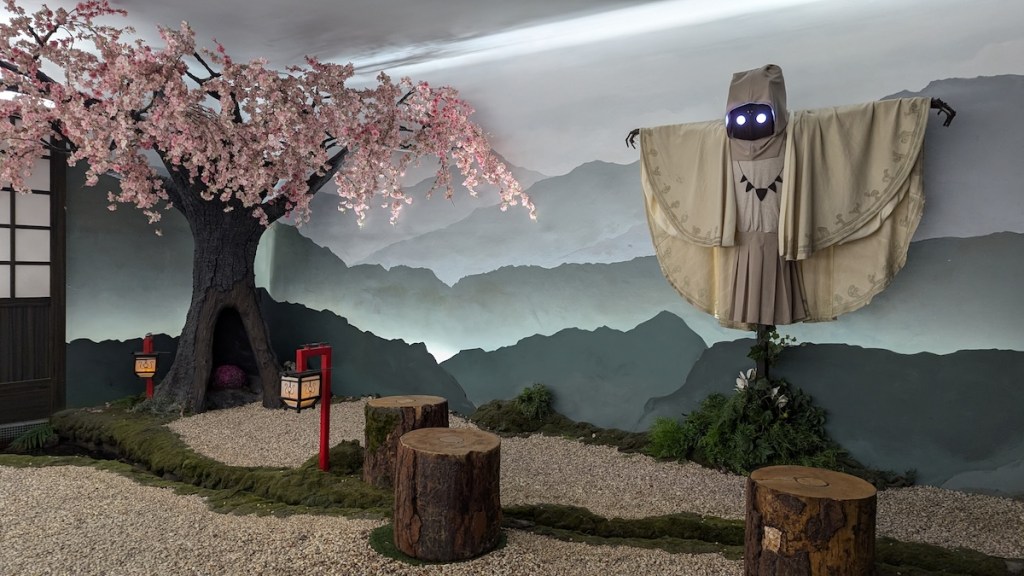
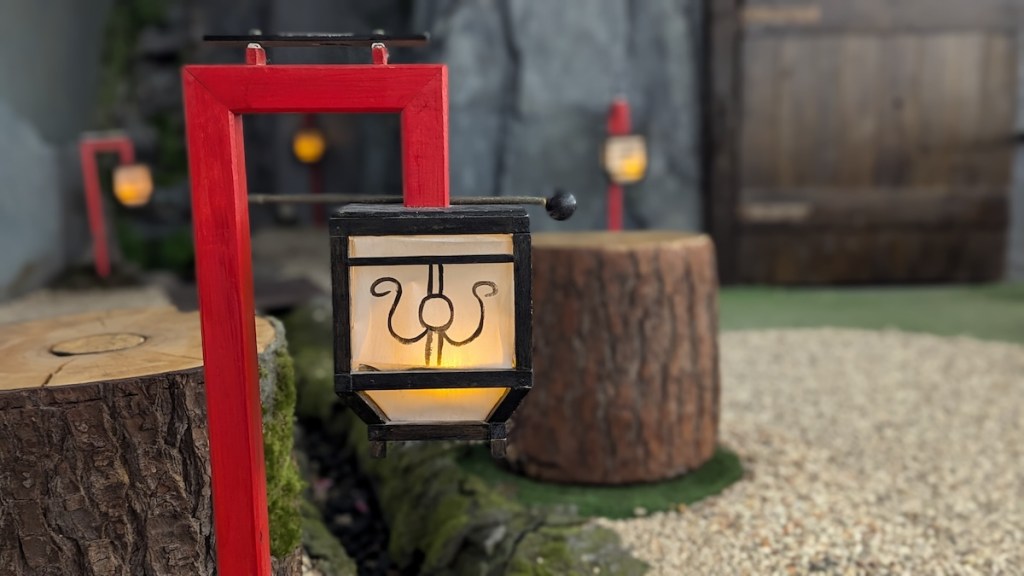
The Crumbling Prince took place in a relaxing Japanese-style garden, divided diagonally by a moss-banked creek slowly flowing forth from a zen waterfall in the corner. This compact oasis was highly stylized, full of tiny details and organic textures. Almost nothing in the environment screamed “escape room” or looked obviously like a puzzle.
Gameplay
Ukiyo’s The Crumbling Prince was an immersive narrative adventure with a low level of difficulty. The story spanned 2 episodes, each around 90 minutes long. There was no in-experience timer, and players were encouraged not to rush.
Players each wore a tunic and a unique fox-like mask, each with a special ability. The Mask of the Moon and the Mask of the Sun each had embedded lights, activated by stroking the ears of the mask. The Mask of the Wild and the Mask of the Lost each came with headphones, allowing those players to speak with natural and supernatural spirits.
Core gameplay revolved around forming empathetic connections, piecing together narrative, translating, searching, and solving simple puzzles.
Analysis
➕ The Crumbling Prince journey began online with a free multiplayer text adventure game entitled The Sound of Spring, which the REA Hivemind reviewed back in September 2021. This optional prologue used the expanded time and space of a written storytelling medium to help set the stage for the in-person experiences, all while telling its own self-standing story. I remember it fondly even years later.
➕ The pacing of The Crumbling Prince was bold and uncommon within the world of escape room-esque experiences. Prior to the game, we were treated to tea and mochi amidst relaxing lighting, all of which helped to slow us down from the outside world. Once inside, our interactions first established a baseline of introspective serenity before layering on darker, more complex emotions. The physical environment further reinforced this slowness with a zen aesthetic and the sound of trickling water. I could see some players expecting a more traditional, fast-paced, puzzle-centric escape room to view this slower pacing as a negative, but speed was not the point of The Crumbling Prince. Relative to the game’s emotional objectives, the tempo of interactivity was impeccably tuned and left space for an unusually effective crescendo.
➕ The 2-episode structure for The Crumbling Prince was expertly conceived and executed. Whether the episodes are played back-to-back or on separate occasions, the break in between offers a nice pause for reflection right around an emotional climax. Episode 2 took sufficient time to re-immerse players in the world without feeling redundant for players who’d only just left it. Though Episode 2 took place in mostly the same physical environment as Episode 1, it offered the opportunity to discover new secrets and spaces. Furthermore, nothing that was reserved for Episode 2 got in the way or felt like a red herring during Episode 1.
➕/➖ Our masks and tunics instantly immersed us in the world of The Crumbling Prince, physically turning each player into a character and even slightly shifting how we physically moved our torsos. So much creativity and attention to detail went into crafting these bespoke costume pieces. The tunics were hand-sewn and hand-dyed, a major step up from an off-the-shelf cloak. The masks were slightly clunky but still on the whole more comfortable than a Sleep No More mask (with the exception of the Mask of the Sun, which both I and another player found harder to wear than the other masks.) Not every mask’s ability was made equal, and some were more consistently useful and/ or interesting than others, though each was uniquely essential at multiple points throughout the experience. I personally wore the Mask of the Sun for Episode 1 and switched to the Mask of the Wild for Episode 2. I was delighted by elements of both: stroking the mask’s ears to activate a light was deeply evocative, and my ability to speak with natural entities was a childhood dream come true. The soft skills and character traits associated with each mask were intriguing in theory, though not always as explicitly reinforced as well as they could have been in our specific character interactions, which could have helped to better balance the mask abilities.
➕ Ukiyo beautifully rendered a peaceful scene with organic elements and running water. Elegant in its minimalism, this approach to set design felt more like that of a theatrical stage than an escape room.
➕ The Crumbling Prince included a range of cozy interactions and philosophical pondering, with a handful of games and light puzzles mixed in, while all in service of a nuanced narrative. This style of interactivity broke from the more typical escape room style in which puzzle leads to puzzle leads to puzzle. If you rush through The Crumbling Prince, you will have a quick but unsatisfying experience. The core value — and the core brilliance — of the design emerges from the space it leaves to form true empathetic connections outside of discrete puzzles.
➕ A small yet meaningful linguistic aha was representative of an internal logic to the world and culture of The Crumbling Prince that extended beyond what we directly interacted with. Having gotten a glimpse into Ukiyo’s upcoming new experience Sonata of Shadows, I’m excited to see how they continue to iterate on environmentally-situated translation puzzles that pull deeper inspiration from games like Chants of Sennaar.
➖ Although the focus of The Crumbling Prince was not about a constant stream of gameplay, we encountered multiple bottlenecks throughout. Some of these moments were as designed: clustered around a single player or artifact, fully part of the scene even if not all players were at the center of the action. But other moments left other players fleetingly without a purpose.
➕ The Crumbling Prince was deeply musical in substance and structure. Ukiyo layered lighting and sound throughout the experience to evoke vivid atmospheres and emotions. Even though we were in essentially the same small space for almost 3 hours, the environment felt remarkably alive.
Tips For Visiting
- The Crumbling Prince: Episode 1 must be played first before The Crumbling Prince: Episode 2, and ideally with the same teammates. It would be a rather disorienting experience to play Episode 2 having not yet played Episode 1. If possible, we also recommend playing the two episodes in relatively close proximity to each other.
- The Crumbling Prince is optimal for 4 players, or 3 players for more experienced teams. At 2 players, you’d receive the minimum possible mask abilities but lose out on some flavor and worldbuilding. At 5 players, 1 of the masks would get doubled and it may feel a bit crowded.
- We enjoyed multiple meals between games at Coburger & Co, right across the street from Ukiyo. They offer reasonably priced burgers and fries, as well as a range of plant-based options.
Book your sessions with Ukiyo’s The Crumbling Prince, and tell them that the Room Escape Artist sent you.
Disclosure: Ukiyo provided media discounted tickets for this game.
![Escape Comics – The Alien Ship [Review]](https://roomescapeartist.com/wp-content/uploads/2026/01/the-alien-ship-the-alien-ship-1.jpg)

Leave a Reply