
When it comes to escape room sets, bigger does not always mean better. As increasingly many escape rooms are dazzling players with sprawling, multi-room sets and seemingly endless budgets, it’s important to remember that smaller, more humble environments can also house top-notch experiences.
There are many cases in which a smaller footprint can actually be a feature, not a bug. There are also many reasons not to build bigger just because you can.
Larger environments with many spaces can encourage an unparalleled sense of exploration and adventure, yet they also risk feeling empty, underutilized, or impersonal. The larger the space, the more difficult it is to design gameplay that meaningfully fills it. And in markets where rent is sky high, as in many major cities, a larger space might not be financially sustainable.
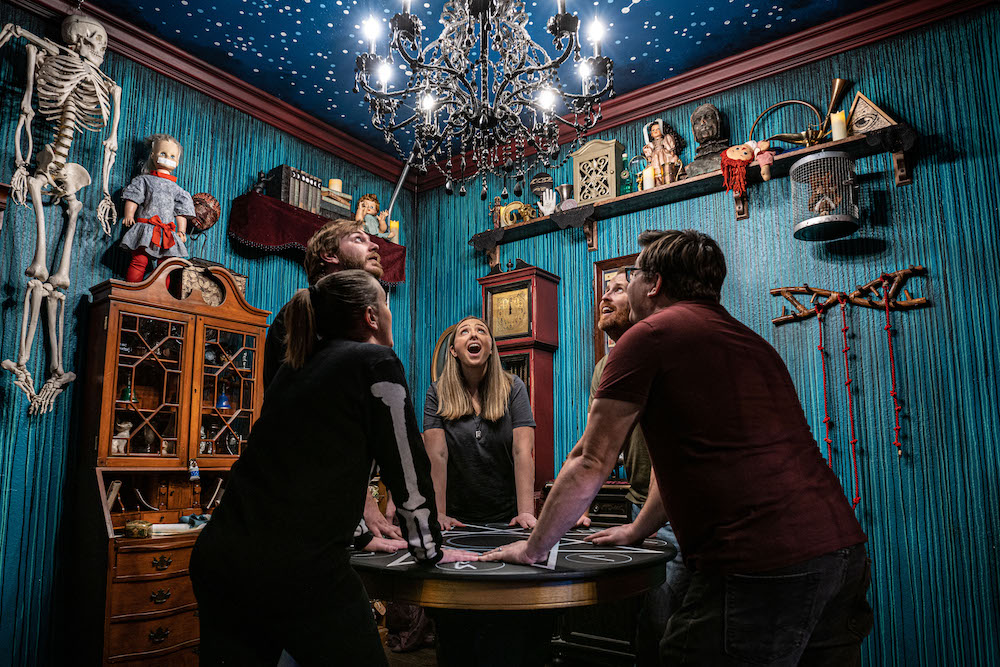
In contrast, smaller environments can’t rely on a constant flow of new spaces to tell the story. Given this constraint, they’re often forced to get creative and utilize other storytelling techniques, which can lead to more nuanced character development, more layered uses of the space available, and a focus on smaller details over bigger reveals.
All the examples in this article, unless otherwise noted, utilize relatively little square footage, which can be a single room or a set divided into multiple even smaller rooms.
Depth Over Breadth
At their best, small escape rooms encourage deeper worldbuilding, deeper character development, and deeper puzzling by keeping players focused on a more concentrated space.
Boxaroo’s The Storytellers Secret (Boston, MA) packed a staggering amount of detail into a compact environment. The puzzles had layers, and this was physically reflected in the space they lived in. Boxaroo subdivided the room cleverly, making this game feel bigger than it actually was.
Next Level Escape’s Forest of Echoes (Sydney, Australia) made a single room magically come to life by giving players the power to travel through time. As the lighting and other small details changed around us, we experienced multiple stories and perspectives all elegantly layered on one another.
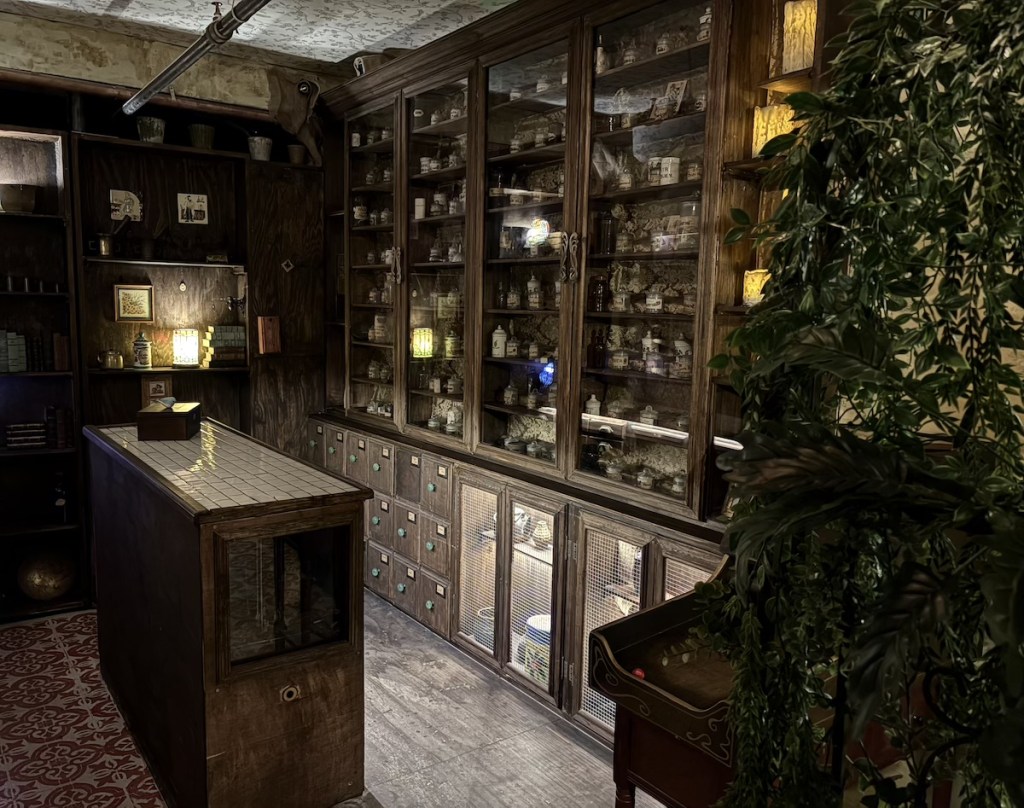
NYC in 2025 is lacking as an escape room market, and I often see people blaming this on the fact that real estate is so expensive. MyssTic Rooms’ The Bird (Brooklyn, NY) proved that size is no excuse, transforming a practically closet-sized space (previously their workshop) into a magical apothecary jam-packed with delightful details, dynamic gameplay, and wondrous tech.
Enter the Imaginarium’s The Mind’s Eye (Pittsburgh, PA) took an even more tech-forward approach, turning a tall, ovular hall into a blank canvas for panoramic projection mapping. We didn’t travel through space; instead, the space traveled around us.
A Central Set Piece
A smaller space can feel less small by directing attention inward rather than outward. Instead of having puzzle stations around the perimeter of the room, place a large interactive set piece that dominates the center of the space.
To quote long-time, well-traveled player and REA Patreon backer Dan Egnor, Arcane Escape Room’s The Ghost of Mentryville (Newhall, CA) “might be the best room in the world in awesomeness per square foot.” Guided by an in-room actor, this unusual game focused around an intricate coffin with many locked compartments. In his review, David notes: “In some ways it was incredible because of its small size, lack of technology, and rustic construction. Arcane Escape Room took a tiny space and figured out how to fit the perfect game into it.”
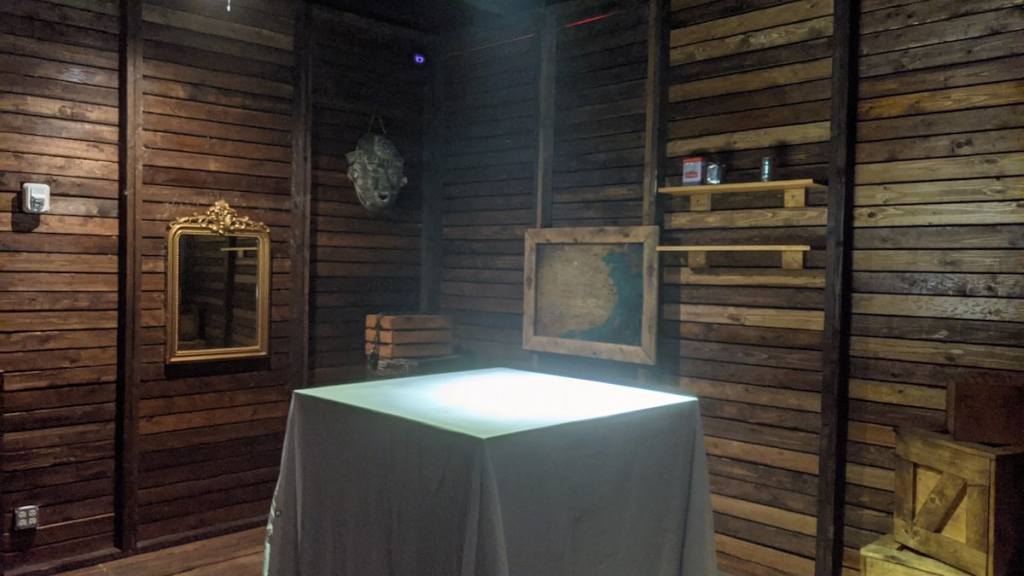
Trapped! Escape Room’s Pandora’s Box (Las Vegas, NV) centered around the titular Pandora’s Box, a large mechanical marvel that was interactive on all sides. Our attention was primarily on the box and the different interactions it offered. As we solved puzzles, we triggered a range of special effects in the room around us.
More Intimate Theater
Actors in larger escape rooms often help to keep players moving throughout the space, leading to a continuous flow state. However, actors needn’t always be scare actors, and there are many types of scenes that are best suited for smaller, more intimate spaces.
Cross Roads Escape Games’ The Weeping Witch (Anaheim, CA) is one of the smallest horror games out there, and it’s also one of my absolute favorites. This largely one-room experience was both terrifying and safe, despite being in extremely close quarters with an actor. Cross Roads pulled this off by being crystal clear in their pre-game briefing, and cuing players well with lighting and music. While many larger horror games rely on chase or hiding mechanics, The Weeping Witch innovated a range of alternate techniques that were similarly compelling and showcased the performer in unforgettable ways.

Strange Bird Immersive’s The Man from Beyond (Houston, TX) has remained the top TERPECA game in the United States for many years, and the core experience arguably takes place in a single room. The magic in The Man from Beyond comes not from discovering new spaces, but from extraordinary levels of polish and restraint applied across the puzzles, the theatrics, the space itself… and the pull of the actress.
60Out’s Miss Jezebel (Los Angeles, CA) and Quest Tavern’s The Last Supper (Pomona, CA) both feature a distinctive play style, alternating between actor-driven scenes and gameplay objectives that must be completed (and concealed) before the actor returns. In an almost roguelike fashion, we revealed new information in each segment, and the gameplay was invigorating without taking up much space. David’s review noted, “Escape rooms don’t have to be big to feel huge, and The Last Supper felt grand.”
Cozy Aesthetics
In the video game world, “cozy games” center around non-violence, relaxation, and open-ended exploration. I’m not sure that an equivalent genre fully exists yet in escape rooms, though I’ve come across a small handful of rooms that embrace warmer aesthetics and encourage players to slow down, more than your average race to the finish line.
The Other Tales’ Once Upon a Winter (Hawthorne, NJ) had a charming objective: to help Mother Winter by gathering the pages of a magical storybook. This game was set in the coziest little one-room cottage, and while the puzzles were fairly standard fare, this environment encouraged us to relax and savor the journey.
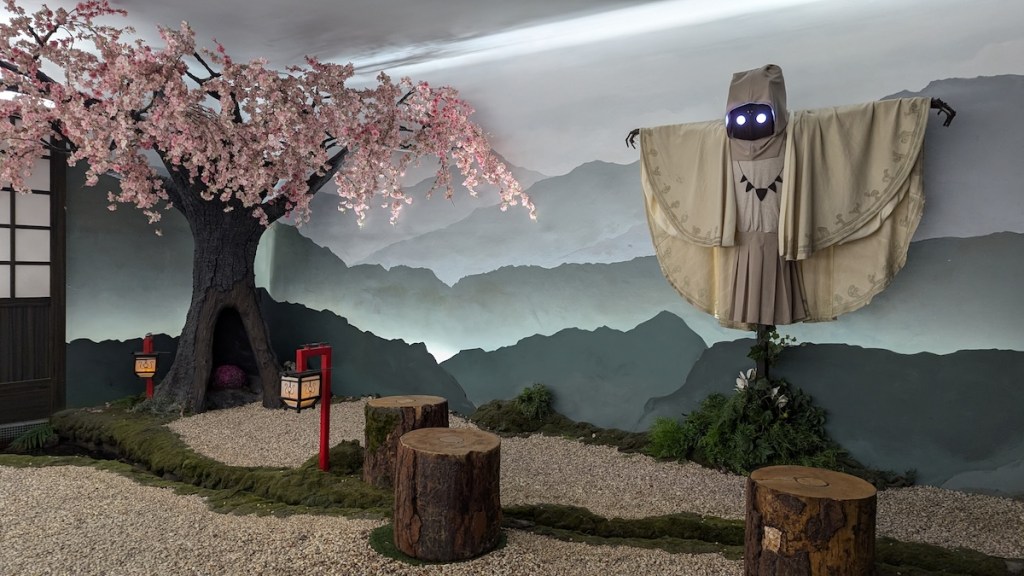
Ukiyo’s The Crumbling Prince (Melbourne, Australia) began in a candlelit briefing room where players were offered warm tea and mochi while they received the rules and got into costume. This sensory priming had a clear objective: to get players to leave the outside world behind and calm down, and then carry that feeling into the main experience. The primary game space, a single-room minimalist zen garden, included some of the coziest interactions I’ve seen in any escape room, like gathering fruit and filling a bucket with water. Building on this serene foundation, the game layered on a breadth of complex emotions through interactive character narration and refined lighting.
Larger escape rooms can also have small, cozy spaces within them. For instance, in Escape Cafe’s Zoltar Speaks (Hilversum, Netherlands), multiple stalls within a historical Middle Eastern bazaar were so relaxing that we would have happily taken a little nap in them. Draped fabrics, pleasant scents, and calming music all went a long way. These scenes were just a small part of a much larger game, but I’d love to play a small escape room built entirely around this vibe.
Budget Brilliance
Scrappiness can be a compelling aesthetic. Limitations in budget, time, or fabrication skills may encourage designers to get extra creative with unusual materials or take interesting risks.
The Gate Escape’s D.J. Death (Leominster, MA) and Doldrick’s Escape Room’s Spoopy’s Ghoulish Graveyard Gameshow (Orlando, FL) both originated as limited-time Halloween pop-ups, but they were so popular that they became permanent installations with fairly minimal modification, still retaining their scrappy charm. In each, we loved interacting with spooktacular characters through a series of high-energy challenges. These games successfully optimized for fun.
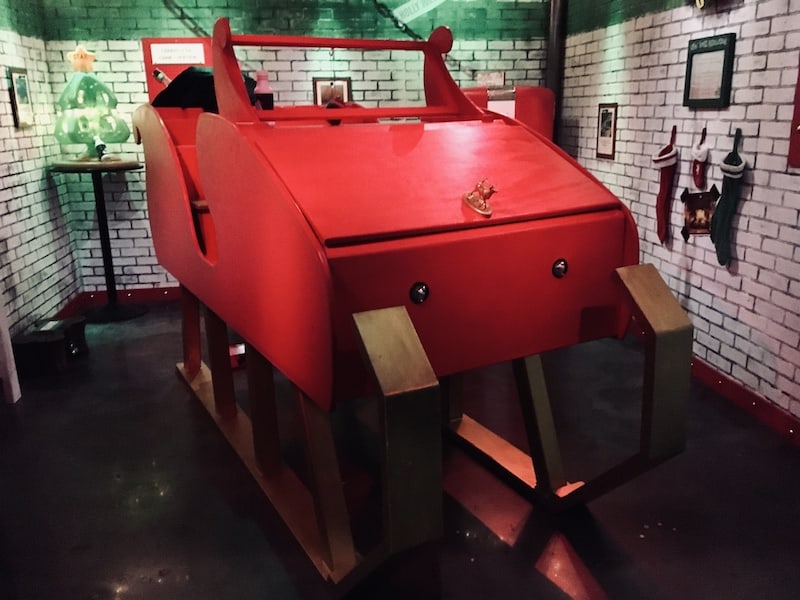
Red Sled Redemption, another offering from Doldrick’s, “was the most genius inexpensive and small escape room build that we’ve ever seen.” This single-room game cleverly repurposed old toys into creative puzzles, and a large wooden sled occupied the center of the room.
For their first escape room, MindFox Escape wanted to keep things relatively simple, but also memorable. Black & White Cafe (San Diego, CA) brought a flat coloring book world to life with some black markers and a high attention to detail. MindFox Escape wasn’t the first to create this type of environment, but they were unique within their region, and this small, inexpensive room quickly became a player favorite.
The Cool Space also realized that they needed to open their first game quickly and on a tight budget. Seance (Sydney, Australia) took place in a single tiny room, and players were seated around a table the entire time. The Cool Space used this unusual format to their advantage, bringing the room to life with off-the-shelf smart lighting and utilizing a range of seance effects.
There are also plenty of low-budget escape rooms that are terrible, but just because an escape room is scrappy, whether by choice or necessity, doesn’t mean it is automatically a lesser game.
An Appeal to Creators
The takeaway from all of this is not that you need to stop making massive blockbuster escape rooms. It goes without saying that such experiences have the potential to be incredibly exciting, appeal to a broad audience, and win international acclaim.
Yet, looking at top TERPECA rankings in recent years, it might be tempting to conclude that you need to build sprawling environments and invest 6- to 7-figure budgets if you want to “compete” in the current global landscape of escape rooms. The standards for escape rooms are rapidly rising, yes, but in my opinion, a need for size one-uppance couldn’t be further from the truth.

Furthermore, even if you have the ability to create a large and expensive game, could you instead create multiple physically smaller games with similar overall resources? Or maybe, in between creating blockbusters, try something more experimental with fewer resources in a smaller space? These approaches could be more sustainable not just from a business perspective, but also from a creative one. Faster iterations allow us to fail faster and thus learn faster.
There’s a strong precedent for making smaller experiences that are massively impactful. The best escape rooms play to their creators’ unique strengths, and players appreciate innovation, novelty, and individual expression in all forms. Do more with less, rather than less with more.
Continued Conversations
David and Peih-Gee have interviewed the creators of some of the games mentioned in this article on REPOD. In these episodes, they dive in with the creators about the struggles and opportunities around designing smaller-scale games.
S9 E5: MyssTic Rooms: Challenges, Constraints & Creativity
S8 E3: The User-Centric Design of Boxaroo with Fro Myers
S7 E8: Influential and Experimental: Luke & Madison Rhoades of Cross Roads Escape Games
S6 E12: Episode 12: Wood, Wire, & Whimsy— Mike Dold and Rick George of Doldrick’s

![Puzzle Corp. Escape Rooms – Bigfoot: Secrets of the Swamp [Review]](https://roomescapeartist.com/wp-content/uploads/2026/03/bigfoot-secrets-of-the-swamp-bigfoot-secrets-of-the-swamp-2.jpg)



Leave a Reply