
Strange Bird Immersive’s inspirationally innovative immersive adventure THE ENDings is ending on July 26, 2025.
Upon hearing of this abrupt yet inevitable closing, I was lucky to squeeze in a 2-day layover in Houston to see the show twice, on consecutive nights. I’m always hesitant to travel to a city just for a single experience — it can put an unfair amount of pressure and expectations on how well it’ll resonate with me, no matter how amazing it is — but I’m grateful I went out of my way to see THE ENDings. If you’re reading this before July 26, you appreciate immersive theater and interactive narrative, and you can get yourself to Houston, this is an experience you won’t want to miss.
But for most people reading this, THE ENDings will already be a thing of the past, at least in its current incarnation. As such, this article is not really a review, but rather a look at THE ENDings as an intriguing case study: diving into its most innovative elements and its scrappily clever approach to replayability, and distilling and contextualizing these ideas within the broader world of escape rooms.
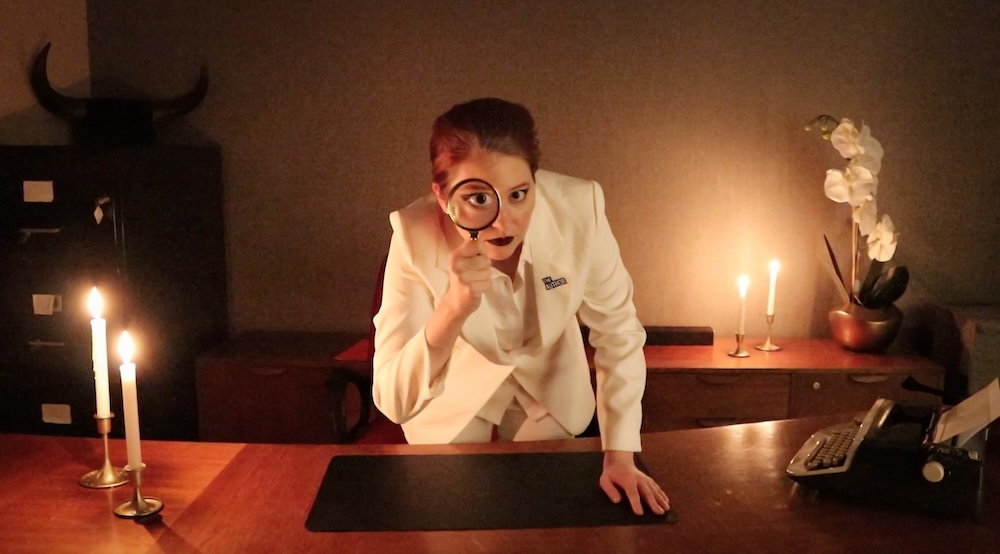
It’s hard to talk about the thing without talking about the thing, so significant structural spoilers and light content spoilers lay ahead.
Player As Protagonist
Upon arriving at THE ENDings, you interview and are hired for the role of The Protagonist. Equipped with headphones and a mobile device, you hear the voice of The Narrator guiding you throughout the experience, describing your actions in real time as you navigate any number of 11 core stories. In each, you are presented with choices — some simple, some more profound — which dictate which branches you explore, with 35 possible endings. At the end of each story, you die, often in quite a glorious or absurd fashion. But death is not the ultimate end. Once one story finishes, you return to The Start (which is literally the word “Start” emblazoned on the floor toward the entrance) and begin a new story afresh.
Throughout, you explore a large, real, and deeply surreal office space, with a tone reminiscent of the video game The Stanley Parable and the TV show Severance.
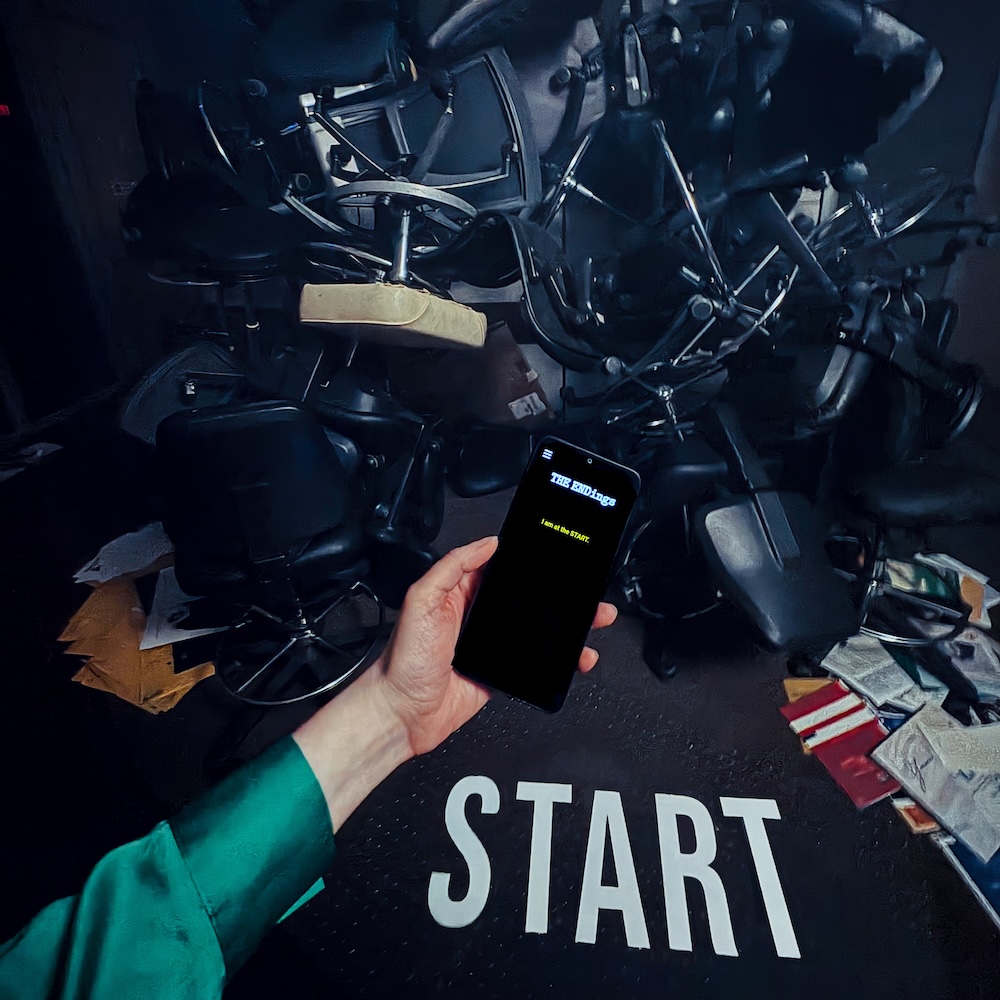
While most escape rooms cast their players as the story’s protagonists somewhat passively or shallowly, THE ENDings defined the player’s role as Protagonist explicitly and literally. This was reinforced through narration as well as through interaction: as you navigate your very first story — essentially an extension of the training level — you’re prompted to find your own cubicle in the office, and after some searching, you realize that your cubicle is that labeled with the name “The Protagonist.”
Building on this foundation of player role as a central motif, THE ENDings proceeded to explore deeper questions: What does it actually mean to be The Protagonist? How much agency can or should The Protagonist have? Who is writing your story and how do you exist within it? Only with a certain level of self-awareness and clarity of voice can an experience meaningfully delve into such philosophical reflections, as THE ENDings pulled off so successfully.
How does this translate to escape rooms? Well, one of the primary challenges of escape room storytelling revolves around this issue exactly. Even when you place your players in the center of the story, swooping in to save the day in some high-stakes scenario, what they actually experience is a series of predefined challenges, each with one correct answer, and fully on-rails. The story they experience is already written, gated, and paced only by their ability to solve some simple puzzles and move through physical space. Even on the rare occasion that they are presented with a choice, each potential branch is still a different story that has been prepared in advance.
Although THE ENDings was not exempt from these challenges and it too was fully scripted up to the final scene, that final scene beautifully reframed the player’s role as The Protagonist and set them up to find their own personal meaning in the piece. While I would not advocate for completely open-world escape rooms, or for always embracing the meta-existential tone of THE ENDings, an increased awareness of how we situate players and a truthful approach to how much agency they actually have (and where that agency comes from) may help us to tell interesting stories with more nuance and tact, both in escape rooms and in real life.
Structural Engineering
THE ENDings also stood out for its simple yet effective structure: two highly interactive one-on-one scenes with actors bookended a fixed period of more open-ended exploration that was guided by the voice of The Narrator and a mobile app. Similar to and perhaps directly inspired by Phantom Peak, the mobile app provided a flexible framework to guide players through different story trails, monitor players’ decisions and progress on the backend, and easily add or modify content. The app was pre-loaded onto a device given to each participant, preventing any possibility of other digital distractions. A chime sound effect played whenever a choice appeared to notify players when to look at their device again, ensuring they spent most of the experience looking around rather than at a screen.
This structure paid close attention to the most important touch points, pulling on the core strengths of immersive theater to make the participant feel seen, safe, empowered, and inspired. By working outward from well-considered interaction mechanics, Strange Bird Immersive was able to choose narrative mechanics and content to elegantly fit the shape of the piece. With crystal-clear onboarding and an incredibly streamlined flow in the app, it was practically impossible to mess up, and if you did somehow get lost, it was easy to get immediate help.
THE ENDings also balanced relatively high throughput — a solo audience member entering every 5 minutes — with enough other elements that made the show feel personal and intimate. Even though other audience members were roaming around the space at the same time, the onboarding and tutorial level made clear that you are largely intended to ignore your “coworkers” and stay focused on your own story.
Meaningful Replayability
An ongoing discussion in the escape room world revolves around the potential for replayability, which runs contrary to the classic escape room format that definitionally can only be played once. After you’ve solved all the puzzles and discovered all the secrets, there is little value in revisiting most escape rooms.
In her Immersology article Discovery and Replayability, THE ENDings co-creator Haley Cooper presents an interesting theory: “To achieve replayability, you must leave some things undiscovered on a first visit. But you will achieve replayability best when you leave undiscovered the most exciting tiers of discoveries.”
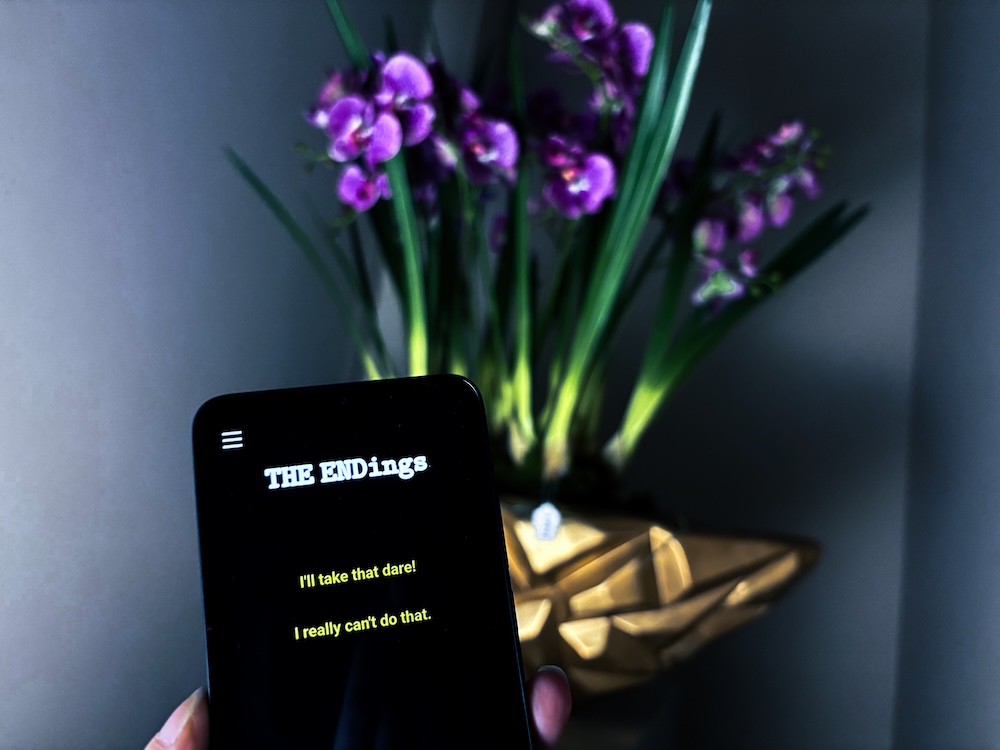
For an experience to be replayable, your first visit must be sufficiently engaging, coherent, and complete on its own to earn your trust and convince you to return, while also providing an enticing glimpse of what lays beyond. Consecutive visits must also be complete experiences that reward you for returning and build on your previous visits, without significantly diminishing returns in content quantity or quality.
Just creating more content than is completable in a single session is not automatically a recipe for success, as is evident in many points-based escape rooms. Unless you create meaningful stakes and a compelling reason for why my journey can continue, I may just assume that I’ve explored most of the highlights on my initial visit. (Well, personally I’m a completionist and probably would return regardless, but such isn’t the case for most players!)
Replayability in THE ENDings
This sort of balance is easier said than done, so let’s dive into how THE ENDings managed to cleverly crack the problem of replayability.
THE ENDings had vastly more content than was possible to fully explore in a single visit. Certain stories were particular standouts, but no paths were boring or felt like time wasters. My first visit welcomed me into the world, entertained me, and provided a finale replete with profound personal revelations. I ended on an actual ending, not on the feeling of incompletion, while still full of curiosity around all the decisions I didn’t have time to make. Upon exiting the experience, I received a program and receipt which summarized the endings I’d reached, while also outlining the structure of all possible endings.
On my second visit, the experience immediately acknowledged that I was a return visitor, both with a physical marker and a modified onboarding flow. It gave me space to explore the world more deeply, remembering where I’d left off. It didn’t try to recreate the same magic of my first visit; it built on it to create new meaning. Participants who return a third time and beyond are further rewarded with an even more personalized finale scene.
Within this structure, there was an opportunity to even further refine the information provided to return visitors. Some story paths branched more meaningfully than others, and it was sometimes difficult to recall which stories branched in entirely different directions at the start versus those which maybe just provided a slightly altered ending. That said, the partial information provided made for a fun scheming session between visits.
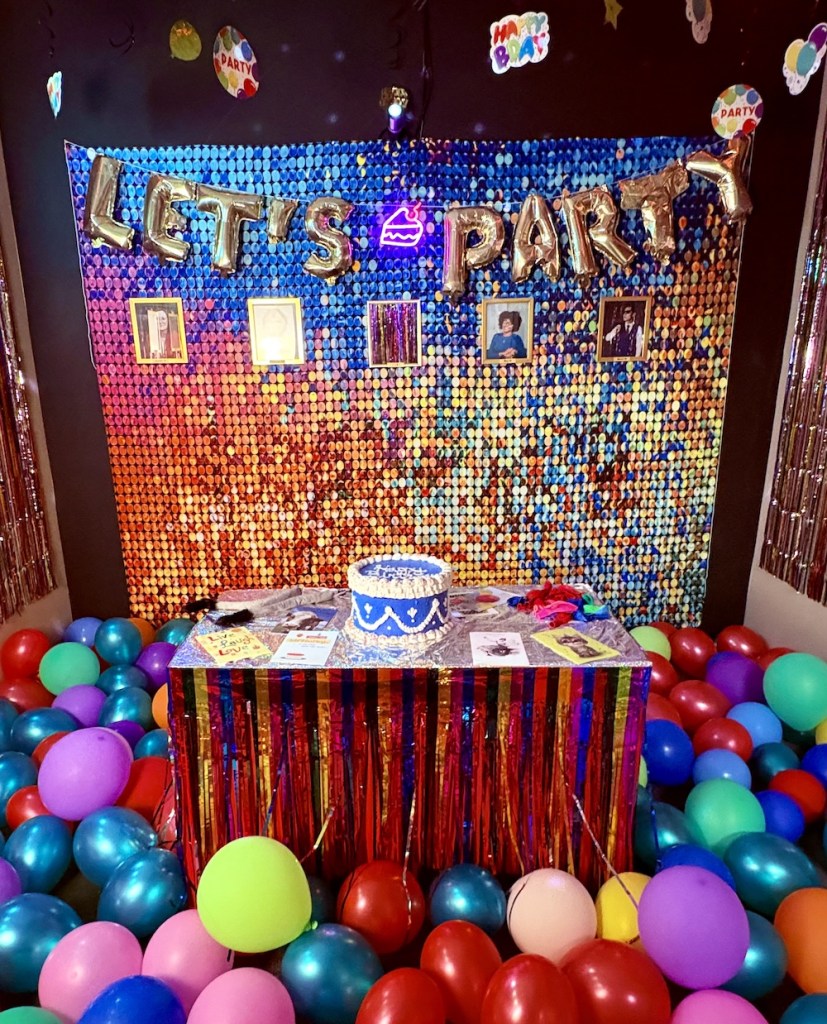
Strange Bird Immersive also leaned into their replayability value in their marketing. They freely shared photos of certain secret spaces, like the iconic Party Room, which players are not guaranteed to see on their first visit (I didn’t.) They offered “Cheat Codes” which are likely to lead you down some fan-favorite paths. But these are teasers more than spoilers. They don’t give away the secret of what actually happens in these spaces or stories, making potential participants all the more intrigued to come explore for themselves. And of course, plenty of other secrets remain hidden.
When Escape Room Creators Return To Their Roots
Strange Bird’s founders Haley and Cameron Cooper are primarily known as escape room creators, yet it’s abundantly clear to anyone who has played The Man from Beyond (or met Haley and Cameron) that they have their roots in theater, and specifically in immersive theater. Innovating at the intersection of these two realms, most of their existing audience consists of escape room enthusiasts, and so in some ways, it was a bold decision to depart from escape rooms and present THE ENDings as an interactive narrative experience without puzzles.
I’d argue that this was a brilliant decision that played perfectly to Strange Bird’s strengths and resources.

THE ENDings took a tiny fraction of the time and money it’d take to create a permanent escape room of a similar caliber and impact. It also took a fraction of the time to train new actors for THE ENDings that it takes to train new actors for The Man from Beyond. The show was immediately profitable and required relatively minimal effort and upkeep to run.
This was all by design. As professional theater-makers, Haley and Cameron are stellar writers and storytellers, and while writing takes plenty of skill, it’s also much faster and cheaper than building intricate sets and contraptions that must stand up to thousands of players’ prying hands. Top-notch writing goes a long way in creating a memorable experience with lasting emotional impact, and working with professional writers (and professional actors) can be a more efficient investment than building an expensive set.
THE ENDings also transformed an abandoned office into its set. This space was a complete mess and otherwise would have laid dormant, making it quite cost efficient to rent. Haley and Cameron were able to turn the existing chaos and weirdness — a mess to clean up for any other potential tenants — to their advantage, writing corporate America’s emergent absurdity into all aspects of their story. Rather than building new sets from scratch, they assembled them together from leftover items in the office and cheap local finds, including multiple palettes of office chairs and phones. For more thoughts on this subject, see Haley’s article In Praise of Found Space on Immersology and my post “Created vs. Curated Set Design” on my personal Patreon.
The downside of using a found space is that you never quite know when it’ll be taken from you and repurposed for its next permanent function, which is precisely what is causing THE ENDings to close now.
I left THE ENDings feeling moved and inspired. As I eagerly await the opening of Lucidity, I also hope that THE ENDings is just the first of many such experiments in non-escape room immersive storytelling from Strange Bird Immersive.
Disclosure: Strange Bird Immersive comped our tickets for this experience.
For More
When you support Room Escape Artist on Patreon at $5 per month (or above), you get access to the REPOD Bonus show, extra podcast episodes where hosts David Spira and Peih-Gee Law continue their conversations, with or without guests!
This month’s “between season” bonus episode includes David’s reflections on his visit to THE ENDings.
![TR-49 [Hivemind Review]](https://roomescapeartist.com/wp-content/uploads/2026/02/tr-49-tr-49-1.jpg)
![Escape Hour Austin – Edison vs. Tesla [Review]](https://roomescapeartist.com/wp-content/uploads/2026/03/escape-hour-austin-edison-vs-tesla-1.jpg)

Leave a Reply