
P is for Puzzle
Location: Washington, DC
Date Played: June 9, 2024
Team Size: 1-4 players per case; we recommend 1-3
Duration: Up to 60 minutes per case
Price: $30 per case
Ticketing: Private per group, but in a shared play space
Game Breakage: None
Accessibility Consideration: The Planet Word museum is fully accessible
REA Reaction
Planet Word’s Lexicon Lane has the potential to be a puzzler’s paradise. Yet, it may be the most ambitious permanent public puzzle project that nobody has heard of.
Comprised of 26 different puzzle box experiences, one for each letter of the alphabet, and set in a beautifully decorated puzzle-themed town, Lexicon Lane will delight wordplay-loving puzzlers of any experience level. Each case is an hour-long mini puzzle hunt, guided by a spiral-bound clue booklet along with various objects in the case and additional information and items scattered throughout the surrounding environment. (If you’re new to the concept of puzzle hunts, you can learn more at Puzzle Hunt 101.)
I found Planet Word to be one of the most alluringly innovative and interactive museums in Washington, DC, and I adore that they chose to lean so strongly into puzzles. The pairing is natural; language is deeply puzzley. We piece together words to form meaning, finding just the right combinations for the right contexts. Puzzles add an extra layer of explicit play to language, enhancing our awareness of the patterns that surround us.
The puzzles in Lexicon Lane were solidly designed with this mindset. They were varied and meaningfully themed, often utilizing custom handmade components in creative ways. I’d usually expect an experience like this to take place mostly seated, so I was pleasantly surprised by how many puzzles got us out of our seats and exploring storefronts and objects in the surrounding environment. Given how many different puzzle trails were overlapping in the space, signposting was quite direct by necessity while still embodying a strong sense of discovery.

Our group split into two subteams. My team played through 4 cases: Riddles in the Key of G, Computer Machinations, Trouble on Mount Olympus, and Purplebeard’s Lost Pirate Treasure. We primarily used the Expert difficulty clue booklets, occasionally peeking in the Classic difficulty booklets when we encountered unclear cluing. Our experience across these particular cases was overwhelmingly positive. With only a few small exceptions, the puzzle design was elegant and satisfying, reflecting the designers’ extensive experience in the world of puzzle hunts.
However, your mileage may vary depending on which case(s) you end up with. Our other team had a somewhat rougher experience, reporting multiple small maintenance issues, environmental inconsistencies that weren’t reflected in the clue booklets, and certain puzzles that were more tedious than clever. They still enjoyed their time at Lexicon Lane overall, but their experience highlighted the importance of maintenance and thorough playtesting across every single element of every single puzzle. Especially when designing an experience for novice puzzle hunters, it’s much easier to lose their trust than it is to gain it back.
There was also some room for improvement around the expectation setting and marketing of Lexicon Lane. Planet Word has created an experience with an immense potential for replayability, yet it’s currently being presented primarily to attract single-time visitors. The addition of some sort of loyalty card to track progress and/ or a metametapuzzle completable only upon solving most or all of the 26 cases could not only attract repeat players but also add more meaning to the alphabetic structure. I’d also like to see Planet Word list the full set of titles on their website; the 3 currently enumerated don’t even come close to representing the impressive amount of content they’ve created.
There is already so much to love at Lexicon Lane, and with a handful of tweaks and improvements, it could easily rise to become one of the top attractions for puzzlers in the D.C. area. Bring a puzzle pal or two and plan to make a day of it; Planet Word is a hidden gem.
Who is this for?
- Puzzle lovers
- Scenery snobs
- Any experience level
Why play?
- So many puzzle adventures to choose from!
- A delightful wordplay-themed town
- One of the most puzzley museums in the DC area
Story
We visited a wordplay-centric town. There was no overarching story, but each case had its own thematic premise.
Setting
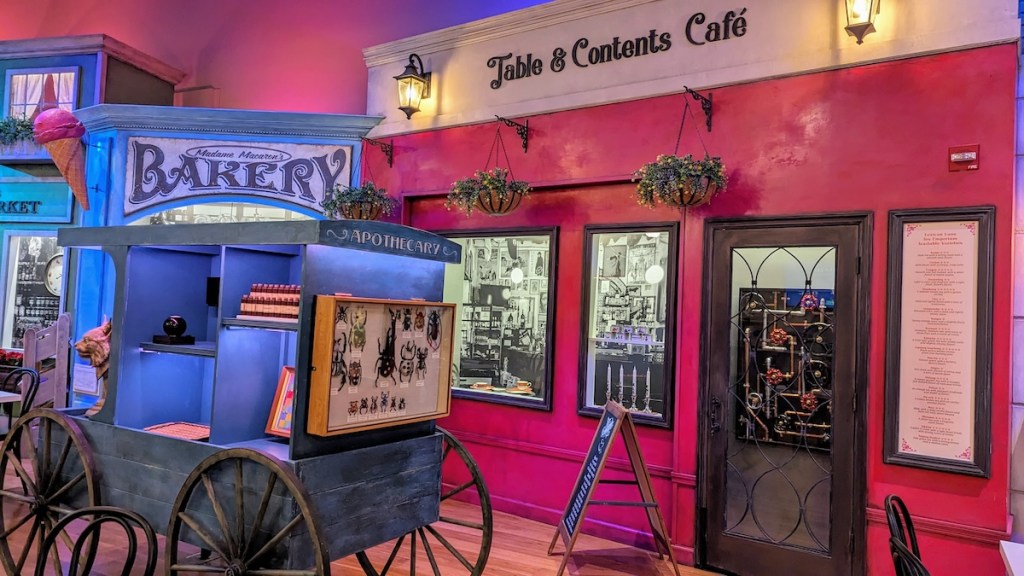
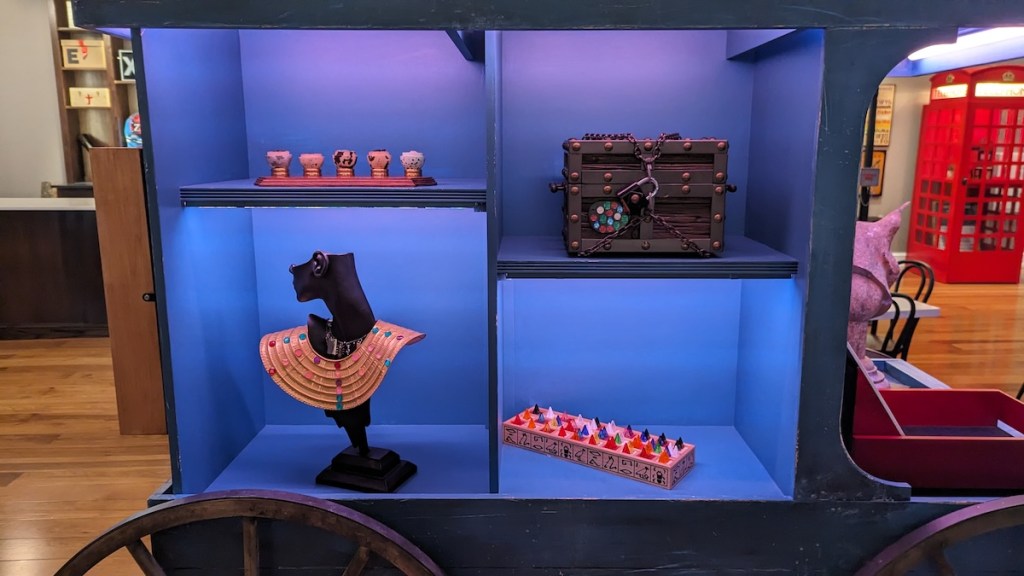
Lexicon Lane took place in a puzzle town that was impressively immersive for a largely sit-down puzzle box experience. Punny facades for various locations and businesses covered 3 walls of the space, including entities like the Table & Contents Café, Madam Macaron’s Bakery, and Lexicon University. Many individual puzzles mapped to a specific location, though others used individual props scattered throughout the space. There was an eclectic range of detailed, handcrafted objects everywhere you looked. Even after playing through multiple cases, we’d interacted with only a fraction of the items around Lexicon Lane, maintaining a high level of curiosity and intrigue for future visits.
Gameplay
Planet Word’s Lexicon Lane was comprised of a set of hour-long puzzle hunt experiences, each contained in a thematic container. They ranged from easy to moderately difficult, with a Classic and Expert difficulty clue booklet available for each case to further cater difficulty to each team’s puzzling background.
Puzzles ranged in style, with a bent towards wordplay. Each utilized some combination of instructions and information from the clue booklet, other items contained in the case and additional objects, information, and locked boxes scattered around the room.

Analysis
➕ Planet Word manifested their love of language and wordplay into a delightful little town. The set design was detailed, eclectic, and instantly intriguing, with puzzle-filled props and punny facades in every direction.
➕ Commanding center stage at Lexicon Lane was a floor-to-ceiling display showcasing the wide range of alphabet-themed puzzle boxes available. Each was a veritable art piece, and no two boxes looked too similar. Going just off of appearance, nearly every experience available was beautifully skinned in a way that made us excited to open it up and explore the contents.
➕ Our hosts for Lexicon Lane were helpful, genial, and knowledgeable about the intricacies of the experience. When prompted, they provided useful incremental hints without spoiling puzzle ahas.
➖ Upon beginning a new adventure, our game host opened the case at the front counter, talked us through the components, and explained any idiosyncrasies or special rules. This spiel was unnecessarily heavy handed and spoiled the element of surprise of getting to open and explore the puzzle components on our own, similar to when you enter an escape room and an out-of-character gamemaster talks you through everything you should and shouldn’t do with specific set pieces. Yet this was not the fault of the hosts, who were reasonably compensating for the lack of sufficiently specific onboarding designed into the puzzle kits themselves.
➕ The puzzles in Lexicon Lane were clever, varied, and satisfying to solve. They were clearly designed by puzzle hunt pros and intended to be enjoyable by both novices and more experienced puzzlers alike. Per the individual theming of each case, many of the puzzles were playfully pedagogical, teaching us about new subjects along the way. We appreciated the sheer diversity of custom handmade props we encountered, each creatively designed around a unique puzzle interaction.
➖ Given the overall high quality of puzzle design, I was surprised by a handful of inelegances and inaccuracies we encountered. A musical puzzle relied on an open-ended aha that was factually incorrect, at least within classical music (speaking as a professional violinist myself). A couple of other puzzles had ambiguities in alignment or orientation. While these were all small details, they can make or break a puzzle hunt, especially for novices, and I’d expect these issues to have gotten ironed out during playtesting.
➖ A nontrivial percentage of flavor and instruction text lacked a reasonable level of precision in its wording. This primarily seemed to be an issue in the Expert clue books, whereas the cluing was more consistent in the Classic books. In thoughtful puzzle design, difficulty shouldn’t come from unchecked ambiguity; simply removing an enumeration or making a clue more generic doesn’t automatically make a puzzle more challenging in a good way. We also encountered multiple instances where the wording didn’t accurately reflect how things were physically positioned in the space during our visit.
➕/➖ In classic puzzle hunt style, each puzzle solved to a word or phrase as an answer. For certain cases, there was a metapuzzle which combined the individual puzzle answers into one final puzzle. It was almost always clear when we’d reached a correct answer. That said, we found some of the final puzzle answers to be unsatisfying and bland, lacking the witty puns that serve as implicit rewards for solvers in many puzzle hunts. Nor was there any capstone effect or narrative conclusion as you might find in an escape room. Instead, we simply checked our final answer at the front counter and got to ring a bell in celebration, which was only really fun the first time and quickly became disruptive.
➕/➖ Lexicon Lane featured an impressively high density of beautiful, detailed objects, both within each case as well as scattered throughout the environment. Almost everything we interacted with was clean and functional, yet I worry slightly about the durability and sustainability of the overall set given the existing maintenance queue and complexity of custom components.
❓ The structure of Lexicon Lane offers tremendous potential for replayability. As is, though, the experience is not particularly well marketed to attract avid puzzlers, or return visitors at all. In fact, many DC-area escape room owners and enthusiasts I spoke with had no idea that Lexicon Lane even existed. In addition to providing more details about the breadth of experiences available on their website, I’d love to see some additional gamification to more fully take advantage of their unique value prop. This might look like a passport where you get a stamp for each case you complete, a unique pin for each case, or even just a loyalty card with a replay discount.
➕ In addition to their Lexicon Lane experience, Planet Word is a truly spectacular museum overall. Make sure to leave a few hours to explore the rest of the museum during your visit. I learned a ton, and I was especially awed by a magical library that used projection mapping to bring books to life.
Tips For Visiting
- Though not officially offered, we were told that players who want to solve multiple puzzle cases consecutively can email Planet Word in advance to arrange for special accommodations.
- Up to 15 cases are available at a time, and they’re rotated out every 4 months. During our visit, 10 cases were available. A few were out for maintenance and repairs, but all the cases we interacted with were in solid condition.
Book your session with Planet Word’s Lexicon Lane, and tell them that the Room Escape Artist sent you.
Disclosure: Planet Word provided a complimentary game.
![Mothman Themed House AirBnB Escape Room [Review]](https://roomescapeartist.com/wp-content/uploads/2026/02/airbnb-mothman-house-2.jpg)
![The Escape Game – Legend of the Yeti [Review]](https://roomescapeartist.com/wp-content/uploads/2026/01/legend-of-the-yeti-legend-of-the-yeti-3.jpg)
![Studio Escape – Madame LeClaire and the Seance of Death [Reaction]](https://roomescapeartist.com/wp-content/uploads/2026/01/madame-leclaire-madame-leclaire.jpg)
Leave a Reply