
Link Start!
The Tokyo Matrix’s inaugural game, Sword Art Online – Anomaly Quest contains an array of physical and digital challenges, some of which change for each play, and leverages the try-die-repeat loop of a roguelike video game to create a novel experience. All of this takes place within the virtual MMORPG world of Sword Art Online, one of the biggest anime hits of the last 20 years. Official art is used throughout, the show’s aesthetic is recreated with high quality, and many characters appear, voiced by their official voice actors in Japanese. The game is fully playable in English, and Japanese voices are always accompanied by English text.
Anomaly Quest is just that, an anomaly. It is neither a traditional escape room nor a challenge arcade, though it shares elements of both. If I had to choose the closest analog in my own experience, it would probably be one of the longer quests at Boda Borg, but I find Anomaly Quest to be its own different thing born of two Japanese inclinations: high-difficulty games players come back and challenge again, and microtransaction-based “gacha” (random draw) video games.
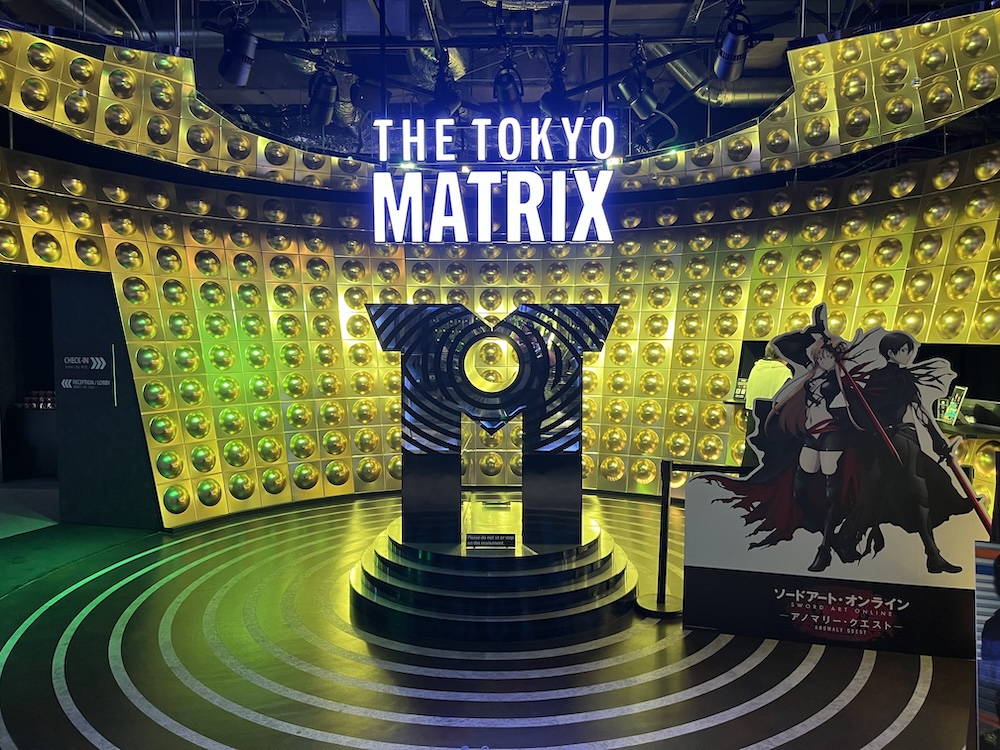
Anomaly Quest consists of at least 5 quests, each of which presents a different type of challenge. In even a single play, I encountered a lot of variety, which was one of my favorite things about it. The game encourages discussion of quests 1-3, so let’s go questing!
Take Up Your Sword

Players are each issued a device in the shape of a weapon hilt which is used for tracking and interaction throughout the game. In Quest 1, players enter a room and fight an onslaught of digital monsters by using the devices as if they were swords. This is done using motion tracking technology to translate players’ physical movement into game attacks by their characters on the screen. By holding their weapon in a cardinal direction, players can even charge special moves and unleash them on the monsters! Special moves are unlocked and enhanced by the experience level of players’ characters. Combat items make it easier to perform special attacks and increase the party’s score.
At the end of combat, parties get a score with a rating and receive corresponding loot to their inventories after the game is complete.
Search the Dungeon Walls
For Quest 2, the game will ask each party to search three times for numbers meeting specific criteria within a long corridor containing a few obstacles where large arrays of numbers are projected on the walls within 15 minutes. Other teams will be around, also completing the same task, but will have different target numbers.
The trick to this quest is that the digits on the walls have been replaced by sword pictograms. A paper translation key is provided, but searching is very slow going if players need to use the key. According to staff, many parties struggle with Quest 2, but some players can read the swords easily.
Choose Your Sequence, But Not Your Path
Upon entering Quest 3, the party is presented with three trials chosen by the game from a possible 8.
Players may choose to attempt the three designated trials in any order, which is important because each completion increases the difficulty of the remaining trials. Both parts of each trial are briefly described on a sign outside the door, so players do not have to make these choices completely blind.
Each trial occurs in a private room and consists of two challenges. When players enter the room, the characters will intro this trial’s physical challenge and then the timer will start. Examples of the physical challenges include throwing darts, a big block puzzle, and a rope pull. Once the physical challenge is complete, the timer stops and the characters introduce the trial’s digital challenge before the countdown resumes. Some of the digital challenges involve memory, smiling, minesweeper, or untangling lines.
Each time the party attempts a new challenge, the game will automatically apply some applicable quest items, if any are equipped, to lower the difficulty. Items are not straightforward about which trials they can be used for or what aid they provide, instead having descriptions such as “increases empathy”. I believe this is another area where players are intended to increase their proficiency through repetition, learning which items do what over time. With each trial containing two challenges, quest items are depleted quickly, adding further to the challenge of completing Quest 3 without hitting a game over.
Game Over – Would You Like to Continue?
If time expires, the system will activate a revive item if one is equipped, putting time back on the clock, allowing players to attempt to snatch victory from the jaws of defeat. If the party is still unsuccessful, the trial is then failed and players must exit the trial room.
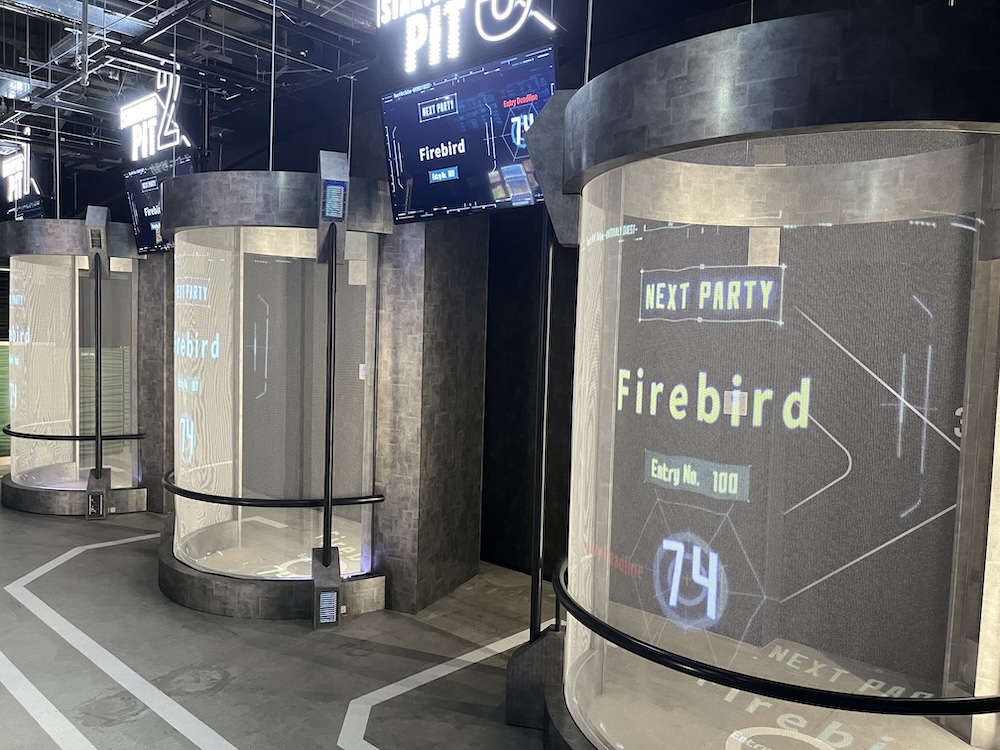
Failing a trial means game over, but if the party has continues available, the adventure can be resumed. When we played originally, parties had no free continues, but currently, parties start with three free continues. This allows players to experience all three trials, or stubbornly attempt the same one, as they please. Each trial has a designated queue area, but we never saw more than one team waiting, and the time limit means trials will cycle at the slowest in about 5 minutes.
If it is not near closing time, parties who have reached a game over with no continues remaining may purchase up to two additional continues per game.
A Replayable Cost for a Replayable Game
The Tokyo Matrix has its own currency “Gold Topolo”, which is used for everything. However, unlike many games which use virtual currency, Topolo is purchasable in precisely the quantities that players are likely to use and there is no discount for buying in bulk, so the system feels fair. Since it is convenient to buy exactly what is needed for the most part, I will use money rather than the Topolo pricing.
Currently, one game costs 1750 yen on weekdays and 1875 yen on weekends and holidays per player (approx. USD $12 and $13, respectively) for approximately 30-60 minutes of gameplay depending on performance and continues. Continues after the free ones cost 500 yen (~$3.50) per player, and both paid and free continues provide a critical opportunity to restock equipped items from players’ inventory.
Parties must have a minimum of 2 players, and can have a maximum of 3. Players create both party and character names, which the game characters will use in both text and voice (as long as players can figure out how to correctly enter these names using Japanese characters), which was a really neat feature.
Pull on the Item Slot Machine
There are three types of crystals, the in-game items. The official game terms for the types of items are swordsman, skill, and holistic, but we called them combat, quest, and support items because it felt more intuitive. Support items are used for reviving, as well as score and experience boosts.
There are two ways to get items: using money or using cheer, a separate currency earned by in-game performance. Using cheer gives level 1-3 combat items as well as level 1 quest and support items, with the exclusion of revives. Each game gave us enough cheer for a few items. Buying items with money costs 125 yen (~$0.88) each, but they’re best bought in batches of 5 because buying 5 at once guarantees at least one high-level item. Players can trade two level 1 or 2 items to get one level 2 or 3 item of the same type.
The party can equip up to three items of each type, drawn collectively from party members’ inventories. Items are single use only: once the game applies them, they are gone forever.
Failure is an Opportunity to Learn, and Makes Success Taste Sweeter
Anomaly Quest is very difficult. It was months before the first completion. Over a year after opening there were still less than 200 wins. We had two games where we reached the third trial of quest 3, and those runs were ranked #8 and #10 for the day when we left in the late afternoon. There are at least quests 4 and 5, though what happens in the late quests is shrouded in secrecy as few players get to experience them and the game asks that content from them not be spoiled. Only a single team had reached the final quest on our day (and failed).
While it is theoretically possible for a party to win on their first play, this game seems designed for players to need to play over and over again, gaining practice, insight, and experience from each repetition. That team that made the final had high experience levels; they had played the game dozens of times. Like a quarter-munching 80s arcade game, players are forced to go back to the beginning and try to get a little further each time. That said, success always felt within our reach and the challenge was my partner’s favorite part. It was hard to resist the pull to play just one more time, where surely, this time, victory would be found.
The Tokyo Matrix is conveniently located in a shopping center across the street from the escape room tower of Tokyo Mystery Circus, so it’s an easy add on for anyone playing English escape rooms in Tokyo.
![Escape Comics – The Alien Ship [Review]](https://roomescapeartist.com/wp-content/uploads/2026/01/the-alien-ship-the-alien-ship-1.jpg)

![Games by Stitch – Elsewhere Electric [Hivemind Review]](https://roomescapeartist.com/wp-content/uploads/2026/01/Elsewhere-Electric-Van.jpg)
Leave a Reply