
All hail the Big Spoon!
Location: Zoom
Date Played: December 19, 2024
Team Size: 2-4; we recommend 2-4
Duration: 60 minutes
Price: $20 per player
Ticketing: Private
REA Reaction
Created by UCLA senior Tyler Neufeld in his college dorm room, Code Green was delightfully replete with whimsy, puppetry, and alien lore. Tyler accomplished more with this humble pop-up than many commercial escape rooms have with markedly larger budgets, build times, and physical spaces.
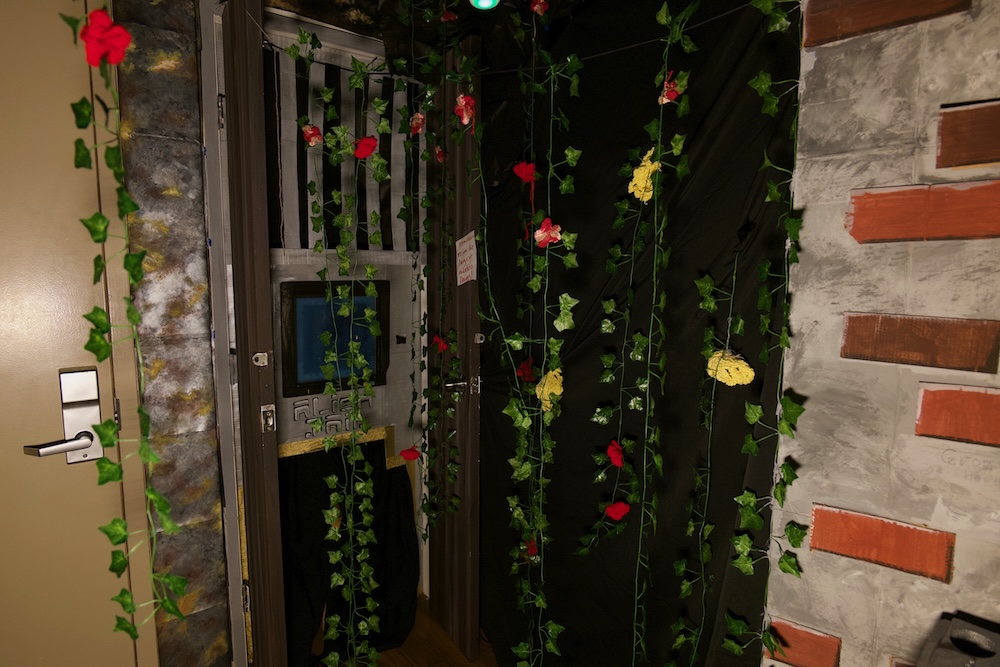
Harnessing his background in scenic design and playwriting, Tyler transformed his actual bedroom into a surprisingly immersive environment, with brick walls, a lush canopy of ivy, and even an “Alien Jail.” The small indications of this escape room’s real-world location — a generic tan dresser with an off-limits sock drawer, a mostly filled mini fridge — further deepened the game’s scrappy magic.

Tyler prototyped Code Green in about 3 weeks, continued to iterate on the concept across multiple locations, and a few dozen teams were able to play the game in-person before it was shut down. While chatting with Tyler after our game, we learned that he’d been inspired to create his own escape room after taking a course in art and entertainment design at UCLA, as well as hearing Tommy Honton speak about escape rooms. During this post-game debrief, I was impressed to see that Tyler had made his own “Adrenaline Map” for Code Green. We also enjoyed spotting the 2024 purple RECON PacLock used in part of the game! Though Tyler may be a new creator, he was already well rooted within the escape room world.
Code Green was designed as an in-person escape room, and the version we experienced over Zoom was essentially a semi-interactive walkthrough of the IRL experience — detailed documentation rather than a fully-fledged virtual escape room. Tyler had loaded photos from the original game into the largest Prezi I’ve ever seen, pushing the limits of the platform and thus resulting in occasional page crashes. He guided us through the space and gameplay in a style akin to an audio escape room with images. We were encouraged to take screenshots of important clues and share them with each other in a Drive folder, which consequently required constant refreshing and made it nearly impossible to keep track of what was relevant or not yet used. That said, many of these inelegances could fairly easily be remedied with the help of a platform like Telescape.
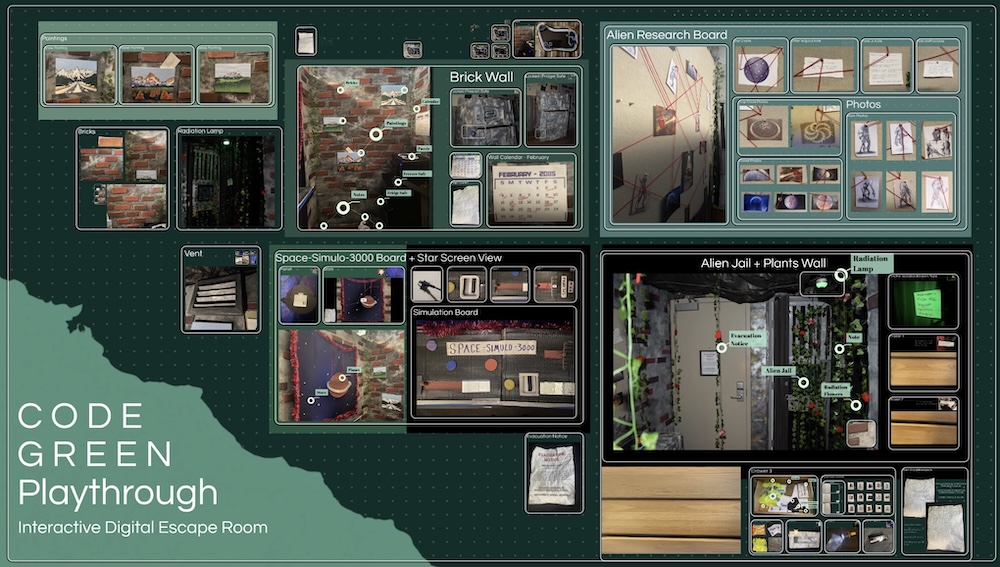
The rather clunky format was counterbalanced by incredibly charming and proactively helpful facilitation. Whenever it wasn’t obvious how we might interact with something, Tyler immediately guided us back in the right direction, creating a relatively cohesive experience even when we ran up against tech limitations. We particularly enjoyed interacting with some adorable characters.
It’s impressive to see a creator attempt to digitize an IRL escape room without having experienced the flood of virtual escape games a few years ago. Right after our game, David remarked: “Today felt like opening up a time capsule from mid-2020, but wholesome.”
Dorm Scapes’ Code Green shows that you can make some really cool stuff without much of a budget. Creativity, thoughtfulness, likable characters, and thorough playtesting go a long way. Although Code Green‘s in-person run has ended, at least for now, I have a feeling that Tyler’s future as an escape room designer is only just beginning.
Book your hour with Dorm Scapes’ Code Green, and tell them that the Room Escape Artist sent you.
Disclosure: Dorm Scapes comped our tickets for this game.
![Mothman Themed House AirBnB Escape Room [Review]](https://roomescapeartist.com/wp-content/uploads/2026/02/airbnb-mothman-house-2.jpg)
![The Escape Game – Legend of the Yeti [Review]](https://roomescapeartist.com/wp-content/uploads/2026/01/legend-of-the-yeti-legend-of-the-yeti-3.jpg)
![Studio Escape – Madame LeClaire and the Seance of Death [Reaction]](https://roomescapeartist.com/wp-content/uploads/2026/01/madame-leclaire-madame-leclaire.jpg)
Leave a Reply