
I didn’t expect to find myself writing this piece, until I played two different TERPECA winning games from Athens, Greece doing variations of the same terrible idea (see our reviews of Hide and Seek and Mystic Project).
So here I am stating very clearly:
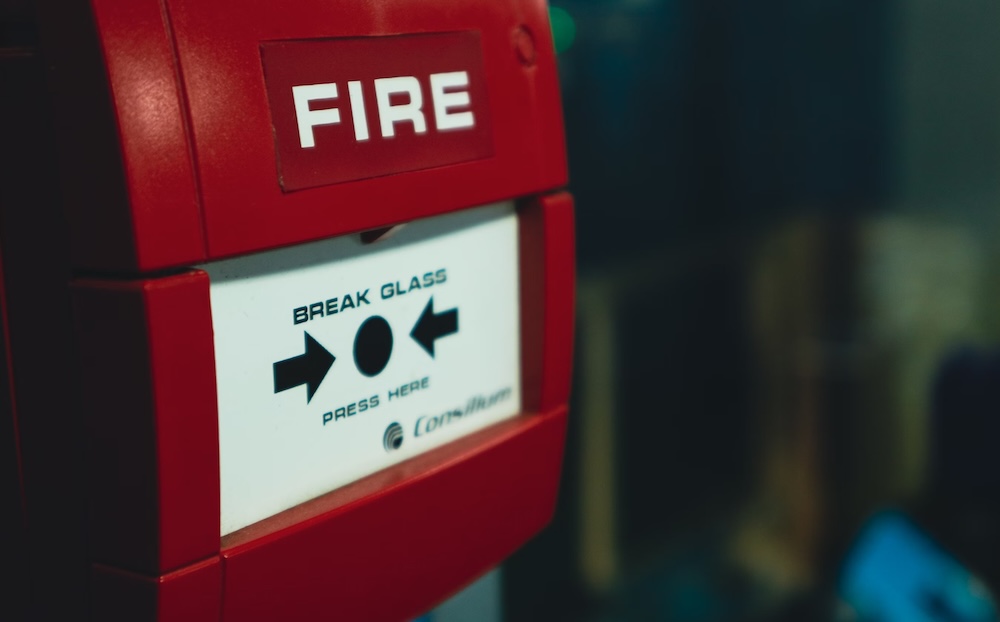
It’s a terrible idea to use emergency equipment like “Push To Exit” buttons as game mechanics in your escape room. This is especially important if you don’t have proper fire safety affordances like the games that are prompting this post.
What counts as emergency equipment?
A few items immediately come to mind as things that should not be mechanics or props in your game:
- “Push To Exit” buttons
- Fire alarm pull switches
- Smoke detectors
- Doors labeled “Emergency Exit”
- Fire extinguishers
- Sprinklers (and their plumbing)
This isn’t a long list, but all of these items are the kinds of things that should only ever do exactly what they are supposed to do.
Why not use emergency equipment in game design?
If you need a game design reason: Players will almost certainly need hints to interact with emergency equipment, or if they don’t… they will need to acknowledge the unreality of your game in order to give themselves permission to do so. Either way, you’re breaking immersion.
But the real reason is that it’s needlessly dangerous. Objects that exist to save the lives of your players in an emergency should not be fake versions of the real thing. In the event of a fire or major medical incident, being surrounded by fake emergency equipment is a nightmare. Someone’s last moments on earth shouldn’t be depressing a “Push To Exit” button only to have it do nothing.
And if you’re thinking, “That will never happen…” It already has, and the owner of that game killed 5 girls and served prison time. He deserved every second of his incarceration.
There are so many ways to be edgy and creative in your game design. Don’t put your players in actual danger in a misguided attempt to make them feel like they are in pretend danger.
The only time that this is even remotely acceptable is when you have proper fire safety equipment and egress control in place to begin with… and even then… there are better interactions that you can build into your games.


![The Escape Ventures Winter Garden – Haunted Harbor [Review]](https://roomescapeartist.com/wp-content/uploads/2026/02/the-escape-ventures-winter-garden-haunted-harbor-1.jpg)
![Studio Escape – For Queen & Country [Reaction]](https://roomescapeartist.com/wp-content/uploads/2026/01/studio-escape-for-queen-and-country.jpg)
![Pop Up Escape – Death & Taxes [Review]](https://roomescapeartist.com/wp-content/uploads/2026/02/death-taxes-death-taxes-3.jpg)
![Brain Games – Flynn’s Arcade [Review]](https://roomescapeartist.com/wp-content/uploads/2026/01/brain-games-flynns-arcade-1.jpg)
Leave a Reply