
I love pins.
My obsession first began while visiting the Disney parks as a kid. I’ve always had a collector mindset, and Disney’s community around pin trading instantly sucked me in. With exclusive sets to complete and rare Hidden Mickeys to track down, I traded with every crew member I encountered and meticulously organized my collection in a big binder.
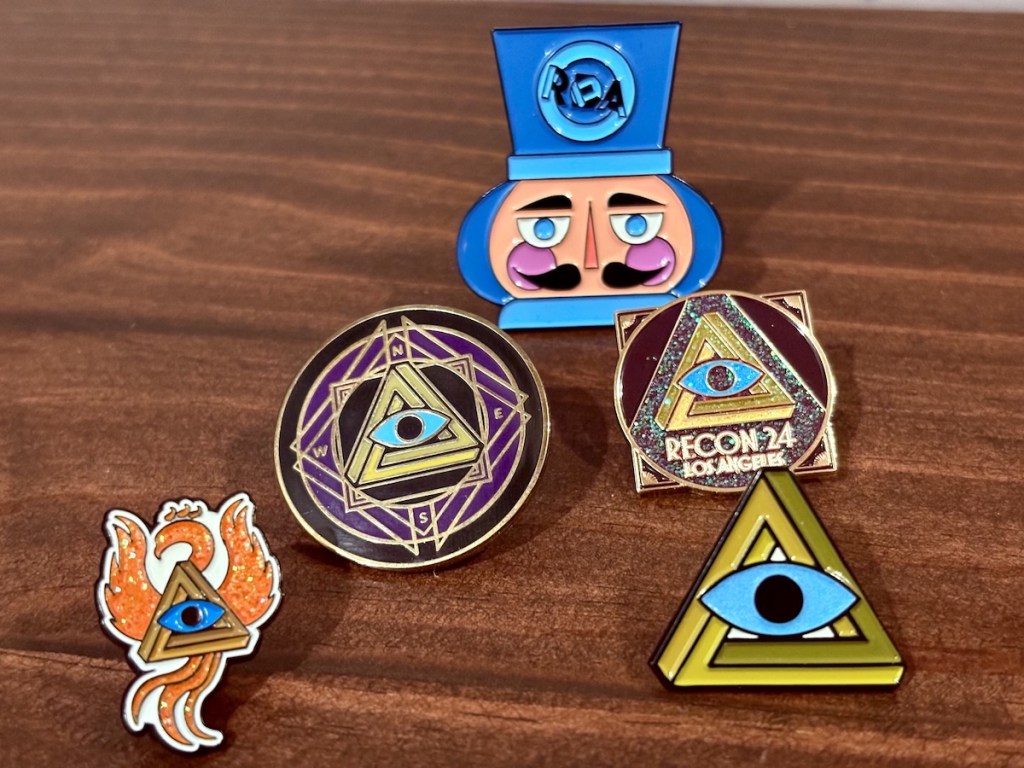
In more recent years, I found myself with a growing collection of pins from various escape rooms, tabletop puzzle games, puzzle hunts, and immersive shows. For a while, this treasure trove lay hidden in a box in the back of my closet, but about a year ago, I purchased a black corkboard and turned my pin collection into an epic mosaic. Each individual pin is a miniature work of art, and together, they form a unique and personal travelogue.

Pins are compact, affordable, and easy to display. You can put them on clothing, on bags, or display them at home. I love usable merch, but my closet is overflowing with t-shirts and sweatshirts, I’ve just about run out of surfaces on which to affix stickers, and I have enough mugs to last a lifetime… yet there’s always room for one more pin.
Pins vs. Buttons
Most pins fall into two categories, based on their back attachment style:
- Tack pin: One or more small prongs on the backside attach into a “butterfly clutch” — those little metal circles that you pinch to unlock. Most enamel pins are this style.
- Pin-back button (or button badge): A circular metal disc has a safety pin affixed to the back. This style is especially popular with political campaigns.
Note that the specific terminology used to refer to these variants can differ country by country.
For escape room merch, I strongly recommend enamel pins over buttons. While buttons are usually less expensive, they’re also lower quality, they don’t attach to as many surfaces, and their safety pins can easily be bent or damaged. In contrast to political campaigns, which run for a finite length of time and thus don’t require durability, escape room pins are mementos meant to last.
Enamel pins aren’t just higher quality; they’re also more interesting. You can make the pin any shape, and even play with special techniques like glitter or glow-in-the-dark enamel.
Getting into specific production variants, I can’t say I have a strong preference between hard enamel, soft enamel, or die struck pins. They all look good when produced well, so choose whichever suits your intended design the best.
How To Design A Pin
What types of designs work best for pins?
Enamel pins look best with clear, simple images and pronounced line patterns. The simpler you can make your design, the better.
In general, your lines will be bare metal, and your colors will be created with enamel. Your colors must be outlined with metal, so keep your colors separate. Think of it like a coloring book, where each outlined region can only have a single color.
How does pin design differ from sticker design or other merch design?
Printed merch can handle color gradients; enamel pins cannot. However, you can use glittered enamel in place of a gradient for a similar effect.
Also, text on an enamel pin must be big enough to be legible.
What are some common pitfalls when designing for this medium?
When designing an enamel pin, make sure that your image:
- Uses vector graphics
- Is 300 dpi
- Consists of Pantone colors
- Has solid colors separated by lines
As with all printed or manufactured materials, really scrutinize the pre-production proofs. If something is wrong in the proof, it will also be wrong in the final production run.
Finally, I highly recommend getting locking pin-backs to secure your enamel pins.
Make Them A Set
Maybe you plan to create just one pin of your escape room company’s logo. Great!
But why stop there? I love when escape room companies have a different pin for each of their games, and there are a few things to consider when designing a cohesive set.
Above all, make sure the pins look good together as a group. Even if each escape room has a very different theme, aim to have a shared style across all the pins. It also helps to keep them similar in size and shape.
On that note, there’s no need to design pins that are overly large. Jumbo pins are more expensive, they take up more space, and much of the joy of enamel pins actually comes from the detail in miniature. Just make sure to scale your design properly so it reads clearly at a smaller scale.
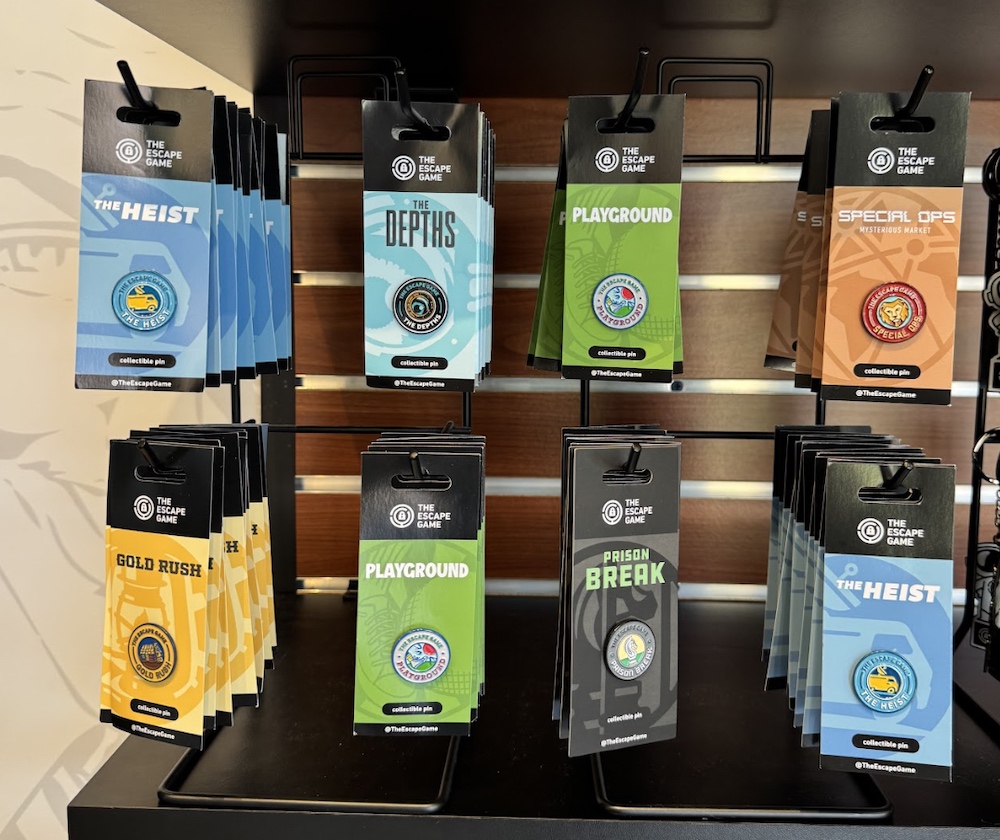
As an example, The Escape Game sells a small, circular enamel pin for each of their games, with “The Escape Game” and the game title around the perimeter and an icon representing the game in the center. Their “Monthly Mystery” series also releases a new pin each month. TEG sometimes even offers a laminated “passport” page onto which you can affix the pins you’ve collected.
Presentation Is Everything
So now you have some snazzy pins. How do you get players to buy and display them?
Enamel pins typically can cost around $1 each when buying in bulk, and they typically retail in the $5-10 range, though larger or more premium variants can cost more.
I’ve seen a handful of escape room companies that gift players enamel pins upon escaping. For instance, Sherlocked in Amsterdam gives each player a pin of their logo — a pair of crossed keys — upon completing each of their games, proof of their membership in a special society. Each pin is individually numbered, and the color is different for each experience.
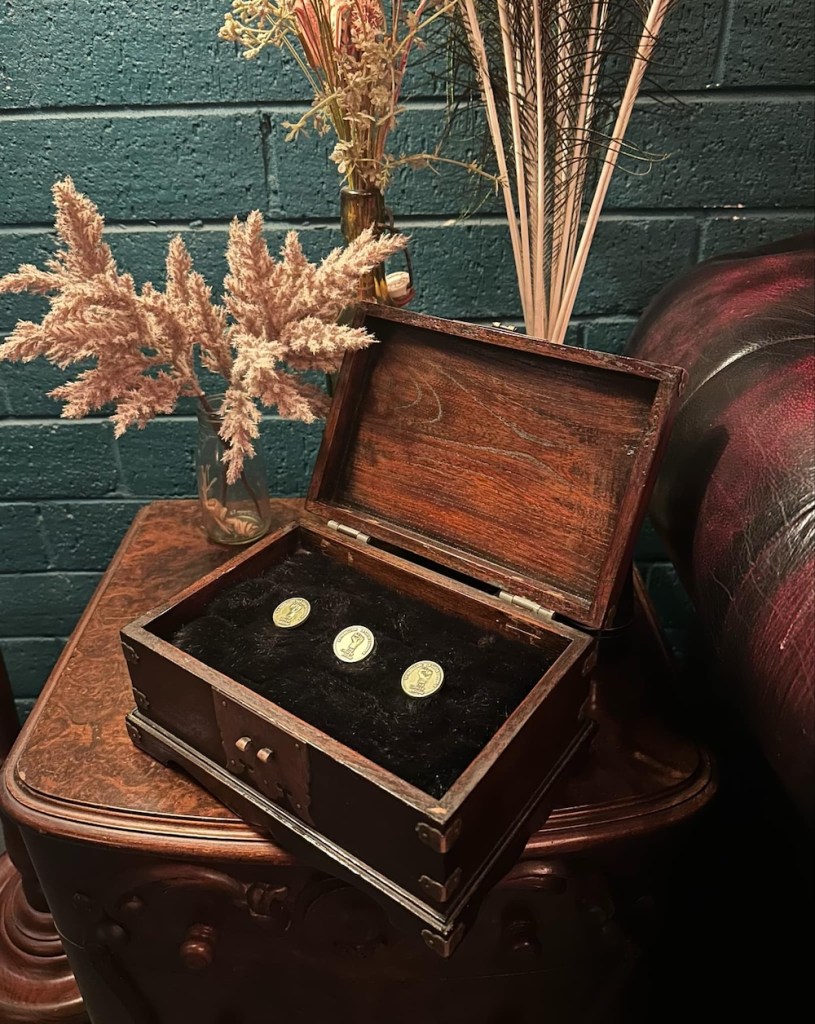
In Sydney, Australia, The Cipher Rooms takes the presentation a step further, placing a pin for each player in a velvet-lined wooden box at the end of the game. This small yet meaningful gesture clearly communicates: “This is a gift for you, and I’ve taken the time and care to make it special.”
Gifting pins like this is thoughtful and generous, though by no means necessary. It’s reasonable to treat pins as premium swag that is available for optional purchase, and to acknowledge that not every player will want one. If anything, giving a pin (or any other swag) to each player risks being wasteful for players who don’t want it but might take one anyway to be polite.
A nice display goes a long way. Players are more likely to know your pins exist if they’re pinned to a small corkboard or worn by gamemasters, rather than sitting in their plastic packaging in the back of a display case.
The focus on presentation continues past the point of sale. Make pins that your players will proudly display, and even share on their social media. Don’t pack too much text onto the pin itself, but consider including more info — including your social handles — on the cardboard backing card. If you make new merch, show it off, and don’t forget to upsell returning players.
Design pins that are cool enough to make someone like me transform the box in the back of my closet into a conversation piece.


![Mothman Themed House AirBnB Escape Room [Review]](https://roomescapeartist.com/wp-content/uploads/2026/02/airbnb-mothman-house-2.jpg)
![The Escape Game – Legend of the Yeti [Review]](https://roomescapeartist.com/wp-content/uploads/2026/01/legend-of-the-yeti-legend-of-the-yeti-3.jpg)
![Studio Escape – Madame LeClaire and the Seance of Death [Reaction]](https://roomescapeartist.com/wp-content/uploads/2026/01/madame-leclaire-madame-leclaire.jpg)
Leave a Reply