
Your Body is the Controller
From the heart of the Kabukicho entertainment district in Shinjuku, Tokyo, Japan, The Tokyo Matrix is back with their sophomore game, Dungeon∞Spiral. (Yes, they use a ∞ in the name, but hereinafter written as Dungeon Spiral.) Much like the game it replaced, Sword Art Online – Anomaly Quest, Dungeon Spiral is a digital-physical hybrid game that lives somewhere between a challenge arcade and a traditional escape room.

In Dungeon Spiral, parties of 2 or 3 players make their way through 4 (or 6) Quests, which contain athletic, mental, and dexterity challenges through which players take down dungeon monsters over about 45 (or 60) minutes of play. Dungeon Spiral is well designed with throughput in mind to keep delays to a minimum. Quests 1 and 4 each have identical rooms with the same content. Quest 2 has multiple stations available for each challenge. In Quests 3 and 5, teams are playing different challenges in parallel, with distribution managed by challenge assignment. Defeated monsters drop gold medals, which serve as both a score and the key to access Quest 5 and the Final Quest.
No Japanese Required
Dungeon Spiral is fully localized for English players. All the digital interfaces are in English and there are professional-quality voices for characters and introduction videos. The staff is prepared to assist players who do not speak Japanese through the sign-up and setup processes. All the permanent signage contains at least English and Japanese. Signs with safety information additionally include Chinese and Korean, which are planned as future game language options.
Here Comes a Physical Challenge
In contrast to challenge arcade experiences like Boda Borg and Level 99, where some content is inaccessible to players without sufficient levels of fitness, flexibility, or strength, all able-bodied players will be able to complete all of Dungeon Spiral’s trials. Physical ability is an advantage to performing well, but we never felt as if a good score would be out of reach due to our party’s physical capabilities. If you have specific physical limitations, I recommend contacting the company ahead of time for details on accommodations.
That said, be prepared to get your heart rate up! Each quest lists the estimated calorie burn and some of them are a lot for a few minutes. There are considerately placed benches for resting, as well as cooled water. The water available in the game is cheaper than buying one from the lobby vending machine – no gouging here. Of particular note is one of the Quest 3 possibilities (pictured below) which contains this rare example of an immersive space suitable for running. A perfect score requires making it to the fourth panel and back in ~6 seconds, be quick!

Form Your Avatar Party
During the setup process, each player chooses a sports avatar, or GITAI, from six possibilities, each of which has three strong points and two weak points across six statistics. In the image below you can see that we chose a fencer and a karate fighter. The game is never explicit about the effect of the various stats, though my expectation is that they affect things you would logically expect them to: higher attack (ATK) for more damage, higher stamina (STM) for more health, etc.
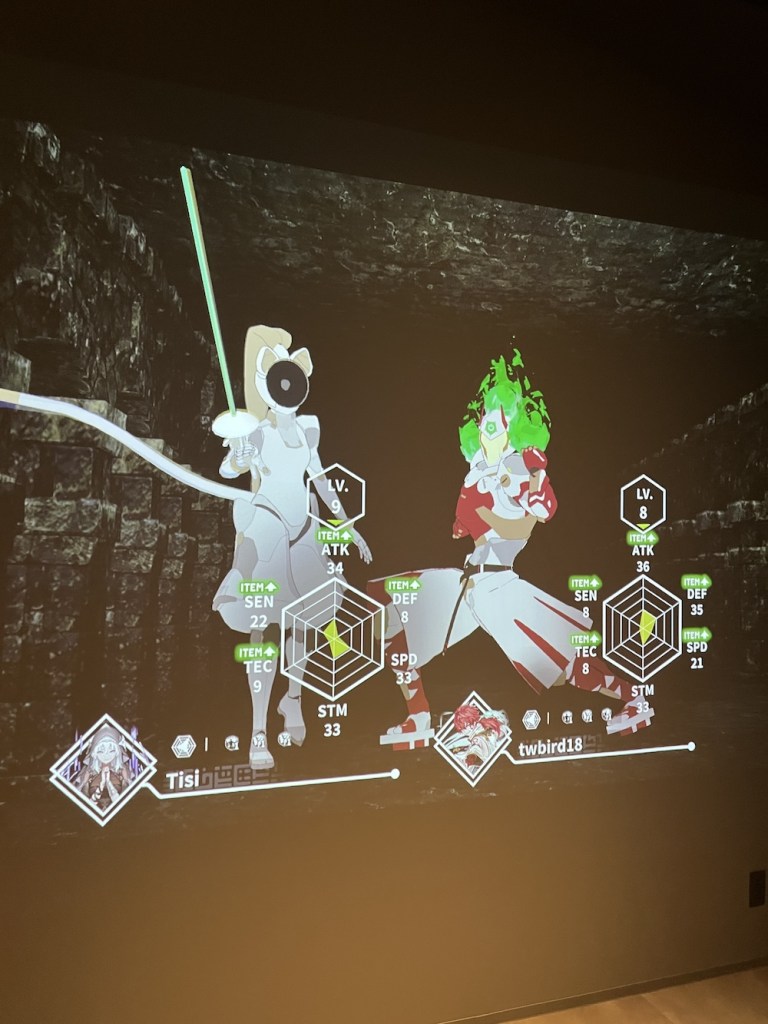
Each player then chooses a buddy character from three possible choices, each with different skills. We felt like Migdal, the healer character seen on the bottom left above, saved us a few times, so I recommend that someone in the party takes her along. Buddy characters cost 500 yen (~$3.40 in September 2025), which means first time players have to pay that on top of the standard 2250 yen ($15.20) game fee for adults, or 1250 yen ($8.45) for children under 12.
Finally, each player applies stat booster items from their inventory. New players get a full set of items, and each challenge completed in the game drops a random item. There was previously a microtransaction model around the items, but it has been removed. Unlike in Anomaly Quest, where items had huge gameplay effects, here they merely supply small stat increases, which is, in my opinion, a pretty big improvement. Items are single use, but apply to all Quests for an entire playthrough.
Your Medals or Your Life
Also changed from Anomaly Quest is the difficulty level for the standard quests. In Anomaly Quest, the difficulty was set high, failure meant game over, and players were intended to play repeatedly to earn further progress. In Dungeon Spiral, everyone is guaranteed to play through all the quests they have paid for. Whenever the party’s health (HP) meter is depleted, your guide Geo is happy to refill your health in exchange for a handful of your hard-earned gold medals, which means you’ll get a lower score, but you can keep playing.
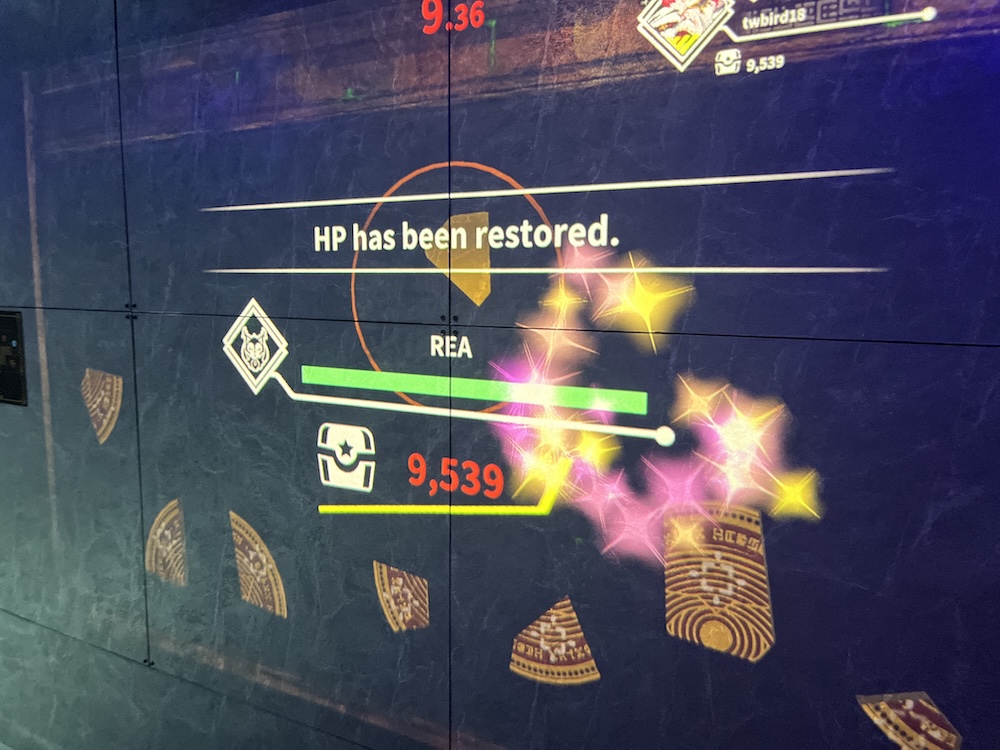
This time, The Tokyo Matrix hopes that players will be motivated to improve, level up, and chase high scores because playing the game is fun rather than punishing. I think a lot of parties will be motivated to do at least a second playthrough once they have a feel for things, so my recommendation would be to plan for 2-3 playthroughs per visit.
Who Needs a Magic Wand When You Have Fists?
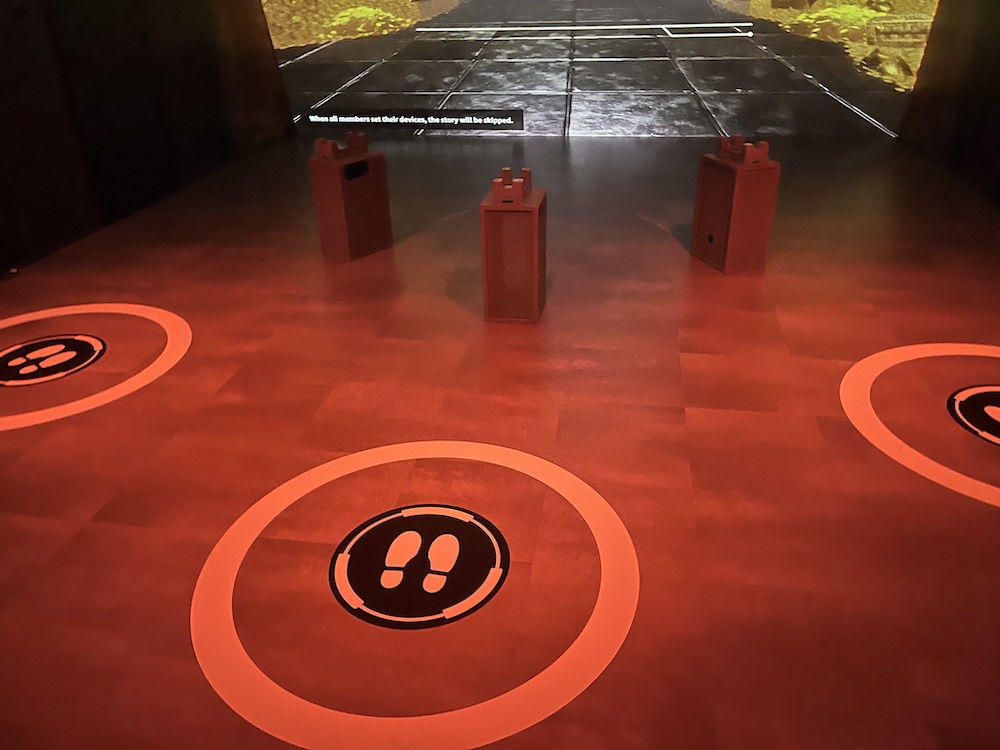
For the first quest, players have to use their avatars to fend off waves of digital enemies projected onto a huge wall. Avatars are controlled with the players’ own bodies, utilizing motion tracking technology. Throwing punches unleashes energy bolts to attack creatures and collect power-ups, a defensive shield can be activated by raising both arms in a guard position, and once a player’s energy is full, they can unleash a super blast.

Direction is controlled by the angle of the player’s torso, not the punch direction, which takes some getting used to. Also tricky is not getting too into the movements and accidentally moving out of the motion detection circle without realizing it. But the fact that this was a problem for us means that we were into it!
The Midas Touchscreen

For Quest 2, there are three touch screen digital challenges available, the only single player portion of Dungeon Spiral. For parties of two, the system assigns two of the three to be played, but the choice of who plays what is up to the players. Each one starts out simple, but increases in difficulty with each wave’s completion. We felt like our technique on these improved a lot on subsequent plays.
What Challenges Await Our Heroes This Time?
Quest 3 is the main event in the standard game for many players, us included. The game will automatically select three of the eight challenges for players to tackle. We played three times, and the system seemed to choose challenges we had not played until we had played all 8. There is a nice variety of activities here to ensure all your muscle groups are getting some attention. Possibilities include a giant puzzle, combat jumping, catapult crank and rope pull, hammer hammer revolution, exercise bike steamroller, and, of course, the monster dash mentioned previously. (They have more thematic official names.)
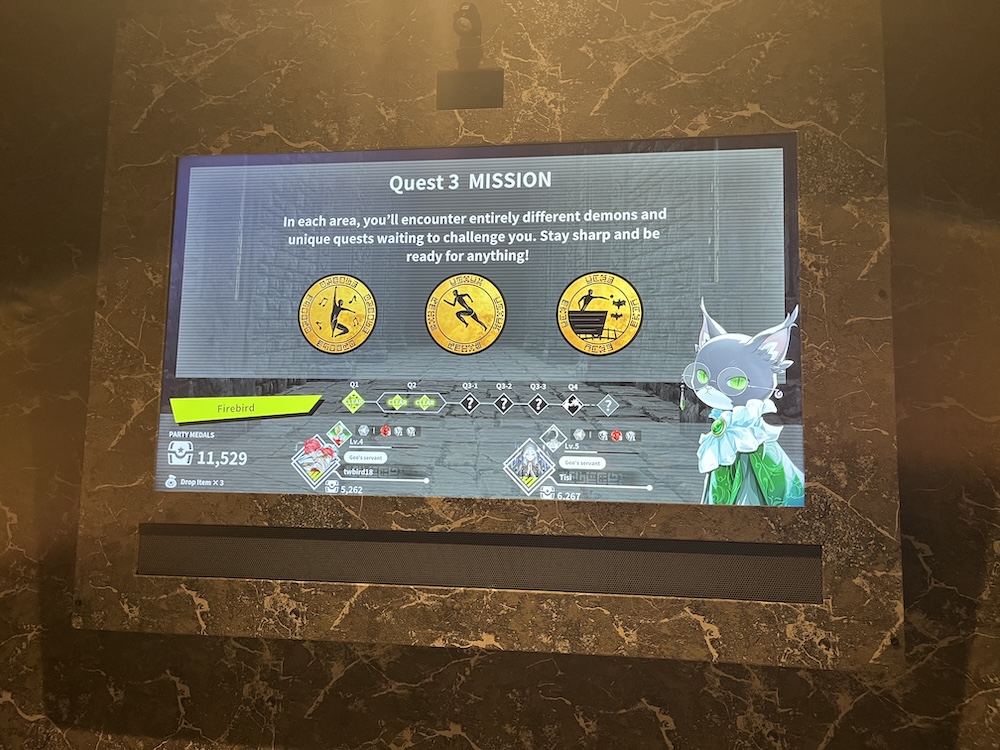
Parties can complete the selected games in any order, which provides an additional buffer against downtime. The order doesn’t have a difficulty effect like it did in Anomaly Quest, so players are free to choose based on whatever criteria they want. We appreciated the ability to put a strength or dexterity challenge in between more cardio focused ones.
Each Quest 3 challenge featured one or more waves of monsters followed by a boss attack, within a fixed overall timer. Proficient play allows players to clear the normal waves quickly and have more time to deal with the boss. If the boss is not defeated in time, it escapes along with the large amount of gold medals it would have dropped, but the party can continue. In one case we were able to achieve an A rank even without defeating the boss, so do your best and don’t sweat how the ending goes. Some of the boss rounds were quite challenging, though they would certainly get easier over repeated plays.
Whac-a-Snake
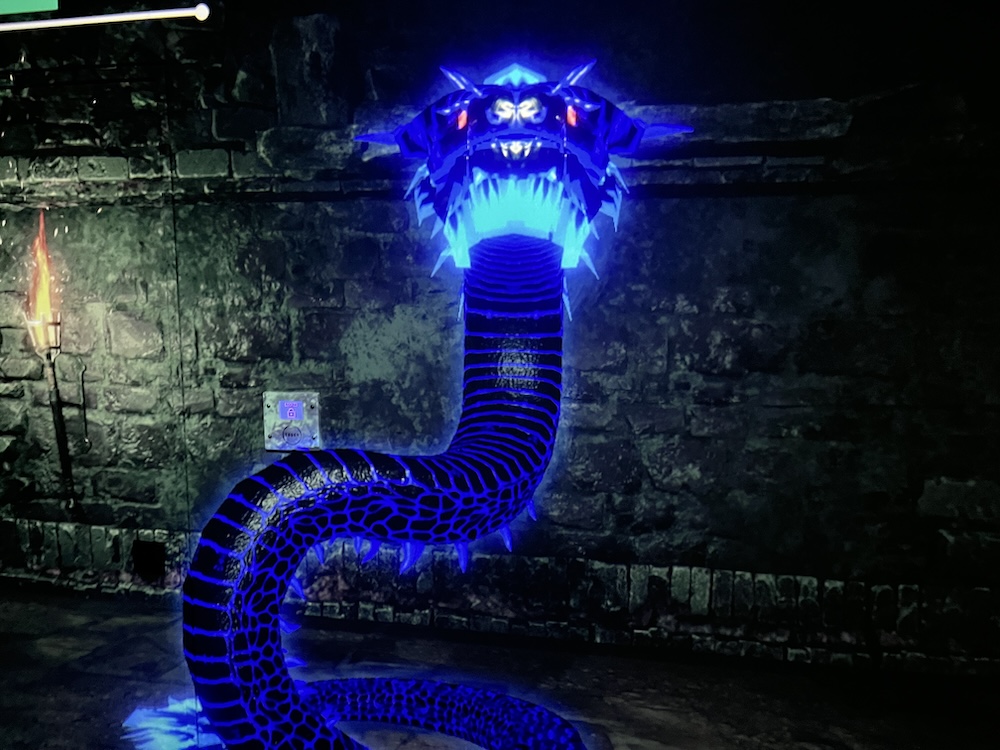
Once all three challenges for Quest 3 are complete, parties move on to the final quest of the standard run: snakes. Lots of snakes. And they all need whacking! In a room-scale projection version of Whac-A-Mole, or in its original Japanese, Mogura Taiji (Mole Buster), players run around tapping their device on the wall to smack snakes before getting bitten, until the big boss snake appears for a final showdown. Once the boss is defeated or driven off, parties are then presented with a fork in the road.
Insert 10,000 Gold Medals to Continue
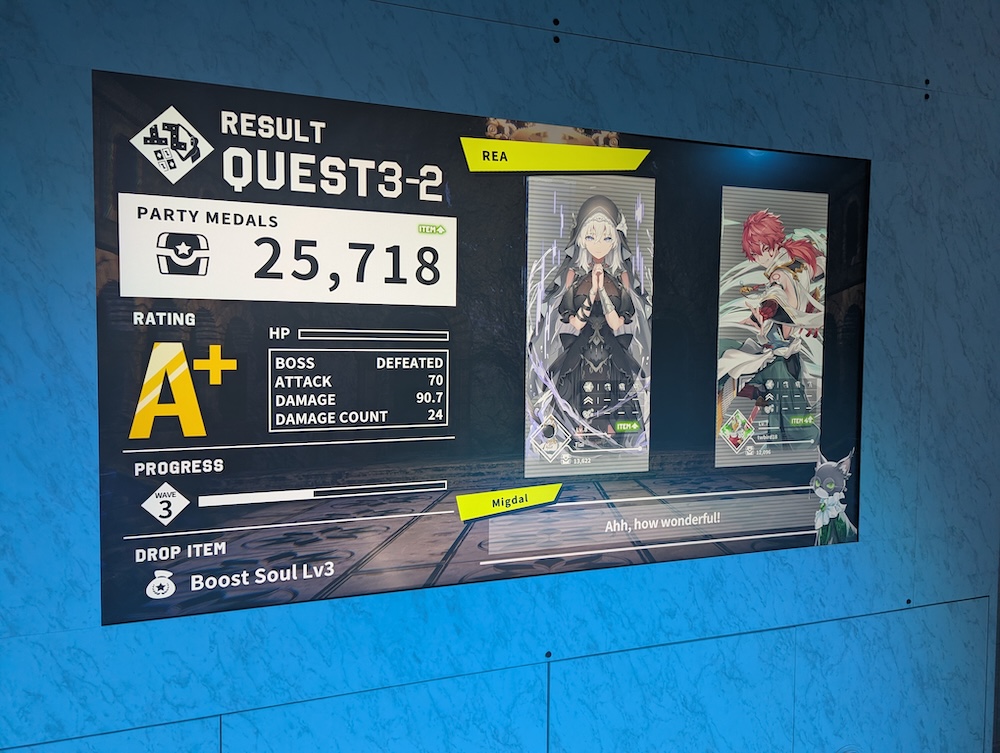
All along the party has been racking up gold medals, and besides bragging rights and ranking, here’s where they can be used. Once the giant snake has been fought, the game will ask if players wish to end the game here or try to tackle more challenging and rewarding quests. Continuing costs 10,000 medals per party member. To put this in some perspective, a player with good performance across the first four quests will net over 5,000 per run, allowing players to play the extra quests for free as often as every other time. Quest 5 and the Final Quest add about 15 minutes, extending the overall playtime to a full hour.
There is also an option to make up the difference with real money, between 300 and 1,250 yen ($2-$8.50), depending on how short the party is. If you want to learn more about the tower and what you as a party have truly gotten yourselves into, you have to play the Final Quest, so I recommend parties play on at least once during your visit.
Welcome to Hell: Frozen Over and Standard Versions Available
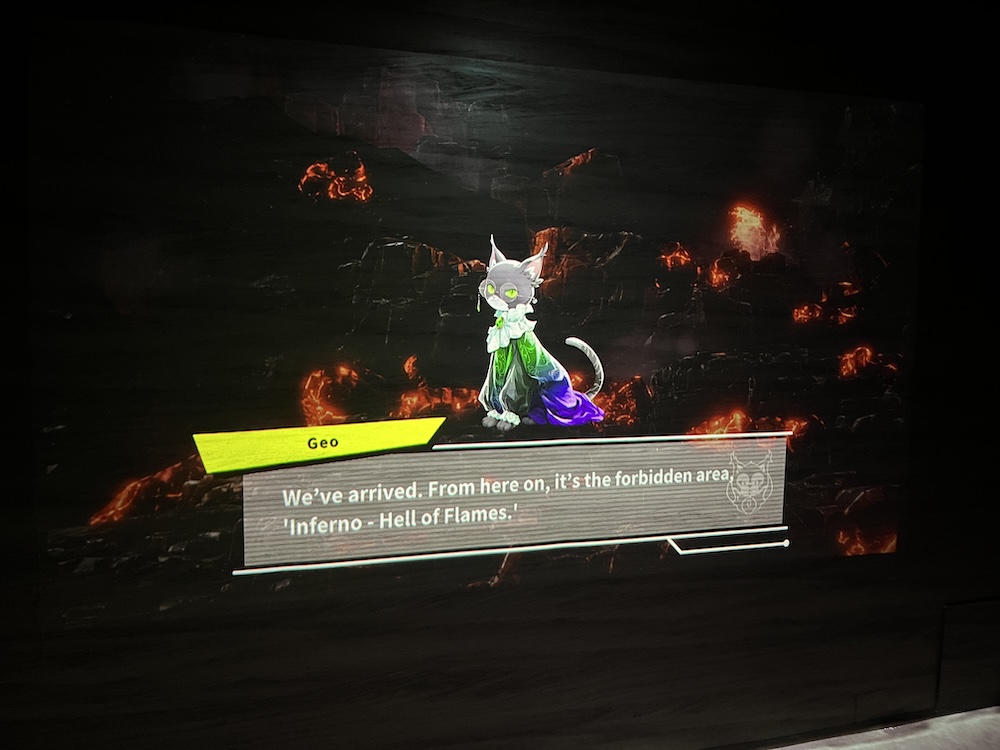
Quest 5 has two different challenges: Inferno and Cocytus, fire and ice, one of which will be chosen by the game. Inferno was perhaps the most “Nick Arcade” experience we’ve had so far. Players move around the room as the game utilizes motion tracking to allow players to intercept fireballs and collect powerups as they hold off a fiery horde. Good performance here is more lucrative for gold medals than the standard quests.
Boxing Without a Safety Net
It’s no surprise that a boss fight awaits players at the top of the tower in the Final Quest. This is also the only portion with a fair bit of story content. The motion fighting system from Quest 1 returns and this time the game means business. The protection that previously provided unlimited life is removed, so players only get one shot at this pretty tough boss fight.
It’s clear that players are not expected to win the first time though, as a loss leads not to a “bad” ending or a simple game over, but to what I’m choosing to call a “normal” ending. Presumably there’s a “true” ending to be had for players who can achieve victory through repeated play to gain experience, leveling up both players and their characters.
Toyko Dungeoneering
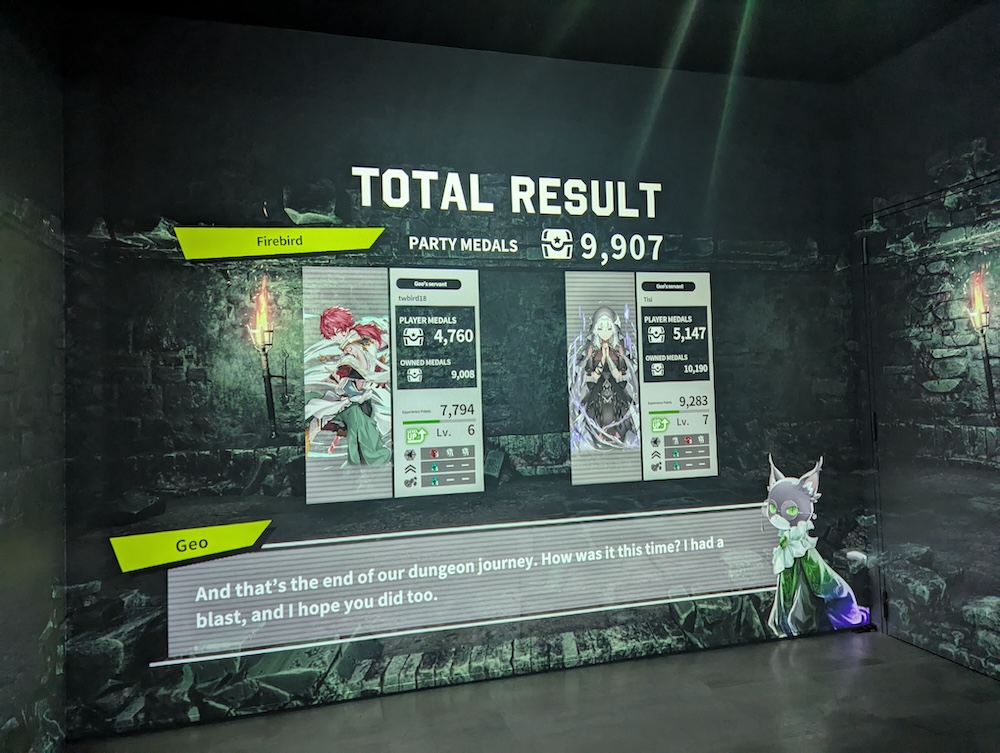
We had quite a bit of fun with Dungeon Spiral. It’s a very original format, and is executed at a high technical level. Some similar experiences have had problems with wear and maintenance issues, even fairly early in their life cycles, but everything at Dungeon Spiral was in great shape and fully operational after five months of play. For players interested in a linear quest experience with some physicality, Dungeon Spiral is worth a trip to Shinjuku if you find yourself in Tokyo. And if you’re playing English escape games across the street at Tokyo Mystery Circus, it’s an easy add at a very reasonable price.
Disclosure: The Tokyo Matrix provided media plays for this game.
![Mothman Themed House AirBnB Escape Room [Review]](https://roomescapeartist.com/wp-content/uploads/2026/02/airbnb-mothman-house-2.jpg)
![The Escape Game – Legend of the Yeti [Review]](https://roomescapeartist.com/wp-content/uploads/2026/01/legend-of-the-yeti-legend-of-the-yeti-3.jpg)
![Studio Escape – Madame LeClaire and the Seance of Death [Reaction]](https://roomescapeartist.com/wp-content/uploads/2026/01/madame-leclaire-madame-leclaire.jpg)

Leave a Reply