
Most crowdfunded escape rooms fail… but does the data reveal ways to improve the odds?

Hypotheses
- Most crowdfunded escape rooms fail.
- Crowdfunding escape rooms has had diminishing returns over time.
- Most successful escape room crowdfunding campaigns set a low monetary goal.
Methodology
Since 2013, there have been 84 escape room Kickstarter campaigns. We collected the following data points for each campaign:
- Campaign Name
- Close Date
- Location
- Success/Fail/Cancel
- Campaign Goal
- Earned Money
- Number of Backers
- Tabletop?
We converted all local currencies to US Dollars using the conversion rate for the date that the campaign closed.
We removed Kickstarters for tabletop escape room games from the analysis below. In doing so, we removed the most significant outlier from the data.*
We focused this study on Kickstarter, the most widely used crowdfunding platform for escape rooms. This limited the variables in the data set. Note that there have also been escape room campaigns on Indiegogo and GoFundMe.
Analysis
Of the 84 escape room Kickstarter campaigns analyzed, 20 completed successfully. That’s a 25% success rate.
Over time
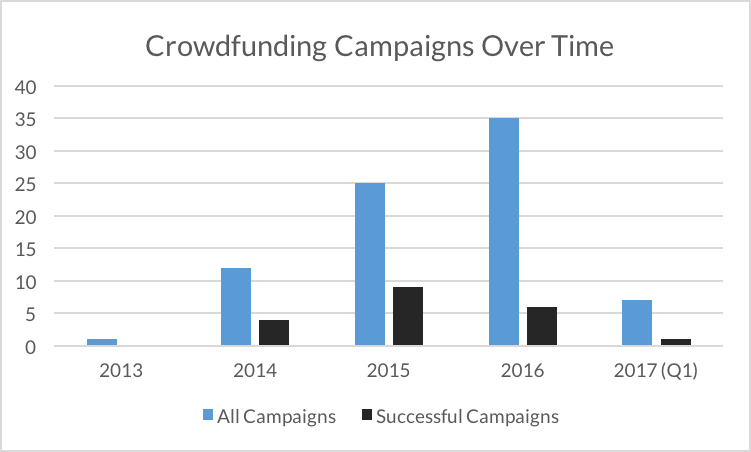
Each year there have been more Kickstarter escape room campaigns. (Note that the data for 2017 is only for the first quarter.) On the flip side, each year fewer of these campaigns have been successful.
Geography
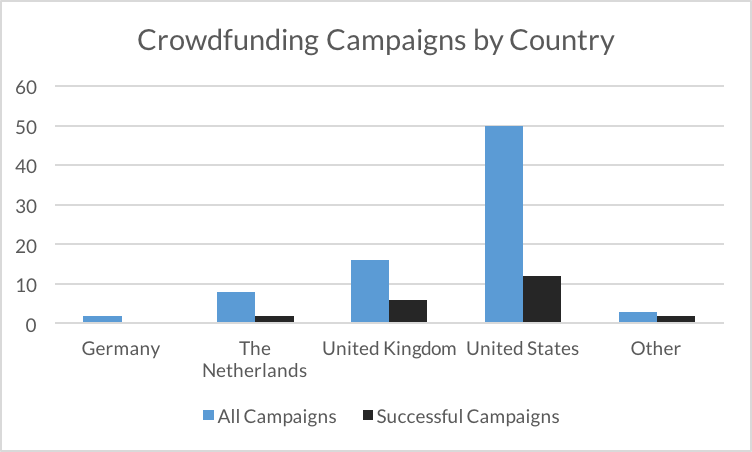
Escape rooms in the United States used Kickstarter the most. This was followed by the United Kingdom, The Netherlands, and Germany, in that order. There was one campaign each from Australia, Belgium, and Canada.
Money
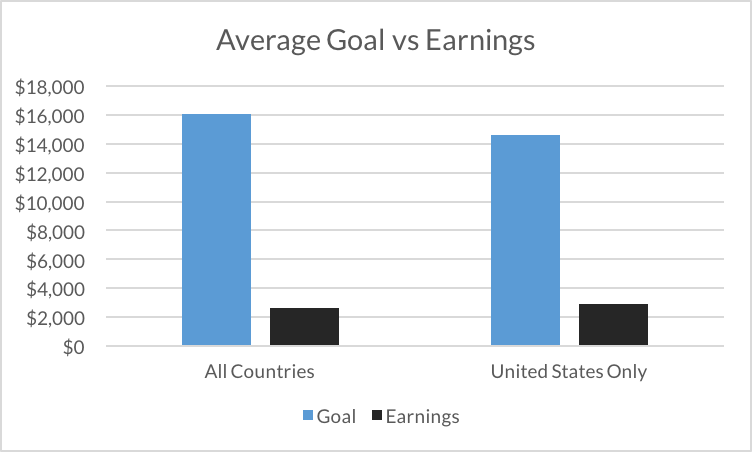
Most escape rooms didn’t even come close to achieving their campaign funding goal. In this regard, the United States was no different from any other country.
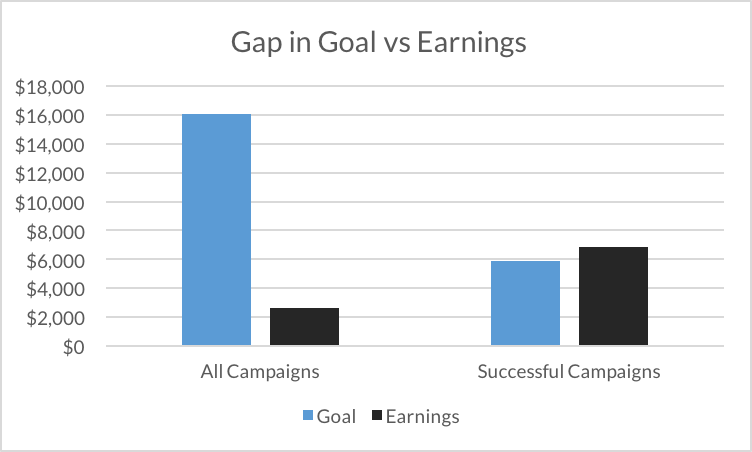
Successful campaigns set lower goals. On average, the goal of successful campaigns was 1/3 of the dollar value of campaigns overall.
Most successful campaigns barely achieved their funding goals. On average, successful campaigns met their funding goal with 119%. More than half of these made their goals with less than 110%.
Inference: This likely means that many of these campaigns were pushed past their funding threshold by the game’s creators. It’s likely not a coincidence that most successful campaigns just barely exceeded their goal.
Backers

On average successful campaigns had more than twice as many backers as campaigns over all. They were likely reaching beyond their family and friends.
Canceled campaigns
5 campaigns were canceled prior to failure. In one instance, the company relaunched a new campaign after the canceled one. The original campaign set a goal at $7,500. When they tried again, they set a more attainable goal of $1,500. They successfully raised $1,520. To succeed, they lowered the goal and then just barely attained it.
Kickstarter’s stats for all industries
According to kickstarter’s published stats (which are continually updated), 35% of all launched campaigns have successfully completed.
A general category, “games” is right in line with this at a 34% success rate.
I initially thought that it may have been the limited geography of escape rooms that resulted in a lower success rate, but the theater category seems to disprove that assumption. Kickstarters for theater complete successfully 60% of the time.
My assumption is that escape rooms are less well known and not viewed as an inherent public good in the same way as theater.
There are a lot of reasons why Kickstarter campaigns fail. Given the general Kickstarter trends, escape room campaigns have room for better performance.
Success stories
These were the 5 most successful escape room Kickstarter campaigns:
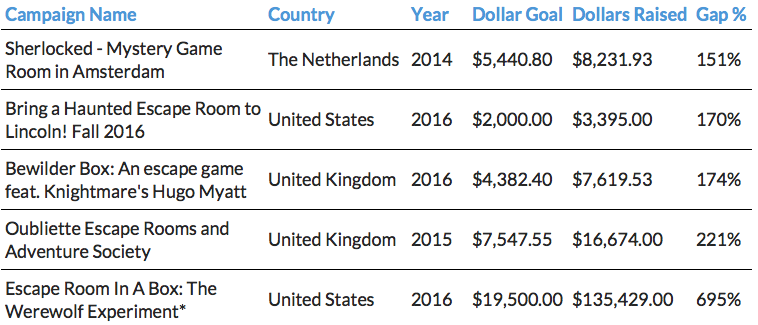
With one exception, they had modest goals relative to the data set.
The earliest one from 2014 was Sherlocked, which we visited in Amsterdam and loved. Most of these were more recent. Perhaps they looked at the data before they dove in?
The outlier of the outliers
Escape Room in a Box: The Werewolf Experiment has been the most successful escape room Kickstarter campaign to date. It raised an impressive $135,429, which is 695% of the original campaign goal.
Escape Room in a Box co-creators Juliana Patel and Ariel Rubin spent 3 months researching and preparing their Kickstarter campaign before it launched. They looked for resources within the established board game industry. They recommend the following:
Juliana and Ariel also recommend that before launching a Kickstarter, you join the community, both locally and on the internet. If you engage with the community, you’ll have a better idea of what the players want and how to differentiate your experience from what’s already available.
Conclusion & recommendations
Three quarters of crowdfunded escape room attempts on Kickstarter have failed.
Most successful crowdfunding campaigns set a low monetary goal and barely achieved it.
The successful crowdfunding campaigns reached a larger audience of backers.
This leads us to believe that crowdfunding might be most efficient as a marketing and pre-sale tool for escape rooms.
Think twice about crowdfunding your entire escape room venture. It’s a lot of work and you certainly aren’t guaranteed success. Do your research and use crowdfunding strategically; it’s not a lottery ticket.


![The Escape Ventures Winter Garden – Haunted Harbor [Review]](https://roomescapeartist.com/wp-content/uploads/2026/02/the-escape-ventures-winter-garden-haunted-harbor-1.jpg)
![Studio Escape – For Queen & Country [Reaction]](https://roomescapeartist.com/wp-content/uploads/2026/01/studio-escape-for-queen-and-country.jpg)
![Pop Up Escape – Death & Taxes [Review]](https://roomescapeartist.com/wp-content/uploads/2026/02/death-taxes-death-taxes-3.jpg)
![Brain Games – Flynn’s Arcade [Review]](https://roomescapeartist.com/wp-content/uploads/2026/01/brain-games-flynns-arcade-1.jpg)
Leave a Reply