
Soul cycling
Location: Boston, MA
Date Played: February 25, 2024
Team Size: 3-8; we recommend 2-4
Duration: 60 minutes
Price: $39.99 per player for a public booking; $100 base rate + $27 per player for a private game
Ticketing: Public, or private for an extra charge
Accessibility Consideration: Narrow passageway, but there is a way around
Emergency Exit Rating: [A+] No Lock
Physical Restraints: [A+] No Physical Restraints
REA Reaction
Witching Hour may well be Trapology’s strongest overall offering yet.
If this were my first escape room, I’d instantly be hooked: the scenery was striking and extended far beyond the opening scene, the puzzles were cleanly clued and fit the space perfectly, and there were numerous satisfying visual and tactile reveals.
The environment encouraged adventure without requiring physical exploration like in Hotdog Heist. The narrative hook was also a bit less out-there compared to Hotdog Heist (though those are precisely the reasons why I personally preferred Hotdog Heist.)
Trapology clearly pushed their skills on multiple fronts, and the extra effort paid off — especially in catering to a general audience.
One area in which Witching Hour still showed room for improvement was narrative. We were offered an elaborate backstory at the start of the experience, as well as an optional app-based interactive fiction prequel called Firefly (more on that at the end). And yet, few of these plot points or characters actually mattered or had any presence during the game itself.
If you are new to escape rooms, I recommend Witching Hour as one of your first adventures. For more experienced players, considering Trapology’s recent switch back to public bookings, it’s up to you whether Witching Hour is worth the high price of a private game for a small team.

Who is this for?
- Scenery snobs
- Adventure seekers
- Any experience level
Why play?
- Atmospheric, smooth experience
- Exciting reveals, especially for newer players
Story
Our friend Jamie had gotten lost in the woods, and her soul had been snatched by a witch. It was up to us to find the witch’s lair and retrieve Jamie’s soul before it was too late.
Setting
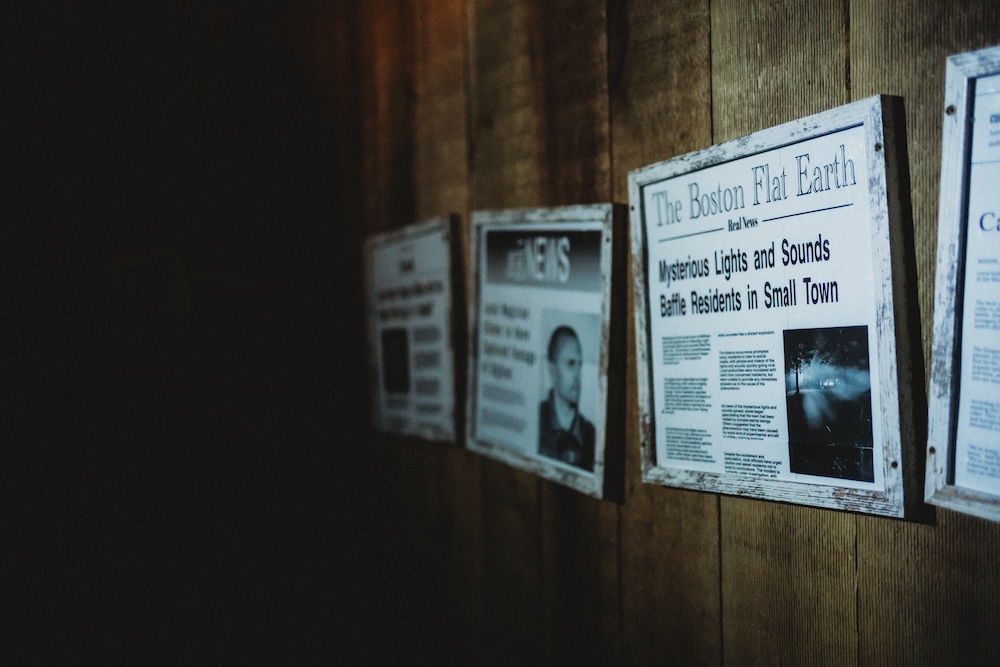
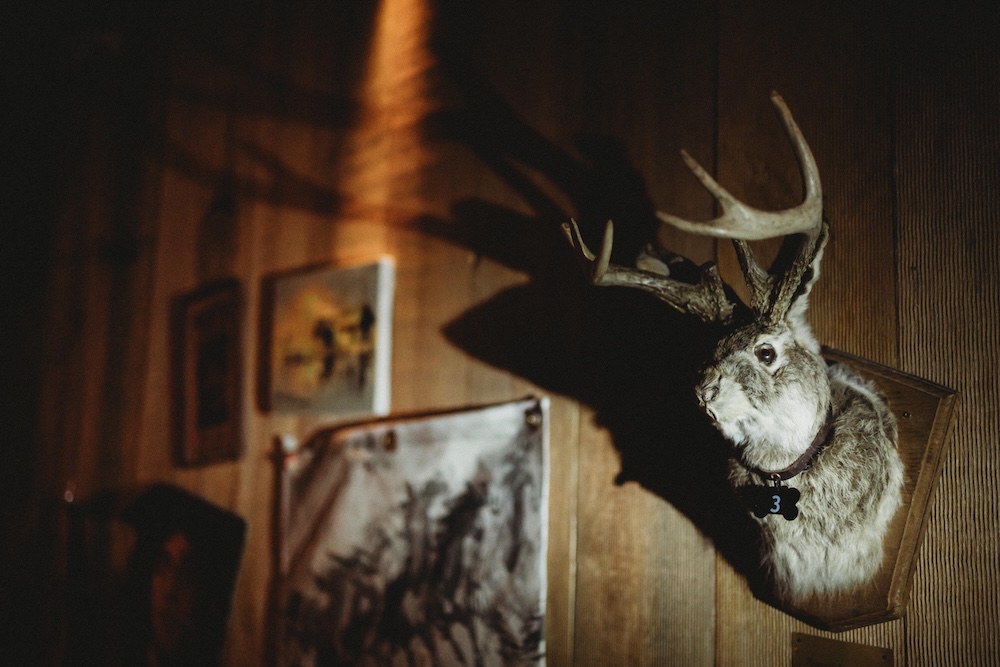
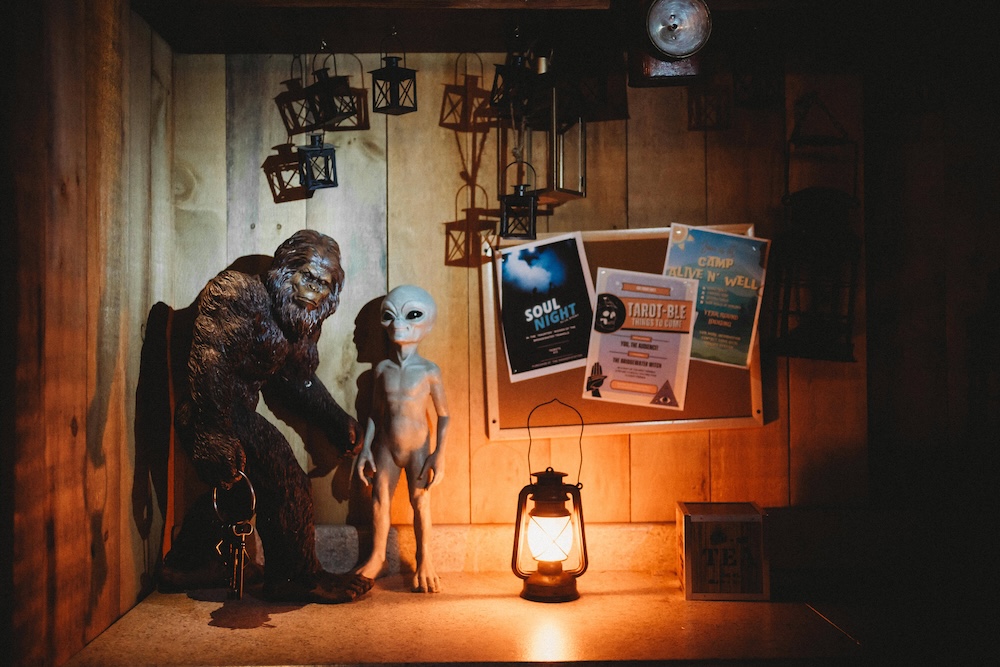
Witching Hour began in a rustic wood-paneled wooden cabin covered in campy cryptozoological ephemera. Somewhere beyond, the witch’s lair awaited. Throughout all areas of the set, we were fully immersed in a high level of detailing and realistic textures and materials.
Gameplay
Trapology’s Witching Hour was a standard escape room with a low-to-moderate level of difficulty.
Core gameplay revolved around searching, observing, making connections, and solving puzzles.
Analysis
➕ The scenery of Witching Hour was atmospheric and immersive. As the set progressively opened up, there was plenty to explore. This was some of Trapology’s finest set design yet across all of their experiences.
➕/➖ The gameplay was well signposted and flowed smoothly. Certain puzzles prompted environmental ahas and satisfying tactile interactions. For newer players, this would make a fantastic introduction to escape rooms. For more experienced players, there were opportunities to add some additional layers or just a greater density of similarly streamlined puzzles to make for a fuller-feeling experience.
➕ Witching Hour was thoroughly tech-driven, with thematic inputs and effects that were pretty consistently reliable.
➕ There was a decent amount of searching, yet it all felt fair and fun.
➖ A framing device was appropriately sized, but would have benefited from some magnets to keep things in place. Additionally, there was an opportunity to add some subtle cluing rather than requiring a brute-force solution.
➕/➖ A creative use of stationary blacklight didn’t quite extend far enough to work on its own, requiring additional gamemaster cluing.
➕ A meta sequence of layered puzzles showcased some of the strongest and most interesting puzzle design of the game, leading us to revisit new layers of the environment in creative ways.
➖/➕ Witching Hour attempted to tell a story, but little of this translated into the game itself. With minimal presence of either the witch or our missing friend throughout the game, it was all too easy to forget that these characters mattered. Our actions in the finale tied the story together, though with no tangible resolution around the friend we’d attempted to save. Nonetheless, the narrative premise had potential, and we appreciated a sprinkling of humorous moments throughout the game.
Firefly Prequel
Along with the in-person escape room Witching Hour, Trapology also released a narrative prequel in the form of an app-based interactive fiction game called Firefly. It is available on the App Store and Google Play for $2.99.
I really wanted to like Firefly. It looked fantastic, with a slick interface and some neat effects. It attempted to pull off the sort of creative pre-game world-building that I hope to increasingly see from more escape rooms.
And yet, Firefly was a massive slog. The story dragged on, binary choice points usually felt meaningless, and the character you’re texting with repeatedly goes “offline” for indeterminate amounts of time. This extra waiting, initially with no option to fast forward, aligned poorly with my cadence of checking my phone. It took multiple days for me to get to the end, making this impractical for most players to finish if they’re booking Witching Hour even slightly last minute. This “offline” waiting added no real value or meaningful realism after the first couple of waiting periods, and only after completing the full game are you granted an option to skip forward through the waiting.
So, what could have fixed these issues?
- Add more gameplay. Escape room players want to play, and Firefly was bloated even as pure interactive fiction. I counted 2 simple puzzles. A few more puzzles and a few fewer words would go a long way. The narrative choice points also felt arbitrary and too often semantically equivalent. These branches were missed opportunities for gamification.
- Nix the waiting. I get the attempt at making the texting seem realistic, but in practice, it became annoying almost immediately. An in-game clock that speeds forward could have accomplished a similar effect.
- Make it meaningful. Playing through Firefly didn’t add anything to my experience in Witching Hour. Especially if players are paying extra for this prequel, add an extra code or narrative detail into Firefly that gives players access to a bonus puzzle or secret interaction in Witching Hour.
Tips For Visiting
- Witching Hour was lightly spooky but never scary.
- Parking: There is metered street parking or a garage with an entrance around the corner on Boylston St.
- Public Transit: Take the T (Green Line) to Boylston Street Station.
- Food: There are lots of options in walking distance.
Book your hour with Trapology’s Witching Hour, and tell them that the Room Escape Artist sent you.
Disclosure: Trapology comped our tickets for this game.
![Brain Games – Flynn’s Arcade [Review]](https://roomescapeartist.com/wp-content/uploads/2026/01/brain-games-flynns-arcade-1.jpg)
![Mothman Themed House AirBnB Escape Room [Review]](https://roomescapeartist.com/wp-content/uploads/2026/02/airbnb-mothman-house-2.jpg)
![The Escape Game – Legend of the Yeti [Review]](https://roomescapeartist.com/wp-content/uploads/2026/01/legend-of-the-yeti-legend-of-the-yeti-3.jpg)
Leave a Reply