
A crafty set of puzzles
Location: at home
Date Played: November 29, 2025
Team Size: 1-6; we recommend 2-3
Duration: about 90 minutes plus setup time
Price: $29
REA Reaction
Mystery Locks’ The Alchemist’s Box was a combination papercrafting activity (if you opt for the full experience setup) and a tabletop puzzle game. Available only as a printable game, some level of arts and crafts was necessary to play this game, but the effort was worthwhile.
We chose to set up the game using what the creators called the “full experience” – using all of the provided assets. For about an hour before playing, we crafted themed envelopes that contained story cards, puzzles, and hints. The final piece was the game’s centerpiece, a cube that would be heavily involved in nearly all of the puzzles. Because this assembly portion provides the opportunity to know which items are in which envelope, I recommend – if time permits – assembling and then waiting a few days before playing to allow yourself to forget any behind-the-scenes knowledge you may have accidentally picked up.
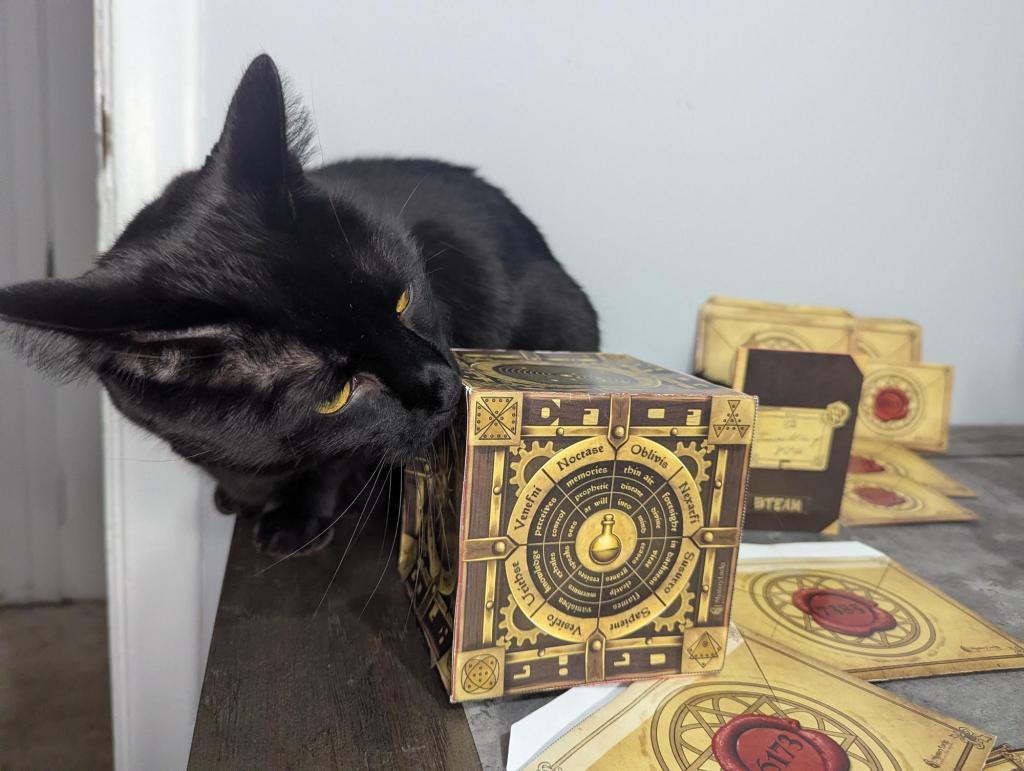
The Alchemist’s Box was heavily focused on making connections between different sources of information. The cube played a central role in this, both from a mechanical perspective and a narrative one. This led to some very satisfying aha moments in the early part of the game as we discovered not just how a single puzzle worked but how the whole game would flow. The downside was that as the game continued on, there were fewer opportunities for those aha moments as the way ahead became more focused.
The highlight of The Alchemist’s Box was the meta puzzle at the end. After making connections faster and faster as we progressed through the game, we stumbled and slowed at the meta. But when the breakthrough happened after some trial and error, the solution was a truly gratifying moment. It was a great capstone on an already enjoyable game. If you like spending time crafting and solving inventive puzzles, The Alchemist’s Box might be a good choice for you.
Who is this for?
- Puzzle lovers
- Anyone into papercraft
- Best for players with at least some experience
Why play?
- Well-designed components you get to assemble yourself
- An excellent meta puzzle
Story
A letter set us down the path to find Isaac Newton’s final experiment, the Philosopher’s Stone. We needed to parse through his notes and diagrams to find it.
Setup
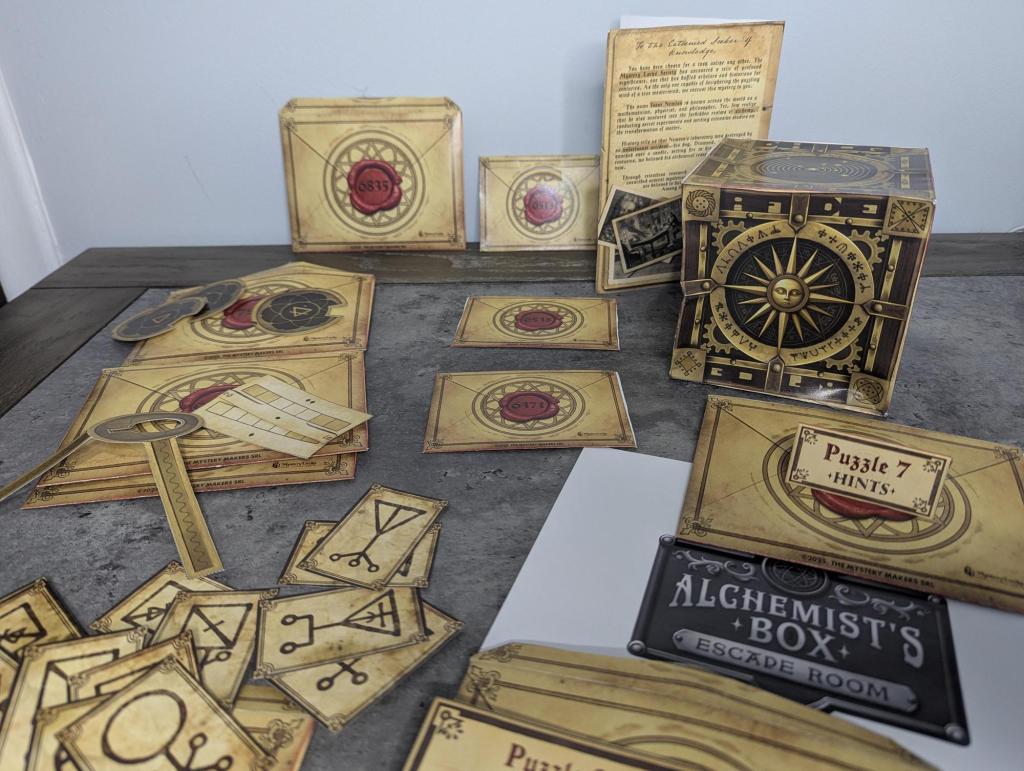
The Alchemist’s Box took a good amount of setup to prepare before play could begin. Because this was a print and play game, everything had to be assembled prior to solving. The instructions provided for three levels of setup, starting with the full experience where every asset was printed and assembled. Players could reduce the items to assemble and therefore the time to set up in a few ways, for example by replacing the themed printable envelopes with standard envelopes they already owned.
Full setup took about an hour to cut, fold, tape, and glue everything just right. The provided instructions were very detailed and made the process relatively simple and streamlined. Once the envelopes were filled with puzzles, stories, and hints and the centerpiece of the game, the paper cube, was assembled, it was time to play.

Gameplay
Mystery Locks’ The Alchemist’s Box was a standard play-at-home game with a moderate level of difficulty.
Puzzles were heavily focused on making connections as well as decoding.
Analysis
➕ Phenomenal meta puzzle to end it. One of the best coming together moments of any paper puzzle that I have played.
➖ Some fonts, especially on the hint cards, could be a little larger to increase readability.
➕ Extremely detailed setup instructions and a fully detailed walkthrough were included.
➖ The progressive hint system was helpful when needed, but could use more granularity. Often some of the steps felt too large.
➕ The low price point makes this game a good bet for the player on a budget.
➕/➖ Having to assemble the game at home made it cheaper and easier to ship (all digitally) but added a significant setup time to the playthrough, and also set up opportunities to gain information you should be gaining through gameplay instead (e.g. recalling the sequence of the envelopes).
💲 For a play at home game with so many good looking pieces, The Alchemist’s Box has a lower than expected cost. Players will want to decide for themselves if the additional setup time is worth the reduced cost.
➕ The Alchemist’s Box did a great job of building on itself. Things learned in earlier puzzles were sometimes useful in later ones.
Tips For Players
- Space Requirements: A small table. There are a lot of components but few of them are out at one time.
- Required Setup Gear: Scissors, tape and/ or gluestick.
- Required Playing Gear: Pencils and a notebook.
Buy your copy of Mystery Lock’s The Alchemist’s Box, and tell them that the Room Escape Artist sent you.
Disclosure: Mystery Locks provided a complimentary game.
![Studio Escape – For Queen & Country [Reaction]](https://roomescapeartist.com/wp-content/uploads/2026/01/studio-escape-for-queen-and-country.jpg)
![Pop Up Escape – Death & Taxes [Review]](https://roomescapeartist.com/wp-content/uploads/2026/02/death-taxes-death-taxes-3.jpg)
![Brain Games – Flynn’s Arcade [Review]](https://roomescapeartist.com/wp-content/uploads/2026/01/brain-games-flynns-arcade-1.jpg)

Leave a Reply