
AI Escape is a free escape room-like game in the style of a text adventure game, but underpinned by large language models.
Format
Style of Play:
- Text adventure
Who is it For?
- Any experience level
Required Equipment: computer with internet connection
Recommended Team Size: 1
Play Time: at most, 15 minutes
Price: free
Booking: play at your leisure
Description
This is a text adventure played using a large language model (LLM).

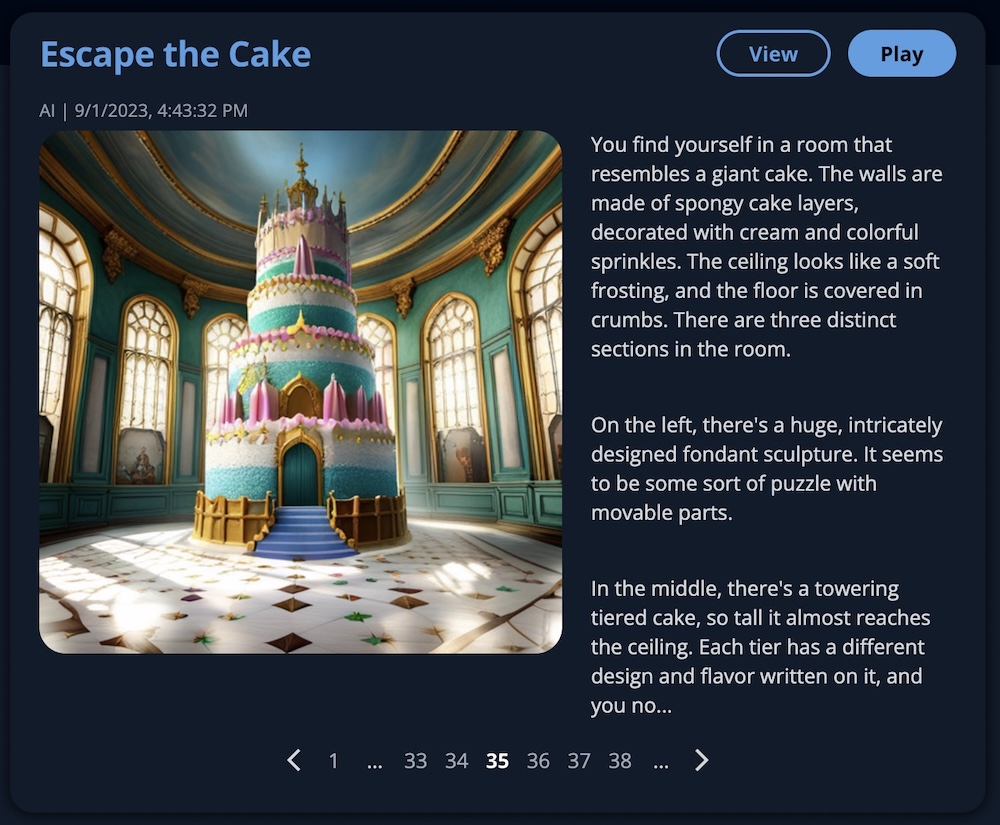
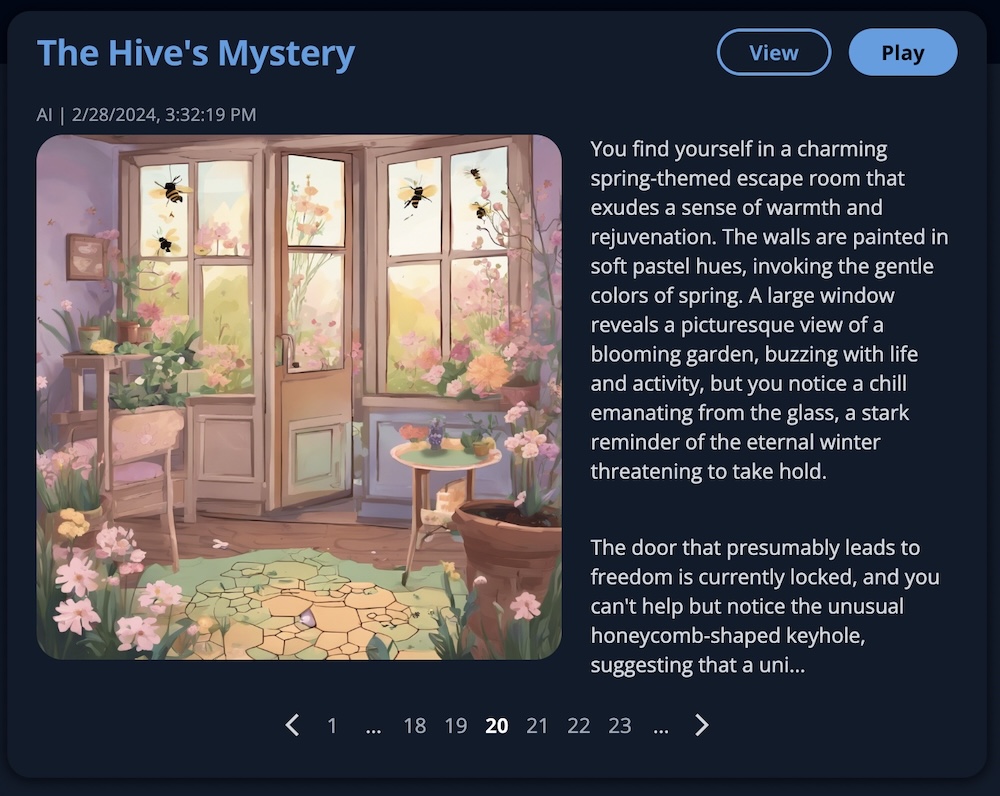
Our writers played the free version, so there was no text-to-speech or custom art style options. We could scroll through the practically endless themes created by other players, or start our own. The system starts off with an appropriate custom image showing the game space. After that, much like an old fashioned text-based adventure, you are told what you see and asked what you might like to do next, until you solve all the final puzzle to escape!

Editor’s Note: At Room Escape Artist, we believe that there is value in AI and LLMs, in that this technology can be a partner in the human creative process. In fact, outside of Room Escape Artist, some of us work in the field of AI and LLMs. However, on this website, all writing and art are created by knowledgeable, thoughtful humans, capturing and analyzing their personal experiences with escape rooms, videos games, tabletop games, and other immersive entertainment. The exception is this review. One writer prompted chatGPT to write their review (with a detailed prompt that described their experience, so that the review would be accurate, and chatGPT rephrased everything for them), and given the subject matter of the review, we’ve chosen to publish chatGPT’s words.
Matthew Stein’s Reaction
AI Escape is a trainwreck of a game that barely qualifies as an escape room experience. It procedurally generates text-based puzzles, but “puzzles” is a generous term—most challenges boil down to asking about an object and watching the game solve itself. There’s no creativity, no logic, just an endless conveyor belt of hollow interactions.
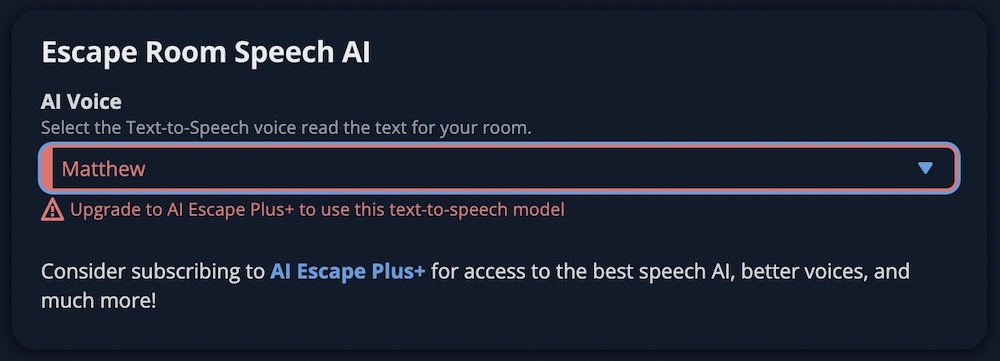
That said, there are some unintentionally hilarious moments. The game locks features behind a “Plus+” subscription (because one “plus” apparently wasn’t enough), including the text-to-speech voice “Matthew”—which was extra funny to me, since that’s my name. You even have to pay to generate levels with harder difficulties, though given the game’s total lack of puzzle design, it’s unclear what “difficulty” even means here.
AI Escape feels like a failed experiment in AI-driven gaming. It’s soulless, monotonous, and absurdly paywalled. But hey, at least it’s good for a laugh.

Tammy McLeod’s Reaction
This was definitely a unique game! I was able to craft the exact setting I was interested in, and the gameplay felt as though it was being run by a human game master. Good options were provided after each action. However, the locks used in the game were inconsistent, and poorly understood by the AI — for example, a box with a keyhole was opened by a 3-digit lock. On the plus side, the room state seemed consistent over the course of the game. Furthermore, the puzzle flow had structural problems. After 2 puzzles, I came across the “final puzzle” and was able to solve it and escape after 6 minutes, leaving behind many other puzzles in the room unsolved. I think this was promising, and it will be interesting to see it progress in the future!
Ryan Brady’s Reaction
AI Escape uses generative large language model (LLM) AI to make a custom escape room game according to the player’s inputted description and an AI generated image to go with it, which is not used in gameplay. The game is then played like an old text parser adventure game, though the LLM is able to accept a much wider range of input than games from the days of LOOK, PICK UP, TALK TO, etc.
Leaving aside the ethical concerns around generative AI, the game was incredibly basic and the puzzles were all very straightforward, assuming you even get to play them out. I say this because while you could complete the simplistic puzzles step by step, giving some semblance of step by step solving, it is also possible with the right input to simply have the puzzle solved for you. As a for instance, if you have a broken gizmo and simply say “fix gizmo,” the game will then take all the the steps to fix the gizmo, describing the gameplay it is depriving the player of. This approach also worked to circumvent the main goal of the game. I generated a game where the goal was to fix my spaceship and escape mars. Without solving all the puzzles, I entered the command “blast off,” and like a terrible dungeon master the game responded, okay you blast off. You win!
Even at the price of free, I cannot recommend AI Escape to anyone. Personally, this has served as a great reminder that Escape Rooms and Video Games are works of art, made possible only through the creativity and hard work of teams of artisans. I don’t discount the theoretical possibility that some day machines will be able to produce creative output, but if AI Escape is any indication, that’s not happening any time soon. Players looking for text-based puzzles are better served elsewhere. Stick to games made by humans.
Which review do you think was written by chatGPT? Write your guess in the comments!


![Mothman Themed House AirBnB Escape Room [Review]](https://roomescapeartist.com/wp-content/uploads/2026/02/airbnb-mothman-house-2.jpg)
![The Escape Game – Legend of the Yeti [Review]](https://roomescapeartist.com/wp-content/uploads/2026/01/legend-of-the-yeti-legend-of-the-yeti-3.jpg)
![Studio Escape – Madame LeClaire and the Seance of Death [Reaction]](https://roomescapeartist.com/wp-content/uploads/2026/01/madame-leclaire-madame-leclaire.jpg)

Leave a Reply