
This is the third part in a series about The Importance of Feeling Seen in Escape Rooms. In part two, we talked about how Escape Room Players Feel Seen at Hope End.
Hope End’s Dolores Wright is a character born to make escape room players feel seen. The people at The Ministry of Peculiarities who are charged with bringing her to life are keenly aware of this important aspect of their job. In the final installment of this series we’ll hear from a few of them as we consider what it is like to act and interact in a role designed to connect with players.
Paris Langle is the acting lead at The Ministry of Peculiarities: “I think the whole notion of being “seen” and understood and impacted and perhaps, changed, by an immersive experience is fascinating and worthwhile. It’s such a larger and more important subject than I think most people realize.”
Escape room performers deserve to be recognized and appreciated. They also deserve to be heard. These actors care deeply for the experience they are creating and I find listening to them talk about their craft unendingly interesting.
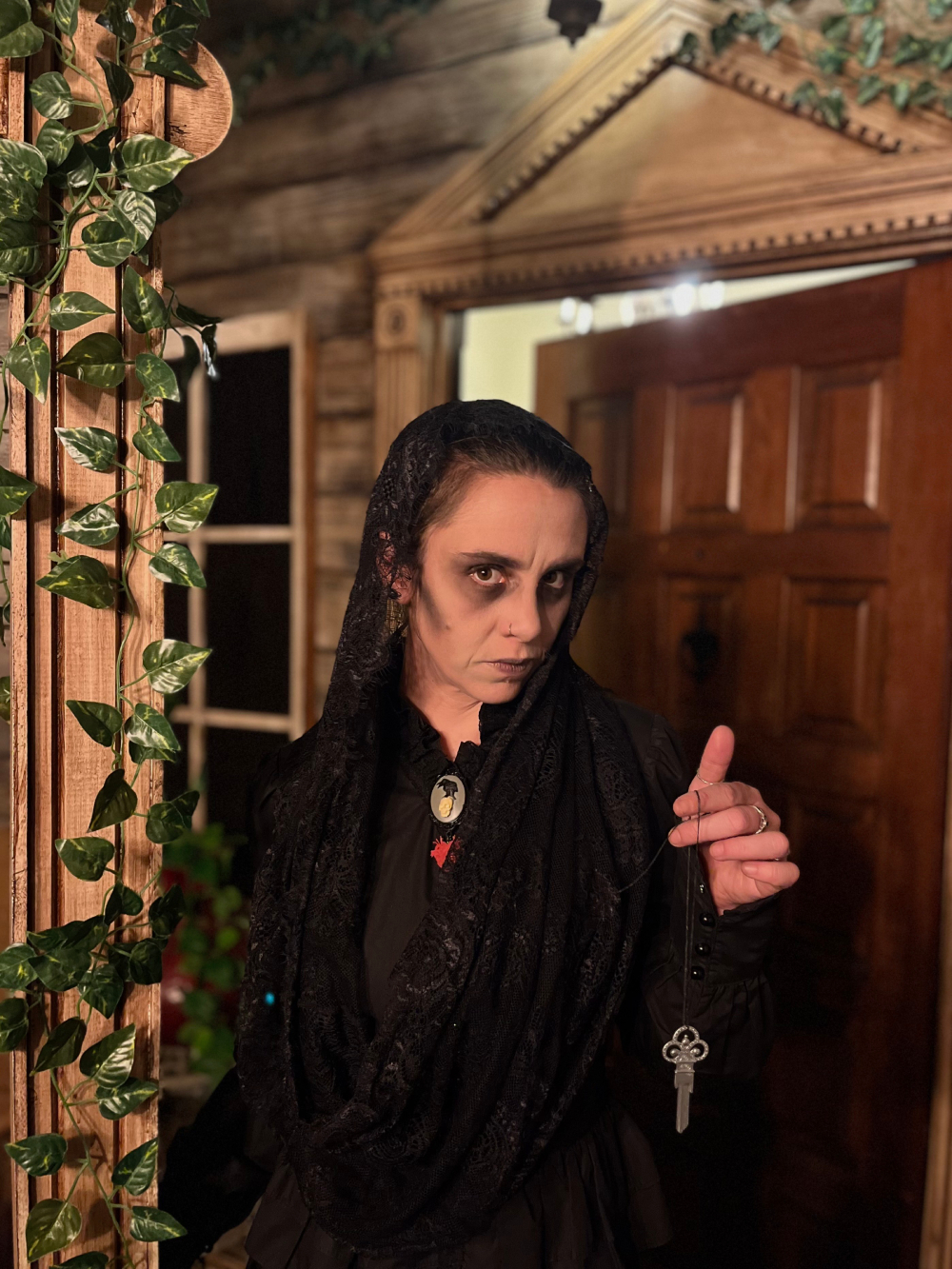
Serious Business
I recently played my 500th escape room. Hope End was a few hundred rooms ago, but I still remember the moment I first met Dolores Wright; it was a powerful experience. The Ministry of Peculiarities has achieved something rare in the escape room world and it was not by accident. Making players feel seen is a core part of their design.
Paris Langle: “Making players feel seen, sometimes, it seems as though this is the bulk of what I do when performing in an immersive setting: I always seek to actively design uniquely specific moments for players, without ever revealing that is exactly what I’m doing. That’s the fun and spontaneity of it for me as a performer, and that’s the awe and wonder for a player who’s willing to actively play along and trust me to take them on this adventure.”
North Jackson plays Dolores Wright: “I must constantly remind myself that everyone is experiencing this for the very first time. What if my performance might actually create true emotions in them that I need to take seriously?”
Observation
“Observe” or some form of that word came up continually in our discussions. Connecting with players is a two-way street. Skilled performers are absorbing as much information as they can. Details that can be used during the game to strengthen the bond with the players.
North Jackson: “We do not get a chance to interact with the players out of character, so all of my observations must occur in the room. I find myself making “callbacks” later in the experience that one player might have mentioned earlier. I mention details of their own lives proving that I am observing them.”
Nina Chatman plays Dolores Wright: “Dolores’ first scene is a really great tool for making the players feel seen. I ask them questions about themselves and their answers will come back to haunt them later. I ask questions to establish relationships so that in the end I can relate those relationships to the Hope family. I enjoy linking [the players] to the tragedy of Hope End.
Paris Langle: “Every. Single. Thing. players do when they’re in front of me, everything. It’s all feedback that then helps me actively create moments that are wholly unique to the player(s) in front of me. I’m in a constant state of keen, sharp observation when performing, always watching the players as a means of helping shape my next move. It’s always a stunning reveal late in the game, of just how much Dolores knows about them and the interpersonal dynamics of their group.”

How It’s Done
Making players feel seen starts with actually looking at them, then really listening to what they are saying. Actors hone their techniques through experience and experimentation.
North Jackson: “Eye contact. Eye contact. Eye contact. To the point where the players almost feel TOO seen. My job as Dolores is to challenge the players to think deeper. I use eye contact as a way to hold them emotionally accountable for how they are experiencing my story.”
Paris Langle: “Direct eye contact, being seen starts with actually being… seen. For me (as Dolores), it’s all about understanding. I’m trying to swiftly, deeply understand them with every move. I’m actively creating and crafting an experience for them to enjoy, one that feels thrillingly unique, slowly weaving the web, leading them into it with the details they don’t even know they are providing me.”
Striking the right balance is essential. Both parties have their parts to play. Players need to feel as if they are important parts of the story and the characters they meet must also feel integral to the game world.
Paris Langle: “The subtle creation of these magic experiences is about balance. It can’t be all about the players, and it can’t be all about me either; there is a delicate, unspoken balance that I, as the purveyor of this experience, am wholly driving forward into the gameplay.”
Not For Everyone
Escape room players have game style preferences as well as mechanics and aspects that they try to avoid. Actors in roles like Dolores Wright must be able to adapt to each group, each player really, to provide the best possible game experience.
Paris Langle: “It’s important to keep in mind that not all players *want* to be seen. Nor do they even want to play along, sometimes. And that is crucial to pick up on, almost immediately, because nothing derails an experience like trying to force a moment to happen. Pivoting, based on the human being in front of you, is an essential skill when performing in an immersive setting.”
North Jackson: “The gamemaster and Dolores work together to identify those individuals as soon as possible so we can create an experience they would enjoy and thrive in. We will take whatever they are offering us with their level of interaction and run with it.”
Emotional Exchanges
When escape room players feel seen they feel like they can give back to the game world. When experiences are designed to accept that input and then use its own agency to affect the players, magical moments tend to happen.
Nina Chatman: “Each Dolores has her own goals for what she wants the audience to leave with. For me the most engaging part of the story has always been the idea of guests coming into a home and accusing the owner of something. Dolores feeds into this misunderstanding because of her misery and anger, and in the end she charges people to look past her rather unlikable qualities to see the truth. It’s my hope that people walk away with the reminder to look past the disagreeable parts of humanity and to look for the good.”
North Jackson: “I find that there is a special feeling in the room with the guests—feelings that move past words. I have actually learned a lot about humanity and the things that connect us all through embodying Dolores.
My favorite part about playing Dolores is the life I can bring into the room. The players are rattled and vulnerable in Dolores’ presence. That unusual discomfort often leads to discovering something new about yourself. That is one thing that I believe the Ministry excels at creating in a safe way.”
Paris Langle: “I’ve had incredibly intimate moments with people in that last scene: players have cried, I’ve cried, we’ve hugged, we’ve held hands, they’ve told me about someone they lost and still miss, they’ve told me about betrayals and heartbreaks, we’ve discussed revenge and forgiveness, they’ve given me (as Dolores) intensely heartfelt advice. Ohh it’s magic when players want to participate in that sort of mutual exchange. I can’t tell you how many times people say it’s like a mini “therapy session,” but Dolores does not charge by the hour.”
Few escape rooms are described like this. Connections are happening in Hope End. People are leaving not the same as when they arrived. There is power in this medium.

Takeaways
I asked, “How important is it that we create experiences that impact players long after the game is over?” and I got some beautiful answers.
North Jackson: “I meet players all the time with enough experience to notice fine details and that have the appreciation for art created in this way. They see themes and lessons in our story in a way that sticks with them and impacts their own lives. Ultimately, I really enjoy knowing that whatever is created in that 90 minutes together, will never exist again—the beauty of theater!”
Paris Langle: “I’d say of the utmost importance. Why do we, as performers, do what we do in the immersive world if not to make a lasting impact on players? Why do we as players who are adamantly fond of immersive gameplay continue to seek out these experiences? What do we talk about when we leave places like Sleep No More or Hope End? We talk about how and when we had individual experiences that felt unique and different and strange and thrilling.”
We talk about feeling seen. We remember feeling seen.
Wrapping It Up
This concludes my series on the importance of escape rooms making players feel seen. Using Hope End as one example of this type of game really helped me think through just what it is that feels so special. Speaking with the creators and the actors proved to be incredibly illuminating. I was overjoyed to learn that they felt the way I did about these experiences and were, in fact, actively designing with customers like me in mind.
Spoilers Club Episode #11: Hope End
While this piece avoided spoilers, if you are interested in a more in depth conversation about Hope End, you will probably enjoy our Spoilers Club podcast, available to our Patreon backers. When you support Room Escape Artist on Patreon at the “Search Win!” level ($15 per month) and you’ll get access to all the Spoilers Club episodes, including the one for Hope End.
![Games by Stitch – Elsewhere Electric [Hivemind Review]](https://roomescapeartist.com/wp-content/uploads/2026/01/Elsewhere-Electric-Van.jpg)
![Great Gotham Challenge – Rockefeller Rendezvous [Reaction]](https://roomescapeartist.com/wp-content/uploads/2026/02/rockefeller-rendezvous-rockefeller-rendezvous-1.jpg)
Leave a Reply