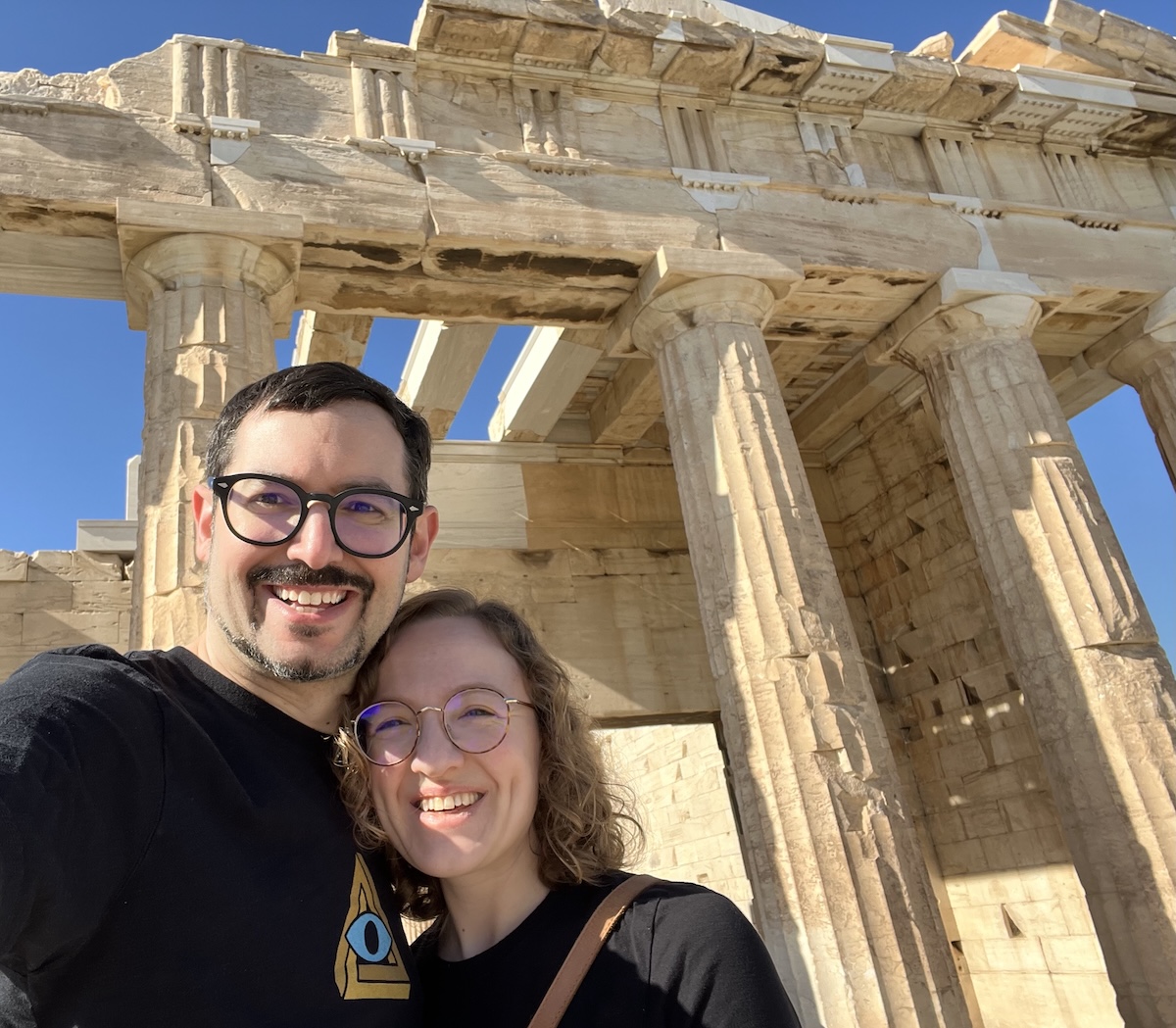
Dear Athens Escape Room Community,

Some of you I know, others I have not had the pleasure of meeting. For those who are unfamiliar with me, I have been writing prolifically about escape rooms since 2014 here at Room Escape Artist, and I have been serving on the TERPECA Board since the Board was created. The past 11 years of my life have been devoted to helping players find great escape rooms, and helping to push escape room creators to make the best games that they can.

A big category within greatness is safety… and I am deeply concerned about the state of fire safety in the Athens escape room community.

Why I Am Concerned

Back in early 2020, I visited your great city after seeing the TERPECA rankings of Greek escape rooms and hearing incredible stories from many traveling players. During that last trip, I found myself impressed by the creativity and quality of the escape rooms in Athens… and also nervous for the future of Greek escape rooms.

Upon our return, I wrote a Field Report about my observations of escape rooms in Athens. Most of that report was filled with praise, but I did call out that there were concerning safety trends in Athens. I concluded that section by writing, “It’s my sincere hope that many of the owners in Greece rethink their approach to fire escapes and signage. It’s the kind of thing that isn’t a problem until it’s a big problem.”

In spite of some concerning safety trends, I came home telling my audience that Athens truly was an incredible escape room community.

Five years later, we returned to Athens, and while I played a few games that I truly loved, mostly I was appalled at the state of fire safety in Athens. More specifically, the use of open flames in escape rooms in addition to poor egress options in the event of an emergency. Across a dozen games, I saw two different performers brandish blowtorches while I was locked in a space with no means of egress. I saw a series of candles lit on fire while surrounded by flammable material in a game with no means of egress (and when that game ended, the gamemaster struggled to unlock the front door.) And finally, I had a game light me on fire after I had booked “no contact mode.”

Things cannot escalate forever before someone dies.

Greek flag with a faint image of fire blended in.

This Is Not a New Threat

Escape rooms already have a body count due to fire.

Five 15-year-old girls died in an escape room fire in Poland in 2019, and two women burned to death in an escape room in Russia in 2024. Both stories are horrific. Every professional in the escape room industry should read the stories of these fires.

“But those weren’t my games. It will be fine.” I promise you that the owners of both those games that killed people thought that it wouldn’t happen to them. No one expects to kill their customers, but with enough games running over enough time, it will happen. And the odds go up when you are actively introducing flames into your games.

Maybe I Should Mind My Own Business?

I am confident that at least some of the owners who are reading this are thinking something like: “You’re a foreigner. Mind your own business, and don’t come here telling us what to do.”

To that I say, I thought long and hard about minding my own business.

The truth is that the fire hazards in escape rooms in Greece are my business because the Poland fire changed the escape room business all around the world. The result of those deaths was a crackdown on escape rooms around the world, but particularly in parts of the United States and Germany. We lost companies in the United States because of a fire that happened on the other side of the world.

In the days following that fire, Lisa and I also found ourselves speaking on television, radio, and in print to major media all over the world, explaining what happened, and why these kinds of deaths are exceptionally unlikely in the United States and Western Europe.

It was horrible having to speak to media about such an avoidable and pointless tragedy, and I never want to have to do so again.

The Ramifications of a Fire in Your Escape Rooms

I am not going to pretend that I understand how fire inspection and regulation of escape rooms works in Greece.

What I can tell you with certainty is that even if your local officials are ignoring your lack of emergency exits or the use of fire within your games right now, the second that you kill someone, the full weight of your legal system will come crashing down upon you and your community.

You will find yourself in prison with nothing but time to contemplate the lives that you took through negligence.

I don’t expect that you’re going to listen to some foreigner’s thoughts on player safety… but I hope that you do. My deepest wish for the Athens escape room community is that you thrive, and continue producing amazing games… but please do so without fire, and with better emergency exits. I know that a lot of you feel economic pressure to make increasingly extreme games because “this is what your players want,” however, the second that one of you kills someone with a game, ticket sales will plummet for all of you. Regulatory crackdowns will happen, and those crackdowns will be as random as they are swift.

What Am I Doing Next?

As Room Escape Artist:

We are taking the following steps:

  • Games featuring open flames are no longer eligible for Golden Lock Awards. Flash paper is ok, but any persistent flame, and especially flames fueled by accelerants, will result in ineligibility.
  • Reviews for games with open flames will document the issue clearly.
  • We are going to be extremely selective with our Recommendations Guide for Athens. While we recognize that when we travel internationally, safety standards will vary a bit, we have to draw a line somewhere, and for us, that line is at open flames and accelerants.

As TERPECA Voters:

Lisa and I will put the games with open flames at the very bottom of our long ranking lists.

As members of the TERPECA Board:

Lisa and I have formally requested that the TERPECA Board exclude games with open flames for the safety of all players, gamemasters, actors, first responders, neighbors to these games, and the global escape room movement.

We understand that a change like this adds a lot of complexity to the TERPECA system, not just ideologically, but also logistically, and would be challenging to implement, for many reasons that most owners and voters cannot necessarily appreciate. We understand that change takes time, and the TERPECA board will consider our recommendation seriously, but that the road to change may be a more long and winding path.

The best case scenario is that all companies voluntarily take safety more seriously, and don’t put any such decision into the hands of the TERPECA board at all.

Closing Thoughts

In 2017, I spoke at WroEscape in Wrocław, Poland. While I was on stage, I argued that escape room companies needed better fire safety because as escape rooms grew, there would eventually be a fire, and the outcome of that fire would come down to the fire safety of the game that it happened in.

After I gave that talk, a guy came up to me in a bar and gleefully told me that he “liked my talk,” but I was “a nervous, litigious American.” I smiled and had a drink with him. Truthfully, I didn’t think much of the interaction at that moment. I’ve been called a lot worse.

Fourteen months later, the Poland Fire happened, and ever since then I’ve found myself thinking about that conversation. I wonder if that guy ever thinks of me. I hope that he is as haunted by that conversation as I am.

I wish you all success,

– David

17 responses to “An Open Letter to the Escape Room Owners of Athens Regarding Fire Safety in Your Games”

  1. Well said. As a player, I never want an experience to compromise safety for the sake of spectacle. Change is urgently needed.

  2. An escape room lit YOU on fire?!? Please share more details about this–that sounds truly insane.

    1. Tomorrow’s review of The Sculptor will tell the whole story.

      1. I’ll keep an eye out for it!

  3. To be honest, penalizing a game on the rankings, because of safety issues, defies the point of a ranking. It should be put in a different category. I don’t think its fair to the game and the owners, to point a finger and downgrade a game that could be awesome. This will definitely affect how seriously I take de Terpeca rankings. Perhaps we should start a new association that ranks its rooms the right way. My two cents

    1. I appreciate your perspective. Every single TERPECA voter is free to use whatever criteria for fun that they want. I cannot enjoy myself when I think that a game has a higher chance of killing me or a future player.

    2. Antoine, out of curiosity, how would you rank a game that fired a live bullet inches away from your head? How would you rank a restaurant that had metal shavings on a shelf right above a pot of risotto? I thought REA might be overreacting on fire until I read this: https://roomescapeartist.com/2025/07/30/house-of-horrors-escape-room-fire-in-russia-claimed-2-lives/

      Indulge me in an anecdote: I used to love carnival rides, but then I rode the Zipper once and they didn’t ensure that the door was fully latched. By the time I realized the door wasn’t secured, the ride had started. I spent the next several minutes pulling the door closed in fear. There was no emergency button. There was no way to escape. I cannot enjoy any carnival rides knowing that there aren’t proper safety measures in place.

      The concept of carnival rides was cool to me until I experienced a near-disaster. I truly believe any experience playing fast and loose with safety should not be well regarded. We look to food inspectors to ensure a restaurant is safe to eat at, but most people would question eating at a restaurant if the sole bathroom had no soap and was utterly filthy. No good time should have a looming threat of death or serious injury.

      Plus, literally every rating system is subjective. I’ll rate almost any room with a story and actors higher than a puzzle fest. To some, that is heretical. And yet, I am still a TERPECA voter and nominator. David has his criteria, and you have yours. Your voice matters, Antoine, regardless of whether you agree with David or not.

    3. When you say it’s not “fair” to “point a finger” or “downgrade” a game based on safety concerns… concerns that involve real risks of serious injury or even death… you’re not making a neutral argument. You’re making a moral choice to minimize danger in the name of entertainment.

      If we were talking about something trivial (how dirty room a room is, for instance), I’d agree. But we’re not. We’re talking about basic safety protocols that are either absent or dangerously improvised.

      That is bad for players, owners, and the industry as a whole.

      A game that has a disregard for player safety doesn’t deserve to be promoted. It deserves scrutiny and accountability.

  4. I couldn’t agree more …
    Been to Athens in May, played some cherry picked games of which 2 of them used open flame, and while it really adds to the ‘dramatic effect’ it left as really questioning safety and how the industry operates there. And we are from Poland so history of Koszalin isn’t something remote. While maybe blowtorch usage did not so much concern me there (mainly due to relatively clean surroundings, because while definetely flammable, for example wooden door framing is unlikely to catch fire if accidentally touched with flame, but after some thinking then you get to the point, that it uses gas can which can be faulty) I really raised an eyebrow to some fire usage in the darkness where after completing passage I was almost sure thet there were dangling fabric elements.
    I loved both of the games, but at the same time it feels wrong.

    1. On the subject of blowtorches, one detail that I maybe should have out into the post is that the density of propane gas is such that it slowly builds up in inclosed spaces. Those torches are an extremely bad idea.

  5. Personally, I believe there’s —and in some regards should be— valid room for variation in the industry, including when it comes to safety. I know many people would disagree, but I see my hobby more like a sport. When I go skiing, I could choose an American resort: highly streamlined, strictly regulated, heavily monitored, very safe—but also very expensive. In Western Europe, where such systems are less prevalent, I can go to a regular ski area that’s far less regulated, placing more responsibility on the skier. The likelihood of injury or even death may be higher, but there’s still a good chance of getting help quickly. Or I could venture into a completely ungroomed ski zone with one-of-a-kind pistes—riskier still, but perhaps the most rewarding experience for someone like me who enjoys extreme alpine conditions.

    The first time I played an escape room in Athens, I was surprised — even as one of those Europeans who casually lean toward assigning more risk management to the customer than the operator. But I realized I was in a different culture with a different philosophy. Since then, I’ve always paid attention to where my risks lie. To be blunt: If you’re very risk-averse, you probably shouldn’t enter the Athens escape scene.

    I’m also not sure if comparing premium experiences in Athens to the situations in Poland or even Russia is appropriate. Those cases are cautionary tales, absolutely — and they’ve led to real changes in how things are run. But ultimately, in both cases, it was extremely negligent operators who caused the incidents. And frankly, you can find idiots like that anywhere. These tragedies stemmed from poorly run rooms in Central and East Europe, not from the Athens scene.

    That said, I recognize that it may just be a matter of time before something serious happens. I’ve spoken with several escape room owners in Athens, and they’re aware of the risks too. They understand that certain aspects pose real threats to the industry if something major occurs. Regulations have already been modified, as far as I know, which I think is a good thing. We need to keep improving safety and find balanced solutions. There are many questions still to tackle — from fire exit signage vs. immersion, to whether a well-trained actor with fire experience should even be allowed (personally, I think yes). And that’s just fire safety; there are many other dimensions to consider. Downrating games simply because they don’t meet the safety standards of my hometown doesn’t sit right with me. It feels unfair to the creativity of the designers. I knew these games would be riskier when I played them, and I knew they wouldn’t meet certain standards—because otherwise, they simply couldn’t exist or just be too expensive to run otherwise.

    Controversial as it may be, I do believe there needs to be space for experimental — and yes, sometimes more dangerous —experiences. If we over-regulate and expect every escape room to meet the highest safety standards, we’ll end up with nothing but safe (and prohibitively expensive) options, like the American ski resorts, while eliminating open areas and ungroomed extreme pistes altogether. I do think it would be helpful to have clear signage, like ski areas do, allowing every customer to make informed decisions. Icons indicating physical contact, presence of fire, fire exits, chains, etc., could be a useful addition. I also do think we need to educate players that different rooms in different cultures will pose different risks.

    I may sound like the guy in the bar who called you a “litigious American.” I don’t think that’s fair. I see you as a deeply empathetic person who values life above leisure—and that’s admirable. I also think you deeply care for the Athen’s community, that’s the reason why this letter exists. You could say I simply prioritize choice over safety. (Which, again, doesn’t mean we shouldn’t improve situations and educate both operators and customers about potential risks!) Over-regulating the industry—forcing every room culture to adhere to uniform, stringent safety rules—could kill some parts of the scene. And if I have to choose between a 90% chance of losing unique premium experiences and a 0.001% chance of endangering myself… I’ll still choose the latter.

    But I fully understand that most won’t agree. It was just important to me, to give my point of view also as voice.

    1. I appreciate your perspective, and at one point in my player career I would have agreed with it.

      Watching the aftermath of the Poland fire take 5 lives and wreck my home escape room community changed that perspective. I’m not exaggerating when I say that the Poland Fire ruined the New York City escape room community – we never recovered here.

      Beyond that, your acceptance of 0.0001% chances might be a feeling of personal risk, but that’s not a luxury that I have as a leader in this global community. With enough players going through Athens a 0.0001% chances might over time means that over a long enough time horizon, even those unlikely things will go wrong. And for what it’s worth, I think that your percentage estimate is wrong.

      Beyond that, I am also in a position where my actions send lots of people to play games and I do not want that blood on my hands.

      When I go skiing, I am aware of the risks of skiing. Especially if I am going backcountry skiing. When I walk into a random escape room in Athens, I have no idea what I signed up for. All that I knew that it was on the TERPECA list, I never expected the kind of risk that many of the escape rooms in Athens imposed. In fact when I went to play The Sculptor, we chose no contact mode and they ignored our wishes: https://roomescapeartist.com/2025/08/01/freaky-minds-horror-live-games-sculptor-review/

      Lastly, you speak of the increased regulations in Athens, plenty of people have, but no one ever mentions (1) what they are, and (2) if the owners will really adhere to them.

      My perspective here is that if people truly want extreme games, are knowingly consenting to the dangers, and local laws allow that kind of thing… then sure, go have fun. That doesn’t mean that those games inherently belong on my regional recommendations guides or TERPECA. And moreover, I, as a TERPECA voter am free to set my own standards for my own list. I am free to value my personal safety over my perception of the quality of a games set or puzzles.

      All that said, I really do value your perspective and the time that you took to write it.

      1. I completely understand your point of view and why you felt compelled to write that open letter.

        I think the main difference between us lies in how we perceive games that cross a certain boundary. Personally, I believe these games still deserve a place in the escape room scene — much like how extreme sports exist alongside more traditional ones. Besides regulation, I think we should consider clearer signage, more detailed categorization, and robust trigger warnings as standard best practices (as I mentioned earlier).

        Right now, it’s genuinely hard for players to gauge how intense a game might be — in terms of either physical risk or emotional content. TERPECA has only recently started labeling horror levels in an effort to build some kind of international consensus. Propably, we’ll need more labels like these in the future. Cultural perceptions vary widely. I’ve spoken to Greek and Spanish players who don’t flinch at what many Germans would consider terrifying. I’ve even seen young children in Spain playing horror-heavy full-contact games — with their parents. So, clearly, sensibilities differ.

        Providing more upfront content warnings seems like the best way forward. However, it’s unclear whether a global standard for game content or fire safety is even possible — the world is just very diverse. I understand why TERPECA might exclude games that pose higher risks, such as those involving chains or poorly marked emergency exits. But doing so risks alienating players like me, who actively seek out intense experiences fully aware of taking suchs risks.

        I think my skiing analogy still holds up in a way: when people start skiing, they’re taught that backcountry trails can be more dangerous. This kind of education is sorely missing in escape rooms — especially given the huge cultural and regulatory differences across borders in Europe. You can go from highly regulated Germany (detailed legal waivers, safety briefings) to Greece, where games begin without any briefing at all.

        To be clear: I absolutely support improving safety standards to help prevent future tragedies. But we should also ask how much creative freedom the industry can and should retain. I accept that everyone draws their line differently. For instance, I once took part in an immersive experience (less so escape room) where I had to share a bed — including the linens — with a male actor playing a hypersexual gay teenager. I was sexually and physically assaulted (I’m male), and the experience ended with actual vomiting (from an actress). While none of this posed a physical danger, I highly debated with my friends that such things need content warnings (others didn’t and argued, that the surprise is half the merit). I still appreciate that the experience exists — even if it pushed me far outside my comfort zone.

        I can see your point of view and that your leadership within the scene comes with great responsibility. What happened in The Sculptor — ignoring guest boundaries — is unacceptable. Sadly, I’ve heard similar stories from Greek performers who disregarded the no-contact rule. Sometimes it’s due to poor communication from the reservation; other times, they might not realize international players tend to be more sensitive than their local counterparts that forgive such things more easily.

        Part of why I wanted to share my perspective is this: escape rooms are still overwhelmingly safe. You’re more at risk driving a car. I’ve never feared for my life in a Greek escape room — but I have in Greek taxis! So yes, we absolutely need to improve and future-proof this industry. But misrepresenting the risks can do just as much harm. I once met a player who stopped playing altogether after reading a sensationalist report about the accident in Poland. I feel, that can become an issue.

        I’ve somewhat worked in the attractions industry too, where unfortunately fatal accidents happen each year. But the industry has a good process: they improve safety protocols while also communicating that these experiences are still relatively safe compared to other activities. That balance is key — especially in entertainment. We need to maintain trust without letting paranoia take over. Of course, none of this means we shouldn’t act quickly to strengthen regulations and standards where needed.

        Regarding Athens specifically: I don’t know the full scope of Greek regulations (I’m from Germany), but I’ve seen that various laws are publicly available online (if you search for it in Greek language). One that comes to mind is regulation 10181 from 2023. It made a fire safety certificate mandatory for escape room owners, as well as a certificate of good conduct for game masters and performers. Escape rooms also need to be accredited by a certified inspection body. I can’t confirm how strictly this is enforced, but the legal framework exists. I spoke with some Greek owners in 2022, and they believed several rooms might have to close because of these standards — especially basement rooms, where fire exit access is more difficult. I heard rumors that Wake Up was one of the first affected — but that may not be true.

        Sorry for answering so long again (and don’t think I want to argue with you, far from it). I think it just shows that this debate has do be done sooner or later in a sense as there’s much to look at – and from different perspectives.

        Edit: I just looked up the URL for the legislation again – in case:

        https://www.mindev.gov.gr/wp-content/uploads/2023/01/%CE%A0%CF%81%CE%BF%CF%83%CF%87%CE%AD%CE%B4%CE%B9%CE%BF-%CE%9A%CE%A5%CE%91-%CE%B1%CE%B4%CE%B5%CE%B9%CE%BF%CE%B4%CF%8C%CF%84%CE%B7%CF%83%CE%B7%CF%82-escape-room-%CE%AD%CE%BA%CE%B4%CE%BF%CF%83%CE%B7-4.1.23.pdf

      2. I do think there should be a risk warning to these games, and a way to categorize it, without down playing its ranking. Emphasis on safety is important of course, but I still think it’s not right to not mention a great game at its just value in a ranking. There is food for thought on this matter.

        Do you agree? Or your totally closed and one sided on the idea?

    2. Thats exactly my point of view, you’ve described what I meant in my previous comment, and I think your absolutely right.

  6. By and large, urban Greek buildings are structured with reinforced concrete, filled in with brick, minimally insulated, fenestrated with aluminum, and laid with terrazzo, tile or stone. They’re much smaller and simpler than either other European or American buildings. They also don’t come with central air, which is bad for gas concentration but great for fire isolation. The practical effect of this is that it’s pretty hard to accidentally set them on fire, harder for fire to spread to a whole building, and you’re rarely more than a minute from the street. This is reflected in news and statistics; residential and non-industrial commercial fires are pretty rare except as a consequence of forest fires, and when, say, an apartment catches fire, the rest of the building almost always remains unaffected. It’s also worth noting that internal gas hookups are very rare, so there’s no fuel running through the building.

    This meant that fire safety regulations were pretty simple for the longest time, though now they align with EU standards. For most businesses, the requirement is that you have an independently lit sequence of lights in all public spaces leading to the nearest exit, and regular fire extinguishers. For large commercial spaces, regular hoses and hookups are required, and the installation gets recertified every couple of years.

    I haven’t been to those specific escape rooms so I can’t tell you what shenanigans they’re up to, but I’ve done ~50 rooms at the height of their popularity. One room tried to lock us in without an emergency release, and they reconsidered when asked not to. Two rooms locked me with actual handcuffs, though in one of them release was the very first thing in the solve sequence, and the other one might have had a weak link. One room had complicated enough geometry that I was unsure what the nearest exit was.

    So yeah, I 100% believe you when you say that they didn’t design with fire safety in mind, but that’s partly because the risk profile is different. My personal safety worry is the nooks and crannies some games used/engineered that would be difficult to get an unconscious person out of in a hurry.

  7. I strongly agree with David’s call for a basic safety requirement for TERPECA.

    Whether or not they are technically an endorsement, TERPECA rankings are taken as such. They funnel people into games. And in my opinion, that creates a responsibility for the organization: a responsibility not to lead people into harm. Without special access to this discourse, no random player would reasonably assume that picking games from this list could put them in very real danger of injury or death.

    With the recent inclusion of The Sculptor on TERPECA, players are being funneled into a situation with violence that has no warning, directly violates their consent, and includes open flames on their person while restrained. Before today, I recommended TERPECA and Morty to all budding and regional enthusiasts who passed through my lobby. After today, we will be sticking with Morty. This isn’t merely a matter of principle to me: I have a duty of care to my players, and until TERPECA adds safety guardrails, recommending it would be a violation of that duty. I would be complicit in any harm that followed.

Leave a Reply

This site uses Akismet to reduce spam. Learn how your comment data is processed.

Trending

Discover more from Room Escape Artist

Subscribe now to keep reading and get access to the full archive.

Continue reading