
We love how many daily puzzle games are now available. It seems like new ones appear every day!
This craze really kicked off during the pandemic, when Wordle went viral… and subsequently inspired more puzzle games.
Most of these games are free, although some of them show ads on the screen. (Edit: Since publication most of the New York Times games have moved behind a paywall.)
Every contributor at REA has different favorites. Here’s a guide to the puzzle games we love most.
We’ve reviewed the independently hosted games first, and then the collections by the Atlantic, LinkedIn, the New York Times, and Puzzmo.
If you have a favorite daily puzzle game that isn’t listed here, please leave a comment.
Table of Contents
If you like words:
- Bracket City (Atlantic)
- Crossclimb (LinkedIn)
- Dead Letters
- Fluxis (Atlantic)
- Letroso
- Pinpoint (LinkedIn)
- Raddle
- SpellTower (Puzzmo)
- Squeezy
- Stacks (Atlantic)
- Strands (NYT)
- Typeshift (Puzzmo)
- Wordle (NYT)
If you like logic, deduction, and spatial games:
- Bongo (Puzzmo)
- Clue Raider
- Clues by Sam
- Connections (NYT)
- Flipart (Puzzmo)
- Mazele
- Memoku (Puzzmo)
- Pile-Up Poker (Puzzmo)
- Pips (NYT)
- Queens (LinkedIn)
- Really Bad Chess (Puzzmo)
- Sudoku (LinkedIn)
- Tango (LinkedIn)
- Zip (LinkedIn)
If you want to test your knowledge about specific subjects:
Games
Cinematrix and Telematrix
By Sarah Willson
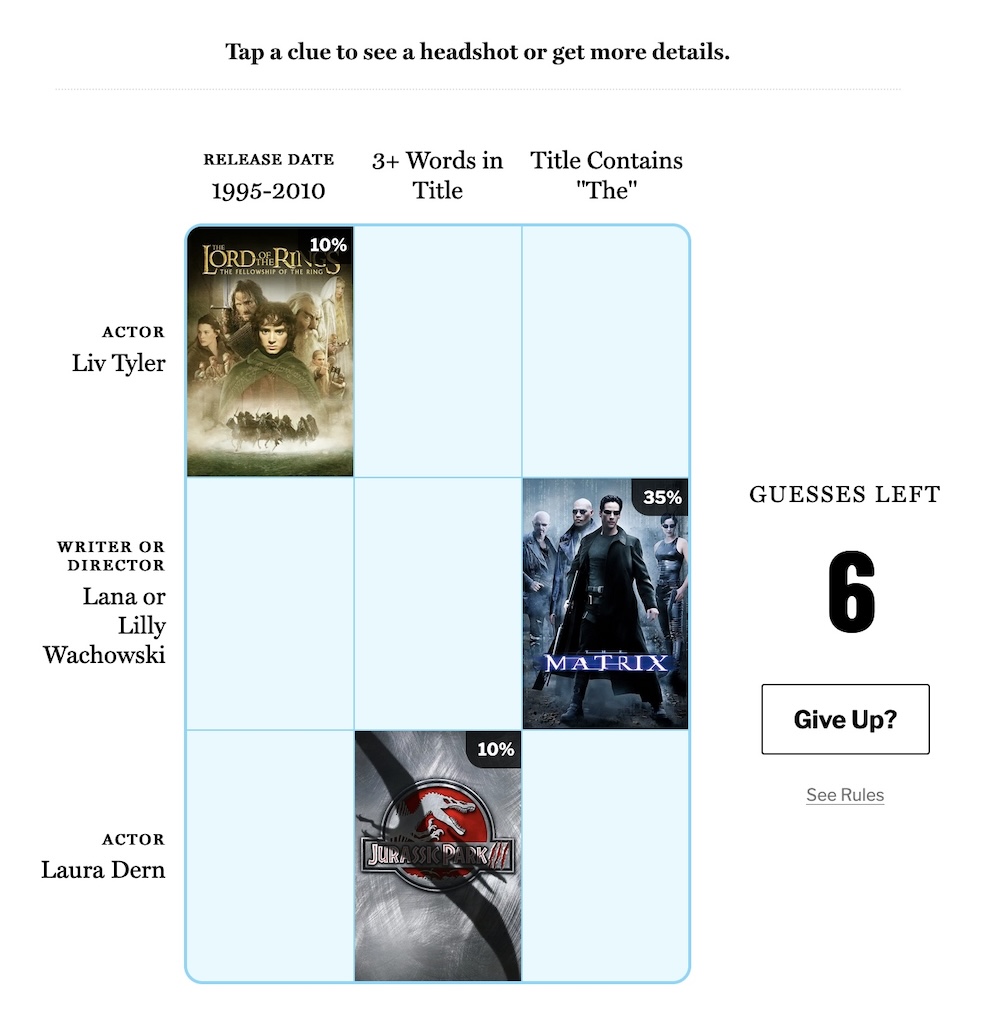
Cinematrix and Telematrix: Can you think of a Nicole Kidman movie that won an Academy Award? How about a movie starring Idris Elba that’s one or two words long? If the answer is “yes, and that was fun,” Cinematrix may be for you. In Vulture’s daily Cinematrix, the object is to fill in nine movies that fit the criteria provided by the grid. Often multiple movies will fit a given square, so a big part of the puzzle is placing the ones you know strategically to fill as much of the grid as possible. Serious movie buffs can think up the most obscure movies for a higher score, but it’s fun to rack your brain for suitable guesses even if you’re just a casual moviegoer. A new Cinematrix comes out every day, and there’s also a TV version, Telematrix, released on Mondays and Thursdays.
Clue Raider
By Chuck Kaplan-Smith
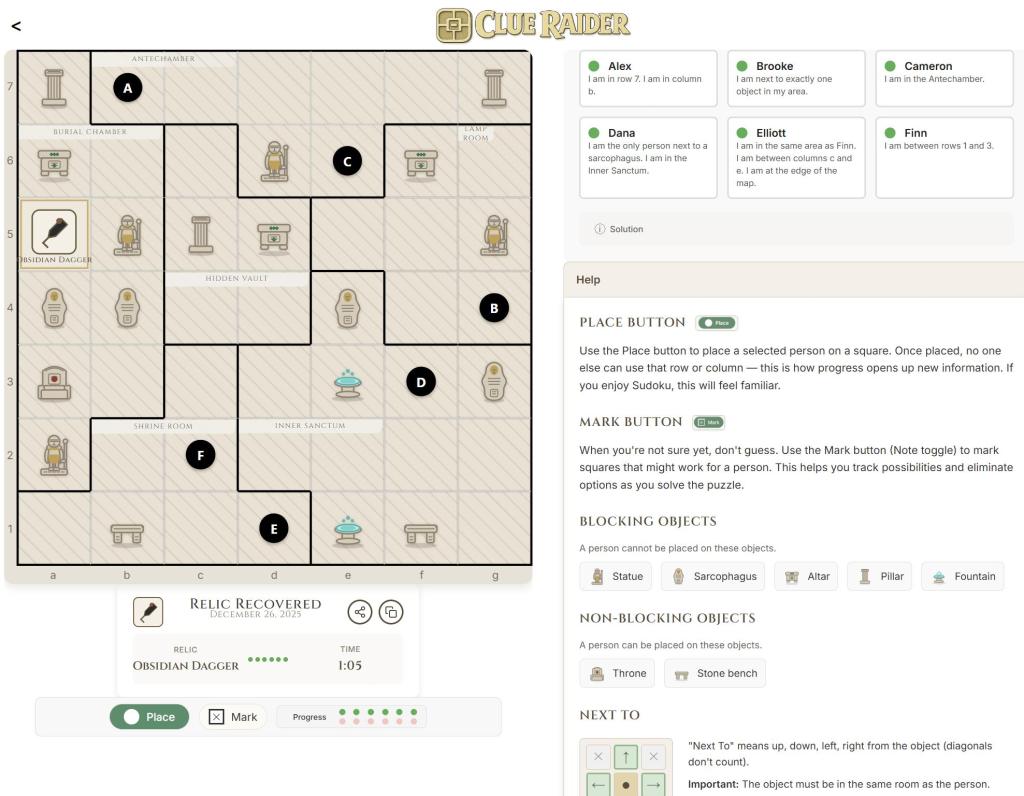
Clue Raider takes the standard logic puzzle formula to a curious, challenging, and addictive place by adding spatial and environmental considerations. A mix of Clues by Sam (see below) and Sudoku, Clue Raider has players using limited information to place characters in a 7×7 grid—but once you place an object, no other object can go in the same column or row. Adding in the use of several Egyptian props to either restrict options or complicate the decision space makes logic puzzles a little more interesting than the traditional text grids of yore. This is the Lost Relic puzzle format, though the more themeless Mosaic puzzle scratches the same itch on a more abstract way. This is definitely a worthy game. The fact that a week’s backlog of puzzles (plus a cache of 25 bonus puzzles) is available will have this game raiding your free time.
Clues by Sam
By Sarah Willson
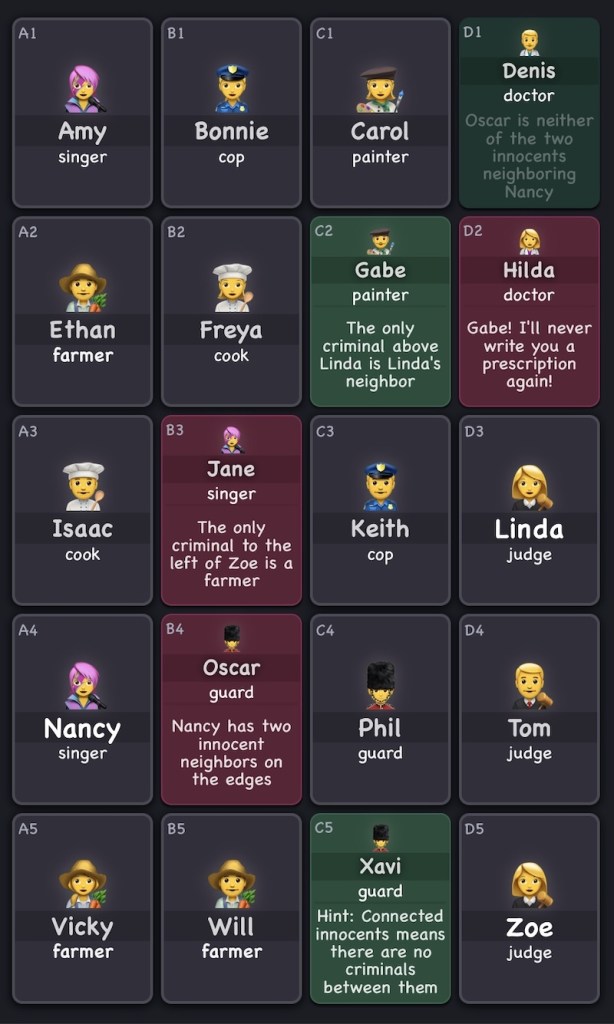
Clues by Sam is a game of deduction: By uncovering clues from a grid of 20 little emoji people, you gradually reveal which of them are criminals and which are innocent. It’s fairly simple to learn (once you internalize what “neighbor” means), but the clues have enough variation from day to day that the puzzles feel fresh. Another delightful bit is the mini stories and quips woven through the dialogue of the characters without clues to offer. It’s a chance to see the designer’s personal touches, whether the suspects are tracking down a bicycle thief or celebrating Sam’s mother’s birthday.
Dead Letters
By Chuck Kaplan-Smith
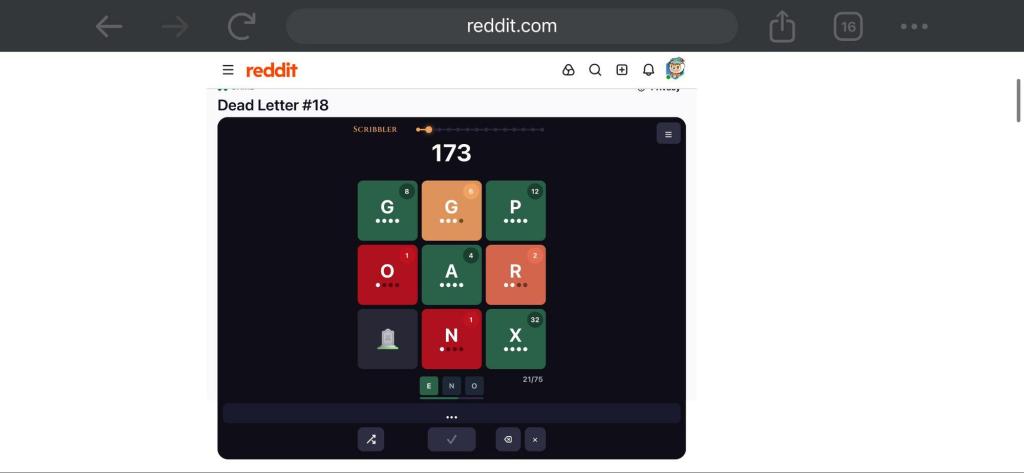
The concept of Dead Letters sounds like if Stephen King turned Boggle into a web game. This Reddit-based game presents you with a 3×3 grid of letters for you to turn into a word up to 9 letters… but if you don’t use one, it eventually will die! Now your maximum word length is 8, and a gravestone serves as a stark reminder of the ephemeral nature of being (and that you have to use your letters in 4 turns or less). Each turn you don’t use a letter, its point value diminishes. The game offers surprising depth, as you are forced to consider optimizing points from newer letters versus ensuring letters don’t die. It’s accessible enough for casual play, but there’s a deep challenge beneath the surface. Sometimes, I like to stick to the classics like Wordle and Spelling Bee, but—to allude to King—sometimes Dead is better.
Letroso

The simplest way to explain Letroso is that it plays like Wordle but with fewer constraints. The rules are basically the same: you guess a word, and each letter is color coded based on whether it appears in the target word and where it appears. Unlike Wordle, though, the target word can be up to 10 letters long, and you have unlimited guesses. Letroso provides a daily game as well as an unlimited mode where a random word is chosen as the target word. As a longtime daily Wordle player, I appreciate Letroso’s twist on the format. I find that it works well as a group game, as the varied word size leads to multiple word possibilities and letter patterns to consider. Having a few people taking a look at it helps with brainstorming. And the unlimited play mode means that you get to keep playing beyond just one puzzle.
Mazele
By Sarah Willson

Here’s another one for the logic fiends. The objective of Mazele is to deduce a path from the left edge of the grid to the right. Similar to Wordle, Mazele uses color to indicate when you have the correct placement of squares in a row or column (green) or at least the correct number of squares (yellow). The difficulty can vary depending on your initial guess as well as the complexity of that day’s path: Some days you guess the maze in two quick turns, but I’ve also had mazes confound me for close to 20 minutes. Honestly, the difficult ones are the most satisfying, especially when you go from very little color to that perfect wall of green.
Metazooa
By Sarah Willson

Metazooa by Trainwreck Labs challenges you to deduce each day’s mystery animal by tracking it across the animal kingdom’s family tree. Each animal you guess will bring you one step closer to the target animal, and 20 guesses is usually more than enough to zero in on the answer, especially once you start getting familiar with the taxonomy. Wikipedia previews of the taxonomic branches give more information to guess by—at least most of the time. Insects and fish can be punishing. But most days it’s a fun, quick guessing game, worth playing for all the animal facts you can learn along the way.
Raddle
by Scott Olson

Sandy Weisz is one of the most elegant puzzle designers out there and his daily puzzle Raddle is a bite sized delight. Knowing the themed starting and ending word (Dancing to Queen is one of my favorites), players must determine the next entry in the thirteen-word sequence given the word length and a set of out-of-order clues. The ladder can be solved up or down, with hints available on the clue or the answer if you are stuck on a rung. Sandy’s entertaining blend of trivia and wordplay is what makes Raddle a winner, and I don’t even like wordplay. References are far and wide (recently Chappell Roan, pad thai, and Airplane! all made appearances), but never too deep, making the puzzles accessible for all. While occasionally an answer may have multiple solutions that fit, leading to a futile search for a different clue, this experience is rare with most rungs solving cleanly. It will not be uncommon that you’ll think “what do I associate with that word” and sure enough, you’ll see a clue that makes you proud that puzzle designer brains aren’t that different from you and me.
If you are interested in learning more about Sandy’s game design philosophy, check out our REPOD interview with him where he talks about designing for elegance.
Squeezy
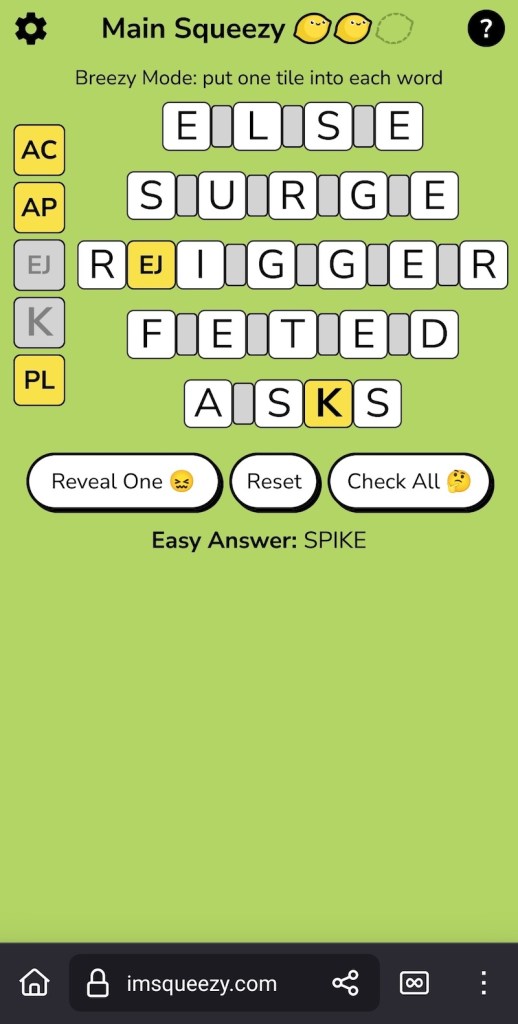
Squeezy is a quick word puzzle game where you insert tiles with one or more letters into words to make new words. I’ve been playing it every night before going to sleep, and it takes only a couple of minutes. Difficulty level ranges from easy to medium, and there are hints available if needed. There are no ads, which is very nice.
You are presented with somewhere between 3 and 8 words, and a corresponding number of tiles. Since there are multiple words and multiple tiles, you need to figure out which tile goes in each word, as well as where in the word it goes. For example, if you have a tile with the letter “R”, you could insert it into “TUCK” to make “TRUCK”. To aid in that, the inserted tiles (in order of the word list) will then spell out a new word. Sometimes a tile could fit in several words, but there is only one solution where all the tiles form new words and spell out a new word in order.
There are three rounds, and the words spelled by the inserted tiles in each round will all be related in some way, like “My Little Pony characters” or “Words containing numbers”. Some of the relationships between words are very tenuous and unguessable, at least for me, but I don’t really consider them part of the puzzle. They are more of a “guess what the constructor was thinking” game.
The graphic design is simple and appealing, and the mechanics take seconds to learn. The interaction design could be a little better- instead of doing the obvious “drag tiles into position,” you have to click on a tile and then click where you want to place it. Sometimes the clicking ends up selecting some of the text instead, and you have to tap again to clear it. Minor, but still a bit annoying.
There are two other modes: “Easy Squeezy,” where there is only one round, and if you want a harder challenge, there is “Wheezy” mode which adds extra tiles that are unused.
The same company offers a variety of other daily puzzles, but they are more common types and don’t appeal to me as much as Squeezy.
Thrice
By Chuck Kaplan-Smith
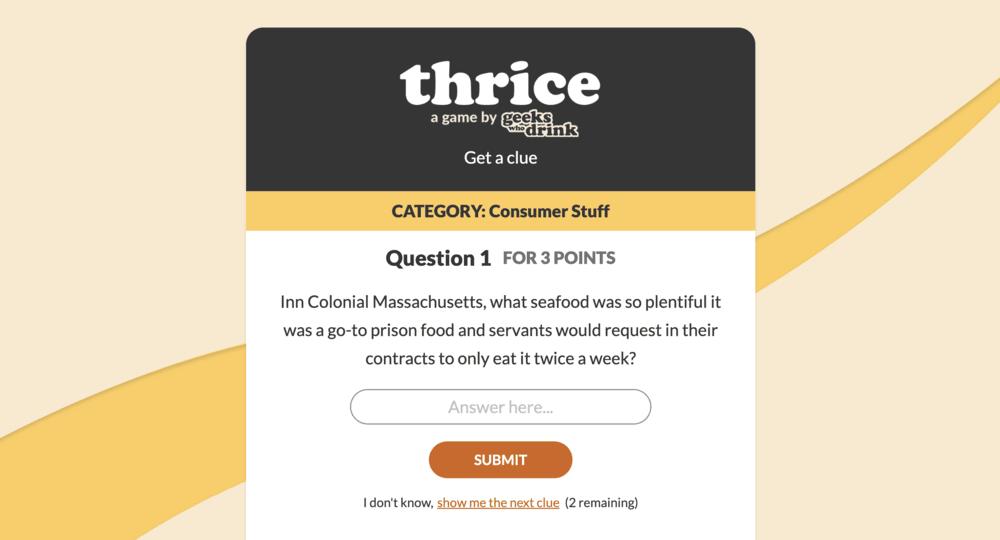
Perfect for pub quiz fiends, Thrice gives you the snark, wit, and irreverence that one would expect from Geeks Who Drink live event. What sets Thrice apart from other trivia games is its progressive hint system. Across five categories, you’ll be prompted for an answer once, twice, or thrice (insert a GIF of Leonard DiCaprio pointing at the TV here)–each subsequent hint providing a different and more accessible entry point to the answer, though with a lower point value. Thrice scratches that trivia night itch and saves you the social pressure of buying a burger and a beer.
Worldle
By Emily Hall
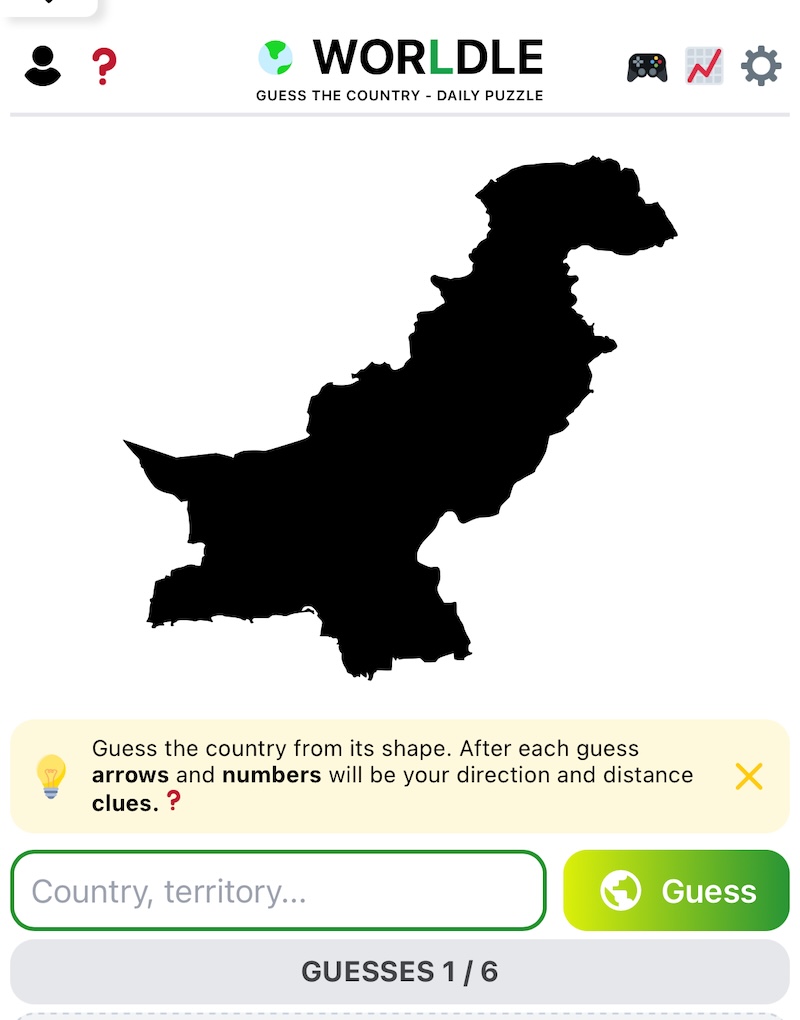
Worldle (note the extra “L”!) is a geography-based daily puzzle game. It shows the outline of a country. You make a guess and then it tells you how far you are from the right country and in what direction. You have a max of six guesses. The added challenge is that scale isn’t represented: Sure you might recognize Lesotho in context as a small country surrounded by South Africa. But when that outline is 1) alone and 2) the same size as the outline of Mongolia, you are probably going to need some direction-based hints. My biggest complaint is that even though it is billed as a “daily puzzle” there are days when the puzzle is blank with no indication of when things will resume. Additionally there are only so many countries in the world, so repeats are expected. But for those who enjoy a daily dose of geography, Worldle is a nice departure from word-based games.
Tradle
By David Spira
🎉🎉🎉 Who here has a casual love of macro-economics!? 🎉🎉🎉
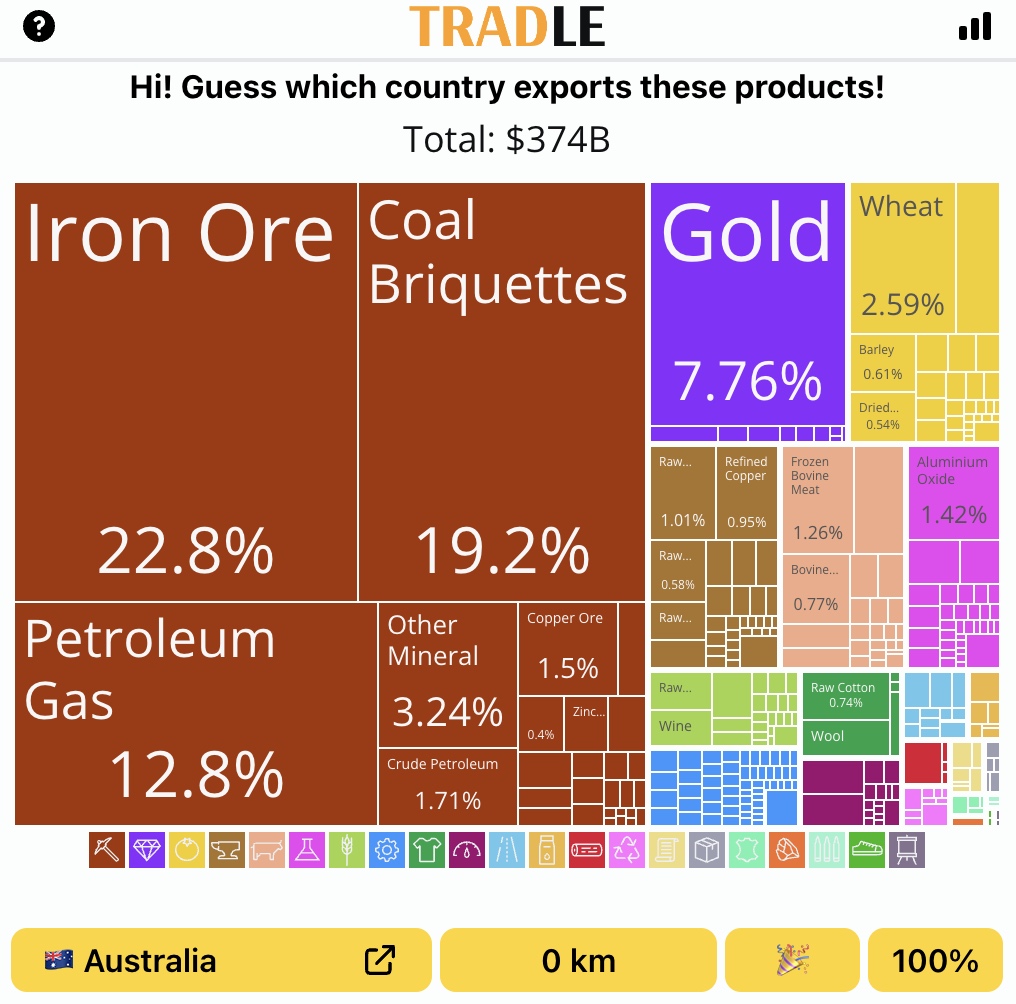
My absolute favorite daily puzzle asks you to look at a visualization of a single country’s exports and the total dollar amount of those exports annualized.
By looking at the dollar amount of the exports, I can get a sense of how big the country’s economy is, and then past that I’ll start toggling my way through the visualization and look for clues:
- What are the main exports? Do I already know where those tend to come from?
- Are there extractive exports like petroleum or mined materials?
- Maybe there are industries that imply a coastline like fishing ?
- Perhaps there are tropical fruits showing up?
- Am I looking at exports that demand complex process?
At some point I just have to take a best guess, and then after that the game literally turns into Worldle (minus the outline of the country).
I adore Tradle. It sits right at the intersection of so many things that I love… although occasionally it will wreck me by making me figure out a very small island nation in the South Pacific that I’ve only notionally heard of… but even that is interesting.
I know that this really isn’t for everyone but if you’re still reading this passage, then maybe this one is for you?
Collections
The Atlantic Games
By Peih Gee Law
The Atlantic Games are a new addition to the buffet of daily puzzle games. Each game is snack-sized, including the crossword puzzle. But don’t be fooled, they’re deceptively challenging. What I enjoyed most about The Atlantic Games is the way they dare the players to think creatively and a little bit outside the box.
Crossword
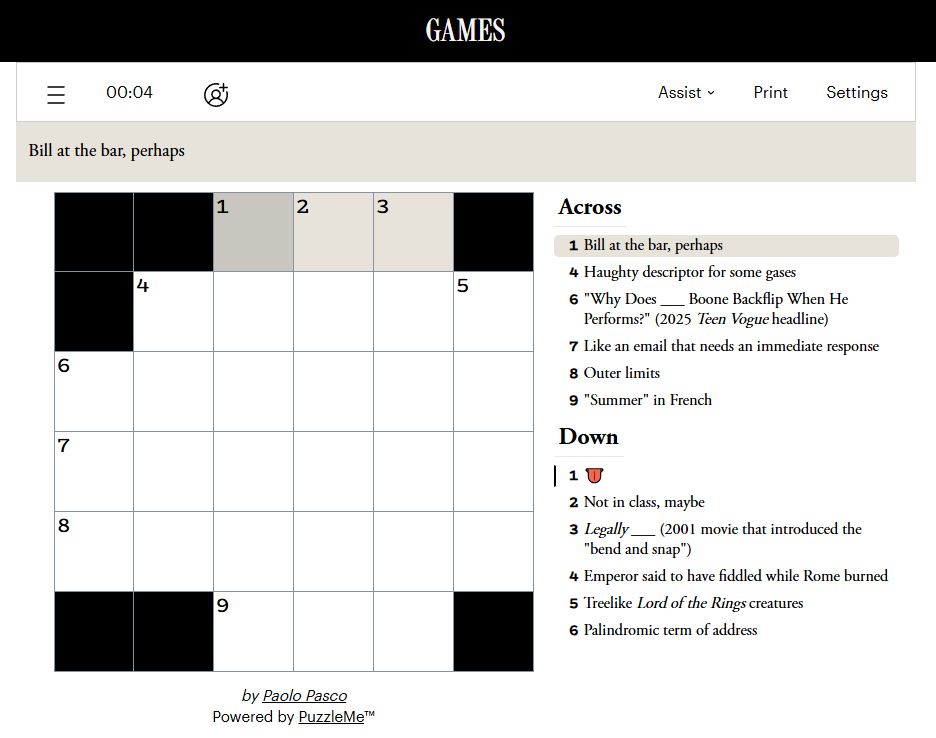
This is familiar territory. A mini-crossword puzzle that increases in difficulty as we progress in the week.
Bracket City
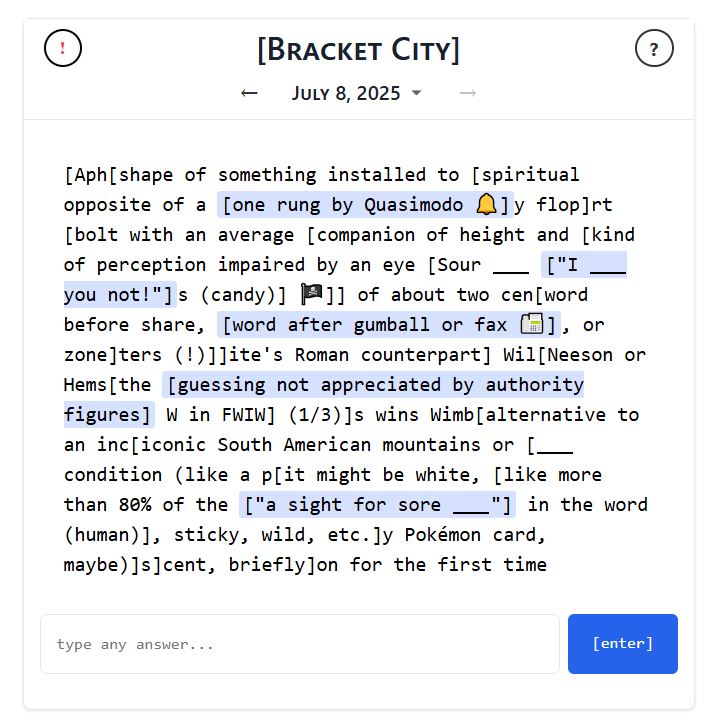
At first glance, this looks like a very strange paragraph. That’s because we’re given a daily historical fact that’s had its insides scooped out and replaced with nested clues. It plays a bit like a crossword puzzle, except your answers form part of another clue. It’s weird, but strangely satisfying.
Fluxis
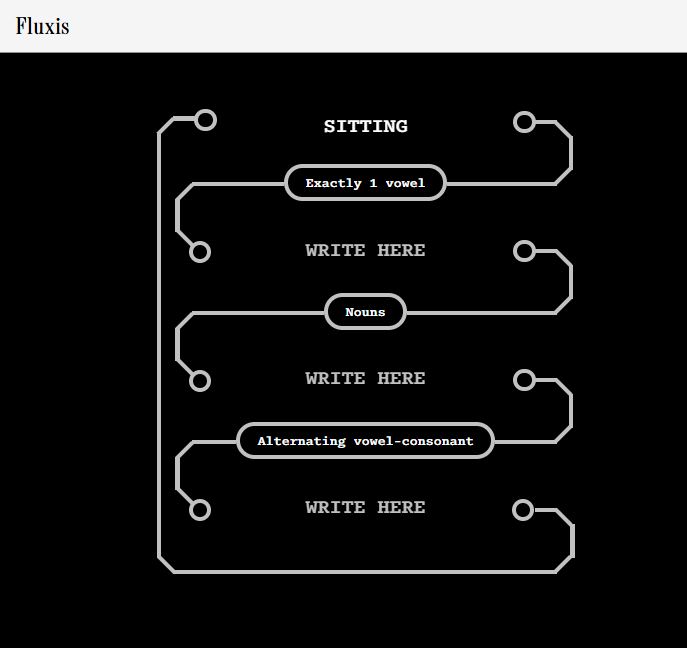
In a way, Fluxis challenges the player to become a puzzle creator. You must link words by forming a chain where the next word starts with the end letters of the previous word. The catch is, each clue must satisfy a certain stipulations. I find this game difficult, but extremely satisfying when I’m able to connect the circuit.
Stacks
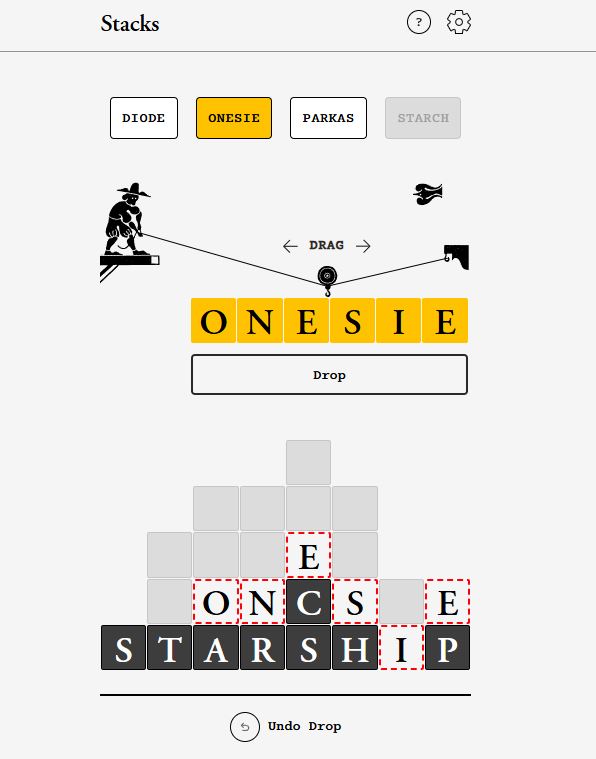
Stacks is a little bit like if Tetris and Scrabble had a baby. You drop words stacking up on each other, but letters will fall through gaps onto words below. It’s solved when you’ve formed new words in each line. Also the little graphic of the word being pulled via pulley is adorable.
LinkedIn Games
by Tammy McLeod
LinkedIn has 6 daily puzzle games, Zip, Tango, Queens, Pinpoint, Crossclimb, and the newly released daily Sudoku.
When you complete a puzzle, it shows “Today’s average” so you can compare yourself to the rest of LinkedIn. You are also shown your quartile position among your connections. It’s a gently competitive system, and though they encourage you to share your result, I am reluctant to spam my professional network with 5 daily posts about my puzzle prowess. I do enjoy spending a few minutes each day completing the games, and it’s nice to see my stats accumulate.
As for the games themselves, Zip, Tango, and Queens are visual/ spatial logic games, and Pinpoint and Crossclimb and word games. Sometimes I’m more in the mood for one type over the other, but I hate to break my streak, so I continue to play them all.

Zip involves drawing a continuous path through a grid that connects numbered squares in order. It is a nice little test of spatial logic, usually taking under a minute. Your score is your final time, though they also show you how many times you needed to backtrack your path, which I try to ignore, since it doesn’t seem to be tracked.
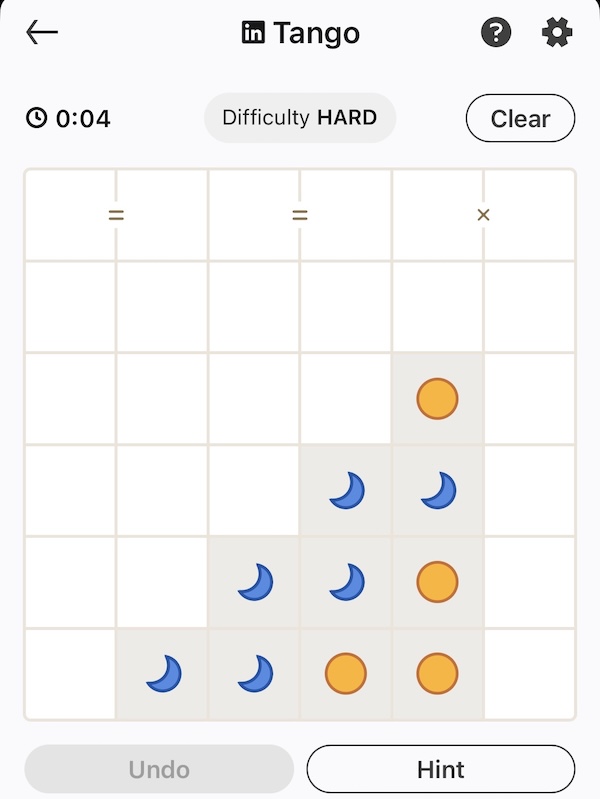
Tango bears similarities to the well-known Tic Tac Logic. You have to fill a grid with suns and moons, with no more than 3 of any symbol in a row. There is always a way of solving it without guessing, which is nice, though sometimes I get stuck for a while finding the next move.
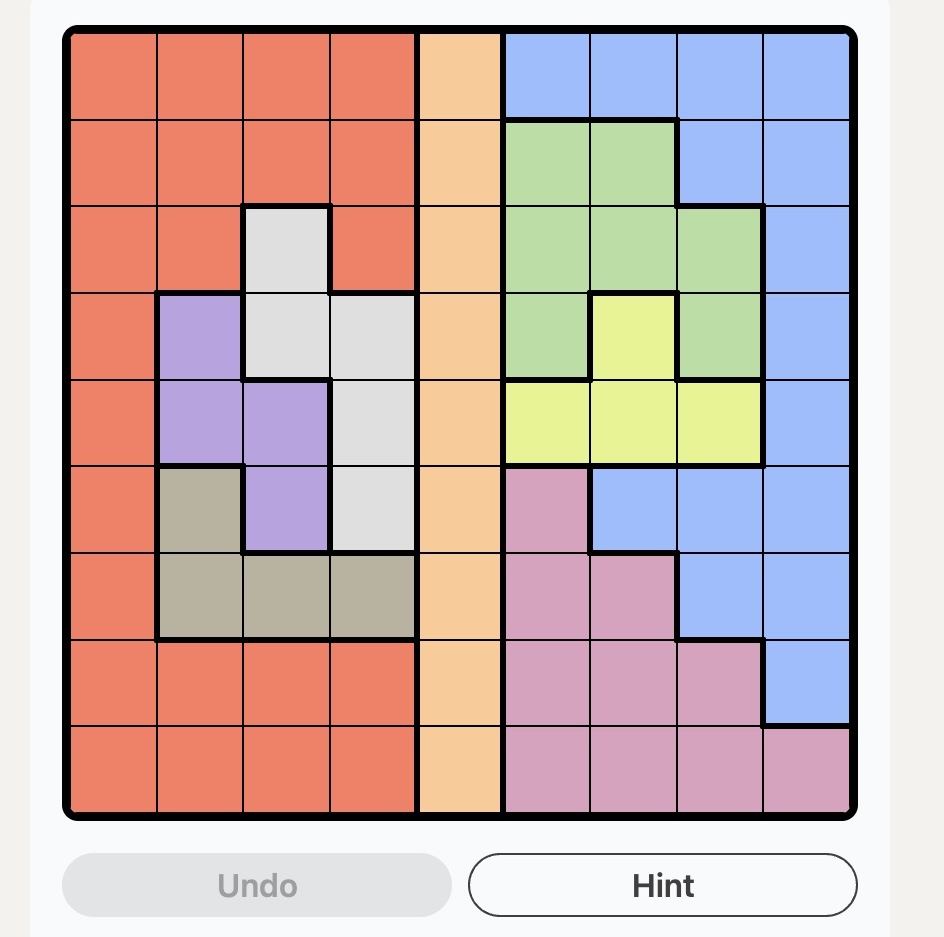
For Queens, you have to place 8 crowns in a grid, one in each colored region, column, and row, with none touching. This one challenges me the most, because of irregular regions. My mind tends to prefer straight lines and blocks only. Your mileage may vary.
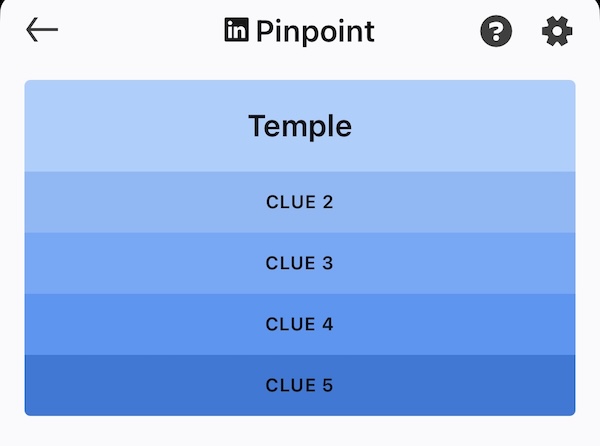
A strong vocabulary benefits Pinpoint players where you have to guess the category as 5 words are revealed one by one. I usually aim to match the average. The system is pretty good at interpreting whether your guess is correct, and I haven’t had any issues with it.
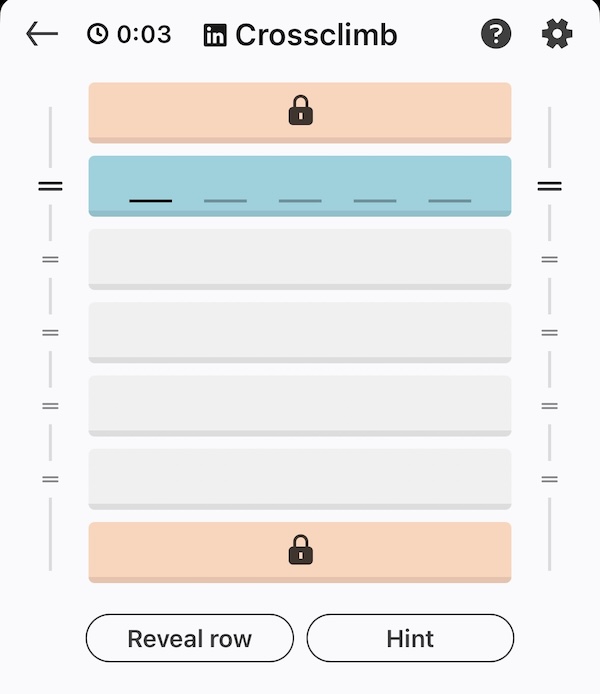
Crossclimb is a word ladder with a twist. You need to solve clues for the words, arrange the words so that they change one letter in order, then guess the first and last words. It’s a rapid fire word puzzle, that I find hard work for something so small!
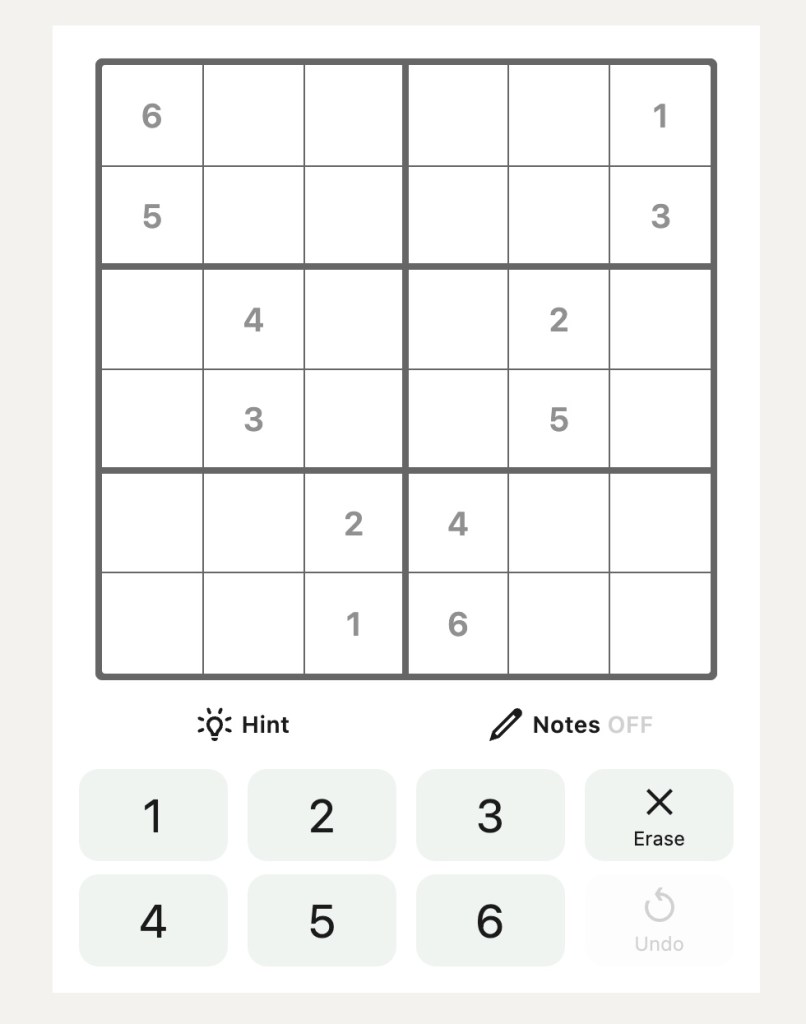
The newly released daily Sudoku puzzle is written by Thomas Snyder, also known as Dr. Sudoku, who is a former champion and published puzzle author. It uses the well known Sudoku rules, but is a mini version, only utilizing the numbers 1-6, and much quicker than a full puzzle. The puzzles that have been released so far are challenging despite the smaller size, and are a worthy addition to the daily gauntlet.
The New York Times Games
by Tammy McLeod
The New York Times Games section has a number of puzzle games, but 3 word games, in particular, stand out for their use of results sharing. Finishing each of those 3 daily puzzles provides the player with the ability to copy and paste their results in emoji form for sharing with others. I am in multiple chat groups where far-flung friends I might normally speak to only once or twice a year, share their daily results. It’s a surprising albeit brief moment of connection, but I am so grateful that it exists. The act of sharing one’s results is socially more active than a passive leaderboard, and I celebrate it!
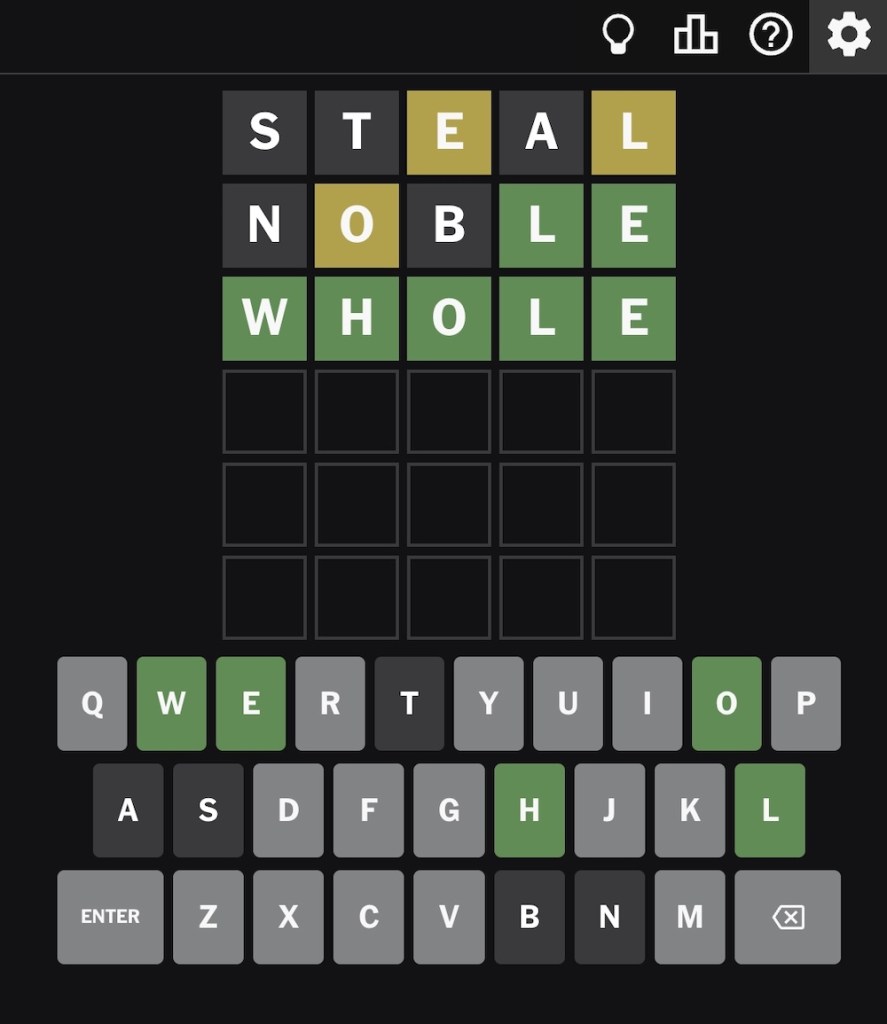
The first game is Wordle, which is a word guessing game that took the world by storm in 2021. The concept is simple. The player has 6 tries to guess a 5-letter word. After each attempt, the game marks a letter green if it is correct, or marks it yellow if it is in the answer, but in the wrong position. If the word is guessed successfully, the player can click to copy a series of colored square emoji, showing the success of their guesses.
Wordle 1,480 5/6*
⬛⬛🟩🟩⬛
⬛🟩🟩🟩⬛
⬛🟩🟩🟩⬛
⬛🟩🟩🟩🟩
🟩🟩🟩🟩🟩
Note the all-important presence of the asterisk after my score, which indicates that I play on Hard Mode, where any revealed hints must be used in subsequent guesses. I am required to include the green and yellow letters that I have. Wordle understands the importance of calling out their players’ effort!

Connections is an association game. 16 words or phrases are shown scrambled and the player has to sort them into 4 themed groups, by selecting 4 at a time and submitting their guess. The groups have a difficulty ranking associated with them, with yellow being the easiest, and purple being the hardest, and a group’s color is revealed on each successful guess. One of the statistics that the system tracks is how often purple is the first group guessed, so I often try to sort out all 4 groups in my head before submitting any guesses. There are usually words from different groups that look like they belong together, so it can be tricky. It doesn’t help that occasionally, groups are things like “Words that end in something that sounds like a body part.” The player is allowed 4 mistakes before losing the game. Some days, the chat groups bond over the trickiness of the purple category. Misery loves company. On other days, we celebrate each others’ success. The daily puzzles have become an unlikely catalyst for building human connection.
Connections
Puzzle #758
🟪🟪🟪🟪
🟦🟦🟦🟦
🟩🟩🟩🟩
🟨🟨🟨🟨

In Strands, the player is given a 6×8 grid of letters that can be broken down into strands of words. The title is a clue to the theme, which is hidden as a “Spangram,” a strand that goes from one side of the grid to the other. The remaining words belong to that theme. Players draw strands to guess the words one at a time, and there is no guess limit. Guessing 3 non-theme but real words earns a hint that shows the letters of one of the theme words. Sharing one’s results shows when hints were taken and when the spangram was found.
Strands #492
“So extra”
🔵🟡🔵🔵
🔵🔵🔵🔵
🔵
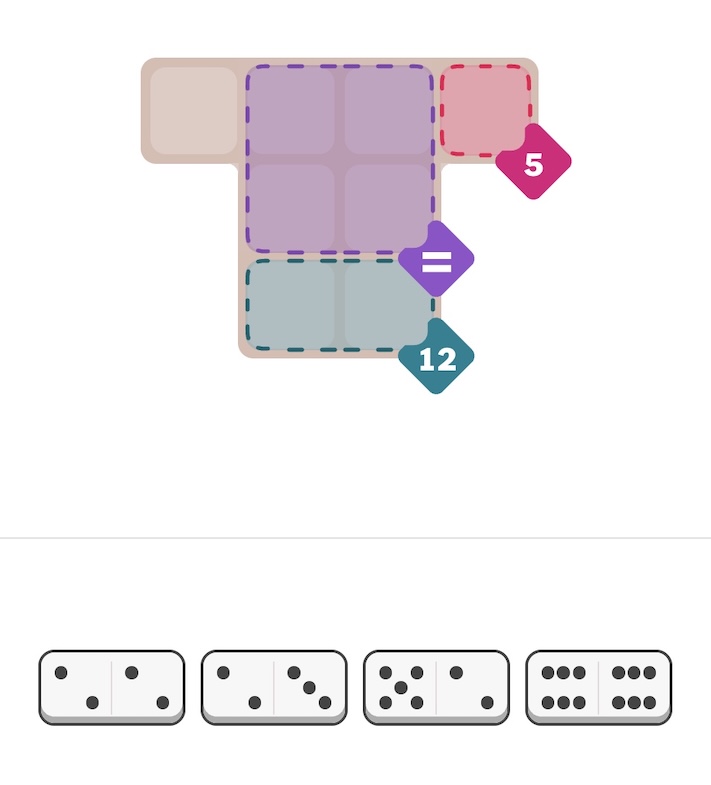
Unlike the other NYT offerings, the newly released daily game Pips is purely number-based and no vocabulary is necessary. Given a layout with various rules drawn on it, the player has to rotate and place all the provided dominoes to satisfy all the requirements. At times the interface feels a bit awkward, so I end up spending more time shifting dominoes than working through the logic. Even so, I really value the variety of having a logic puzzle alongside the word games.
I look forward to playing these games each day, sometimes even staying up till midnight for them to reset. Living on the West Coast, I envy my East Coast friends who gain access to each new day of puzzles 3 hours earlier than I do. But most importantly, I keep coming back, because more than just showing off puzzling prowess, at least once a day, no matter where in the world we are, we are all facing that same puzzle together.
Puzzmo

Since the platform’s launch in October 2023, Puzzmo has become a key part of my daily puzzle-solving ritual. Their lineup of a dozen-some word and logic games is playful, thoughtfully curated, and instantly addictive.
At the center of it all, Puzzmo’s midi-sized crosswords are a breath of fresh air, featuring a diverse cast of designers, modern cluing, an integrated hint system, and a willingness to bend the rules. Other games put more of a twist on the classics: Memoku is a cross between Sudoku and Concentration, Really Bad Chess challenges you to checkmate your opponent… with completely random pieces in all the wrong places, and SpellTower is what you might get if Boggle and Tetris had a child. One of my personal favorites is Flipart, a sort of interactive Mondrian painting where you rotate colorful pieces to fully cover a rectangle. It can be mindless, or you can try to complete a “perfect speedrun” without any extra moves (my current record is 134.) Some of Puzzmo’s most interesting designs involve surprising levels of strategy, as is the case with Pile-Up Poker and one of their newest releases, Bongo. And I’d be remiss not to mention Typeshift, which might be considered the answer to: “what if I just spin the dials on this combo lock and found a set of words that used every letter at least once?” (Naughty behavior in an escape room, but a path to glory on Puzzmo!)
Puzzmo is pulsing with innovation; they’re constantly experimenting with new games and iterating on their existing ones, and they’ve even published a physical book. If you’re looking for bite-sized brain candy that’s approachable yet engaging, with robust support for public and private leaderboards, Puzzmo is the platform for you.
We can’t forget…
The New York Times Crossword puzzle may be the most well-respected daily puzzle game, played by over 2 million people monthly. Will Shortz, the editor of The New York Times Crossword puzzle joined David and Peih-Gee on REPOD to talk about how crosswords have evolved to reflect pop culture, the impact of mini puzzles, and why wordplay connects people in ways you might not expect.
PG’s Playhouse
If you love wordplay, you’ll enjoy our newest podcast, PG’s Playhouse co-hosted by Peih-Gee Law and David Spira. Each episode features a guest, a theme, a set of puzzles, and a discussion pulling all of these things together.
Conclusion
We are loving this trend of daily games, both for the puzzles and for the bite-sized socializing it facilitates. We hope you find a favorite game or two among this list and join us for our daily puzzle ritual.
About the Comments on this Guide
We do not necessarily endorse all the games in the comments on this post, so explore those games at your own risk.
We are playing through them as our writers have time and inclination to do so. We are also receiving a lot of suggestions by email. If we find some we really love in the games in the comments or our email, we’ll add them above as full recommendations.
For the time being, we do not recommend Doodle5, anoun, or 5Qs. With these games, we found that the use of AI for puzzle generation and/ or clues created red herrings and feedback that didn’t meaningfully aid in the puzzle-solving experience. Additionally, answers were often rejected for simply being pluralized or singularized, despite the answer and intent being obvious. With a little more consideration of the player experience, these games could be worth recommending, but when we played, these games lacked the intentionality and thoughtful design that we look for. (By Chuck Kaplan-Smith)
Additionally, we do not recommend Griductive, which emulates the look and feel of Clues by Sam without the personality or humor. While Griductive does boast a variety of grid sizes for alleged difficulty, the clues at each board size (ranging from 3×3 to 5×5) are fundamentally identical. The challenge is merely in the quantity of clues and not their wording. Additionally, in its effort to copy Clues by Sam, it misses one of the key design features: Characters in Clues by Sam are ordered alphabetically, making it easy to find a named character; by contrast, Griductive’s characters are randomly arranged, which makes finding any character in the larger grids tedious. It comes across as something that was procedurally generated, not hand-crafted with heart and wit. (By Chuck Kaplan-Smith)
CoffeeFirst.games is a collection of short (mostly) daily games. Only one of those games is unique, however, which is the chess-based Royal Family. It’s a fun game, somewhat similar to LinkedIn’s Queens game, but with a nicer interface and more interesting. Since the rest of the games aren’t unique, we don’t especially recommend this platform unless you like having a group of standard puzzles in one spot. (By Jacky Chang)


![Escape Comics – The Alien Ship [Review]](https://roomescapeartist.com/wp-content/uploads/2026/01/the-alien-ship-the-alien-ship-1.jpg)


![Games by Stitch – Elsewhere Electric [Hivemind Review]](https://roomescapeartist.com/wp-content/uploads/2026/01/Elsewhere-Electric-Van.jpg)
Leave a Reply