
Elsewhere Electric is a cooperative VR game created by Games by Stitch.

Format
Style of Play:
- Asymmetric co-op. One player uses VR, and the other player is on a mobile device.
Who is it For?
- Best for experienced, patient puzzle solvers
- Players with VR experience
Required Equipment: Meta Quest or Valve Index VR hardware; mobile device
Recommended Team Size: 2
Play Time: up to 30 hours
Price: $24.99
Booking: purchase and play at your leisure
Description
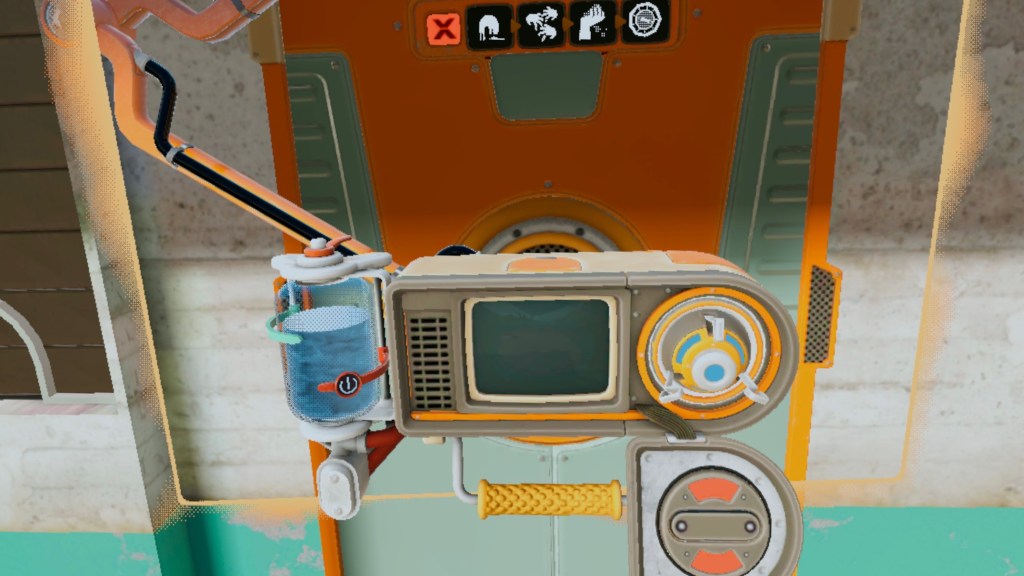
Elsewhere Electric is a two-player co-op game where one player uses a VR headset and the other uses their mobile phone to explore an underground laboratory. Because players shouldn’t see each other’s screens and there’s no built in voice chat, they need to find another way to talk, either by being in the same room or through another method remotely. The VR player will explore the facility, while the mobile player will unlock doors and equipment for them to use.
Theresa Piazza’s Reaction
Games by Stitch created a unique co-op game in Elsewhere Electric, but its gameplay prevents me from recommending this widely. The developers decided both players didn’t need to 1) purchase the game or 2) be familiar with Steam to play Elsewhere Electric, which significantly expanded who I could invite to play this game (always something I’m looking for). While one player needs a complicated setup (steam and VR headset), the other player only needs their mobile phone. Unfortunately the ease of playing ends there.
There’s no onboarding and no narrative story, so players have to be inherently curious about this game to continue playing past the opening screen. Additionally, because neither player should see the other’s screen, players must constantly describe their view to one another. Those elements are a recipe for frustration. Games by Stitch then piles on complications with mechanics like devices draining energy while using resources (reasonable) and invisible alien monsters stealing your energy (excessive) in certain rooms. Solving the puzzle mentally and then failing to execute physically against some arbitrary time limit or finicky piece of technology in an IRL escape room tops the list of my most frustrating experiences, and I couldn’t finish Elsewhere Electric as that seems to be its modus operandi.
Elsewhere Electric would benefit from an on ramp on either the VR or mobile players’s side, but I think most importantly it could also use two difficulty modes. One as is, and one that turns off elements of the games that put players under time pressure, so solvers can get the satisfaction of completing puzzles without needing to repeat the task over and over.
Tammy McLeod’s Reaction
This game started off promising with an intriguing premise. This is a Mandatory Asynchronous co-op game, with one person using VR and the other using a phone app. There were simultaneous challenges of discovery and communication. We had to figure out the interface, environment, and goals without any information or tutorial from the game. Meanwhile, we also had to figure out what we were even supposed to be communicating to each other.
The friction of this introductory experience caused me to lose my partner after an hour of trying to even reach something that felt like a fun puzzle. Unfortunately, it seemed like an asymmetric experience for the players, and a very patient phone partner will be required. I loved the concept, and found the VR portion that I did get to experience promising, but as a casual solo puzzler, this game is probably not my cup of tea.
Ryan Brady’s Reaction
Elsewhere Electric has a 70’s retro-future aesthetic that is refreshingly different and fun to be in. This game takes a huge swing for the fences with its central design concept: the game will tell you nearly nothing. Next to no world-building, no tutorial (beyond one critical item), no manual, nothing.
I believe the intention is for this to be a journey of discovery for players as they poke and prod, slowly determining how the world works. However, for us this was instead a journey of frustration as we struggled to understand how to accomplish simple tasks because we either didn’t understand the game system, or worse, had come up with our own incorrect assumption.
This frustration was compounded by the fact that failure in Elsewhere Electric is very punishing. Most actions require the use of a resource that can only be replenished through a tedious process that involves two scene transitions and starting the level over. I admit this process is thematic, but we were often hesitant to experiment because wasting the resource meant more trips to the van. I think the game would be substantially improved by ameliorating this somehow.
I firmly believe there’s a specific kind of puzzler out there for whom Elsewhere Electric will be perfectly targeted, but it wasn’t us. If that sounds like you, consider taking a leap, but I think this one will be feast or famine for most players.
Disclosure: Games by Stitch provided the Hivemind reviewers with a complimentary play.

![Games by Stitch – Elsewhere Electric [Hivemind Review]](https://roomescapeartist.com/wp-content/uploads/2026/01/Elsewhere-Electric-Van.jpg)
![Great Gotham Challenge – Rockefeller Rendezvous [Reaction]](https://roomescapeartist.com/wp-content/uploads/2026/02/rockefeller-rendezvous-rockefeller-rendezvous-1.jpg)
![Escape Games at the River – Endangered [Review]](https://roomescapeartist.com/wp-content/uploads/2026/01/escape-games-at-the-river-endangered-2.jpg)
Leave a Reply