
The Vanishing is a point-and-click style game created by MysteryXcape.
Format
Style of Play:
- Point-and-click
- Play on demand
Who is it For?
- Read the reviews below
Required Equipment: Computer with internet connection; screen sharing and communication setup if playing remotely
Recommended Team Size: 1-4
Play Time: Approximately 3 hours
Price: $35
Booking: purchase and play at your leisure
Description
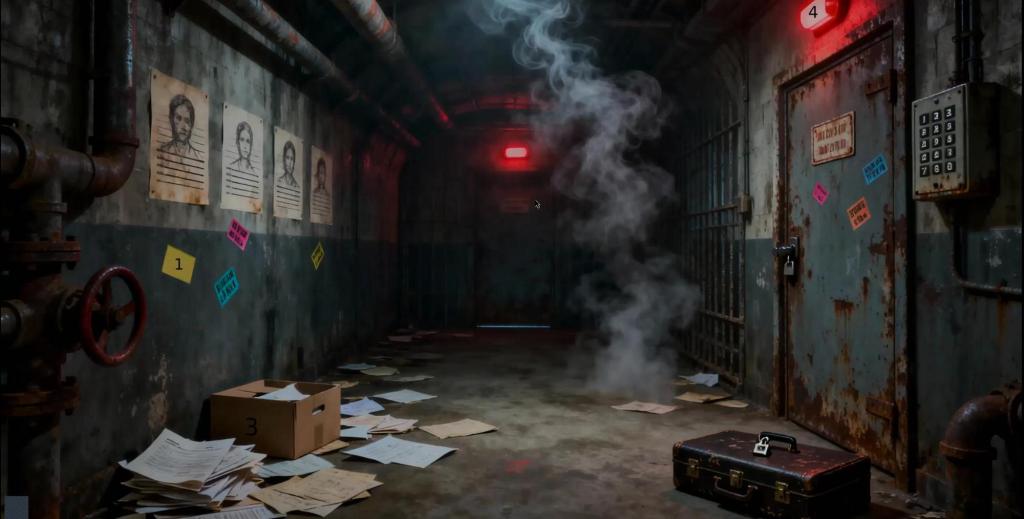
The Vanishing followed Elena Morgan, who had been trapped in a sanitarium. The game itself was disjointed and illogical, displaying apparently AI art and puzzle design with what seemed like little human oversight and editing.

Brett Kuehner’s Reaction
I was looking forward to playing this game with two of my Hivemind friends. The website indicated this was the first chapter in a planned series of connected stories. We’d be solving puzzles and gathering evidence to figure out what happened. From the moment we started, we all got strong “this art is AI” vibes, with telltales like locks that seemed to lock nothing, or a suitcase with an extra handle in the middle of one of the sides. As we progressed, it seemed more and more likely that the entire thing, including the story and puzzles, was created by AI with insufficient human review. Many pieces made little sense and did not connect to anything else in the game. Puzzle logic was often either missing or impossible to understand.
The point-and-click interface was OK, though it lacked modern convenience features. It would have been nice to have a volume control for the background music or an option to give indications of what was clickable without scrubbing the cursor over the entire screen. When we solved a room, we’d transition to a new location that seemed to have no connection to the previous one, and sometimes they were very much at odds with each other, like when we left an underground flooded basement room and went into some kind of child’s jail cell with no indication of water anywhere and with a window. Or when we opened a box and were suddenly in some kind of medical office with no explanation.
Following the same pattern, the puzzles were uniformly very poorly designed, with plenty of information that was never used. There were poems that were supposed to be clues but merely had the form of a clue but no actual cluing. At one point I said “It’s not even like a bad human puzzle,” because of the alien logic that seemed to be involved. I did enjoy one puzzle that required us to construct a key for a lock out of different pieces. It was easy, but at least it made sense and was fun to execute. That was about two hours into the game, though, so it meant there were many many not-enjoyable puzzles we had to get through before it.
Often when doing a Hivemind review, we consider taking a hint just to see what the hint mechanism is like. Sometimes we take hints because we’re truly stuck. This is the first time I can recall taking hints simply to end the pain of a terrible puzzle. Sadly, the pain continued with hints like “The numbers indicate the order in which they should be entered” or “There is an image somewhere in the room that contains a code. Have you found it?” We ended up taking multiple hints on some puzzles, with the first hints giving only obvious information and the last hint giving the answer with no explanation of how it was derived. In general the hints did not seem to have been reviewed for usefulness by any humans. In some cases, even with the full answer, we had no idea how we were expected to have gotten it.
After two hours of unsatisfying struggle, and with no indication of how many rooms were left, we decided to stop. Later that evening I gave it one more try by myself and finished the game. It turned out that we had been on the last room, which, like the others, was filled with meaningless and arbitrary puzzles. Once I completed that room, I got to an “ending.” Neither the ending nor the information I gathered along the way answered the questions that we were given at the start. They seemed to be answering some other questions entirely, like the writer of the ending had not bothered to read the beginning. Overall, the game felt like a disjointed set of vignettes with no logical connection between them. Whether the game was created by AI (which seems very likely) or by humans, it is a perfect example of how it isn’t enough to simply follow the forms of puzzles and clues. You have to understand the principles of what makes a challenge fun, and need to have a goal beyond “some kind of puzzle goes here.” Without that, a game is at best going to feel hollow, and at worst it will be a random and frustrating collection of puzzle-like moments linked by story-like connections, generating frustration and anger instead of satisfaction and joy.
Tammy McLeod’s Reaction
The game opens with a promising theme and polished art, but quickly loses direction. There’s no real sense of a cohesive story, and the puzzles drown you in unnecessary information with little guidance on what’s important. On many occasions, the clues don’t actually make sense, which only adds to the frustration. The locks don’t resemble anything grounded in reality, further breaking immersion. Instead of feeling thoughtfully designed, the whole experience turns into a gauntlet of tedium. The experience strongly suggests AI involvement in the design, and if so, it’s a compelling example of why it should never replace thoughtful, human-crafted puzzle design.
Chuck Kaplan-Smith’s Reaction
From its first use of generative artificial intelligence in the introductory exposition’s visuals and voiceover, MysteryXcape’s browser-based escape room experience The Vanishing presents players with a character wrongfully committed to an insane asylum. Through its broken puzzles, lack of adequate gating, soulless narration, inconsistent and incoherent art, baffling hot spot mapping, and functionally-nonexistent hint system, the experience challenges players to consider, “Is the browser-based escape room game The Vanishing’s pervasive use of AI art, writing, cluing, and audio all a fourth wall-breaking experiment in imbuing participants with the same feeling of insanity as its unseen protagonist via its senseless imprisonment of our joy?” The answer, sadly, is no.
In fact, this farcical query falsely implies that human creativity guided this project. This is textbook AI slop. The product peddled here only makes one wonder how a person could possibly sell an experience they positively have not played themselves? While REA would never spoil a game for others, The Vanishing is not a game — and it does plenty to spoil itself. To start, the puzzle “design” smacks of AI through its absence of obvious entry points, coherent hinting, or —oftentimes— genuine puzzles. You found a teddy bear and a knife? Great! Just make sure you cut the bear using a particular pattern, or your efforts will be rendered moot (and this is one of the less-maddening “puzzles.”) Other times, you’ll be tasked to fish out numbers from a sea of noise, but even being handed the solution will not allow you to backsolve and uncover the logic of the “puzzle.” And that’s if you can even find the “puzzle.”
Like many in-person rooms rely on searching, digital escape rooms require blanketing the screen with clicks to find a hidden interaction. This is never pleasant, but it’s expected. In The Vanishing, crucial places to click only offer a pixel or two for that object’s hot spot. Without pinpoint accuracy, you may spend minutes scrubbing the screen and still miss essential elements. The experience’s visuals also add confusion. The hot spot for a glitchy, distorted 15-digit keypad leads you to an input screen with far fewer digits, which look markedly different than those on the prior screen. A briefcase hosts a second handle on its side, and that superfluous, cosmetic handle hosts an equally-unmerited lock. Bloody handprints range from the size of an infant’s palm to about a yardstick wide. Scant cutscenes immediately jump cut to the next bland and sloppy location with no sense of visual cohesion or progression of the story.
Want a hint? Sure, you can have them! Here’s a sample: Clue #1: Have you opened your eyes? Clue #2: You can see writing on the wall once you open your eyes. Solution: The answer is 4-8-15-16-23-42, and there will be no further questions. These vague responses feign the idea of progression, but without a consideration for how one would access the puzzle and then solve it. The absence of truly progressive hints makes the time penalty sting worse when you are left more confused than before the “hint” was doled out. Full disclosure: The weight of these frustrations caused two-thirds of my team to abandon the game on what we were later told was the final room. There was no sense of forward progress, no build-up in the story, and no genuine incentive to continue. The Vanishing stands out as an exemplar for all digital experience designs of why art cannot be outsourced and why play testing is essential. What MysteryXcape is selling is a bad-faith offering that will cause your patience, trust, and hope for a good game to vanish.
Disclosure: MysteryXcape provided the Hivemind reviewers with a complimentary play.
![Artifact Escape Game – 404 [Review]](https://roomescapeartist.com/wp-content/uploads/2026/04/404-404-1.jpg)
![Artifact Escape Game – The Prime Artifact [Review]](https://roomescapeartist.com/wp-content/uploads/2026/04/artifact-escape-game-the-prime-artifact-2.jpg)
![The Archives of Trevosa [Hivemind Review]](https://roomescapeartist.com/wp-content/uploads/2026/08/the-archives-of-trevosa-the-archives-of-trevosa-1.jpg)

Leave a Reply