
An at-home escape game that bytes back
Location: at home
Date Played: July 2026
Team Size: 1-4; we recommend 1-2
Duration: 9 hours
Price: about $25-30
REA Reaction
Escape Tales: Low Memory is a challenging at-home escape game in nearly every aspect. The rules set and components challenged me to grasp an intricate game system before even solving the puzzle of how to organize my table space. As a choose-your-own adventure game, it boasted dozens of pages of story spread across three booklets. And once the paragraphs of text gave way to puzzles, the cluing challenged me with figuring out which was lacking more: the game’s cluing or my cognitive ability.
Elements of the game felt akin to board games. Completing key puzzles or sections of the game unlocked story cards that captured crucial character memories. A grid-based board and location reference cards allowed for simple investigation of game elements without text covering up the art. A tight economy surrounding action tokens encouraged careful exploration.

However, other elements evoked memories of the more frustrating traits of choose-your-own-adventure games. Many points of interest wasted a valuable action token, even occasionally insinuating that I should have known that element was a poor choice. The final decision of the game asked me to make sense of the contradictory elements I encountered in the game. However, the game already moved several of my necessary cards to the recycle bin as punishment for chasing red herrings. This forced me to make a critical decision with gaping holes in the story.
The oversized Black Mirror-esque story challenged me to grapple with the ephemeral nature of memory and humanity’s complex relationship with technology. The heavy ideas presented themselves through three disparate stories or chapters, each anchored by its own character. Shocking, sudden moments of violence or trauma popped up throughout the game. For me, the moments felt narratively deserved. For people with sensitivities to such elements, this game may not be for you. Like a Christopher Nolan or Quintin Tarantino film, the story proved polarizing and required me to construct my own meaning. What separates challenging cinema from Escape Tales is that films don’t punish you for taking time to fully explore them.
Low Memory allowed for player agency over a handful of branching paths or decision points. This led to an ending uniquely shaped by the decisions I made. In peeking at the other endings, I noticed the game stopped short of telling players they’re wrong, but certain endings did acknowledge successful interpretations of the abstract and fractured yarn spun throughout the game.
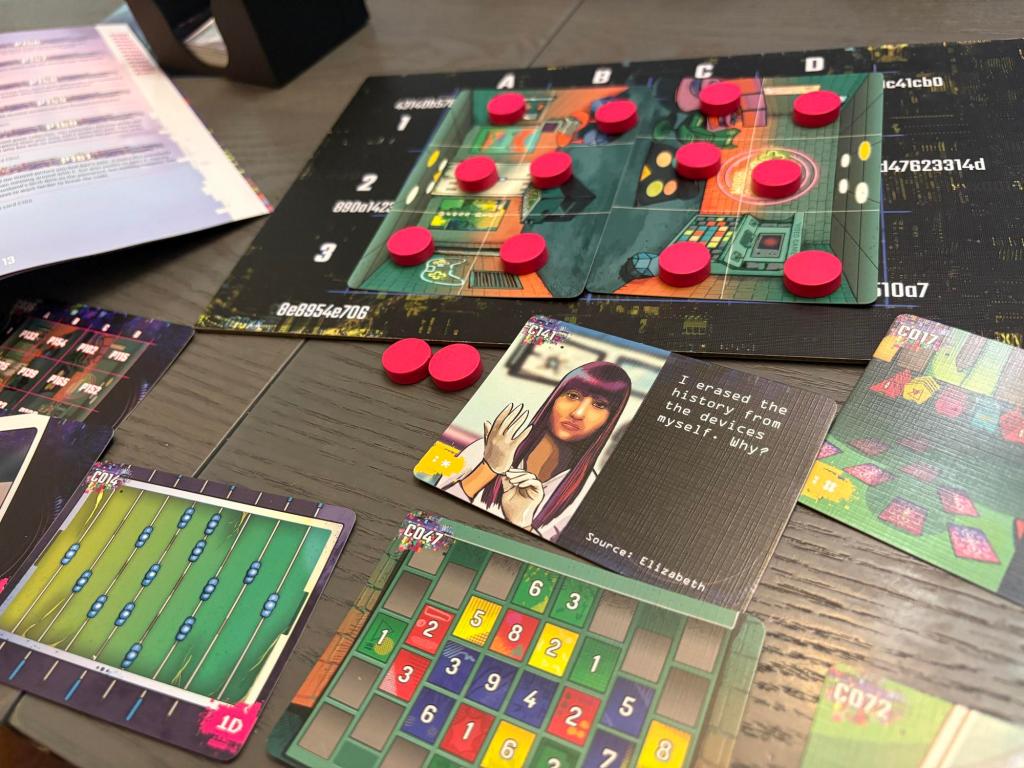
The puzzles required extensive processing power to solve. In a landscape that usually skews toward E for Everyone, having a truly challenging and brain-bending experience was novel. What demanded debugging was the framing of the puzzles. Oftentimes, story text in a 10+-page booklet would provide crucial context to solve a puzzle. However, the unlocked puzzle cards from said text didn’t back-reference the essential flavor text. This rendered already-challenging puzzles that required tremendous abstraction nigh impossible (unless you remembered to flip back to the right entry in the story booklet). The web app offered tiered hinting, but sometimes all the hints and the solution lacked sufficient detail to understand how a puzzle wanted to be solved.
Escape Tales: Low Memory left me with a sense of appreciation for its ambitions and a heap of frustration with its gameplay. The game offers a bold take on the genre, but most players won’t have the mental bandwidth to deal with its glitches.
Who is this for?
- Story seekers
- Puzzle lovers
- Sci-fi fans
- Best for players with at least some experience
- People looking for another reason to be afraid of technology
- Fans of Black Mirror (this group may be indistinguishable from the above bullet point)
Why play?
- The branching puzzle paths that led to a unique ending
- Playful microdoses of psychic trauma
Story
In the cyberpunk dystopia of 2060, Elizabeth awoke to fractured memories and an upturned home. She turned to a memory scanner and unearthed truths better left forgotten.
Setup
Flavor text from a narrative book opened up each section of the game. This flavor text lead to a location card (or cards) with multiple points of interest to explore. Each point of interest lead to more flavor text; this resulted in either a dead end or puzzle cards. The web app collected answers to puzzles and then pointed to new sections of the story book. Solving major puzzles or reaching significant beats in the story unlocked a story card (representing a core memory of a character). This gameplay loop was copied-and-pasted throughout.
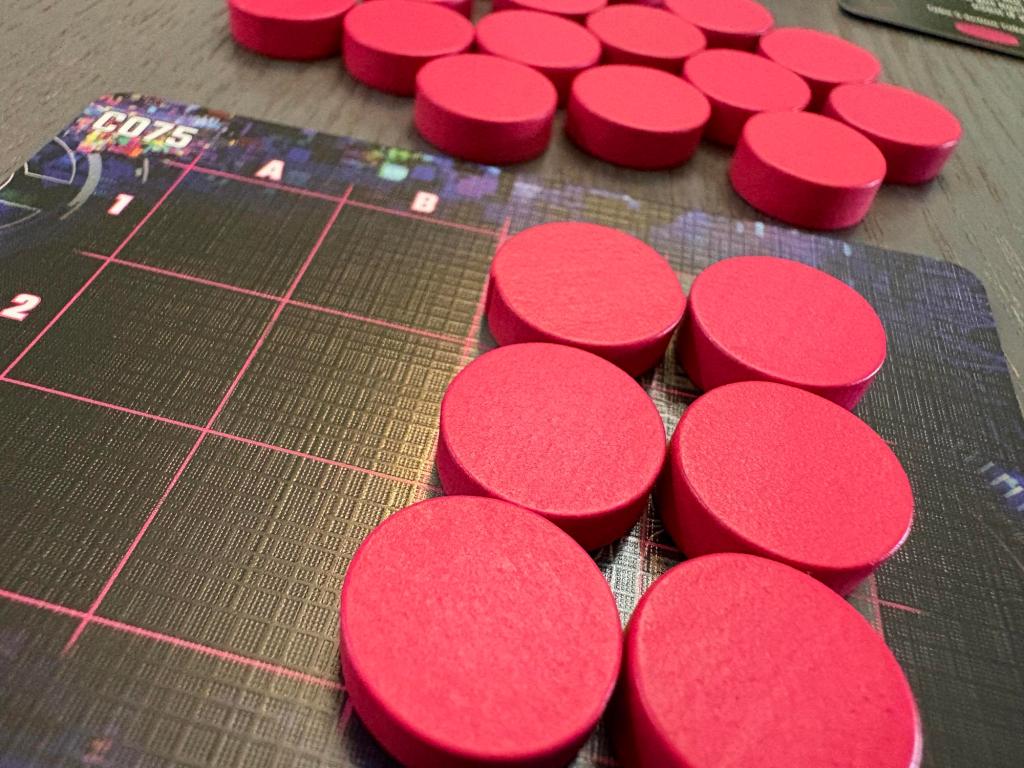
Action tokens stood out as the most unique portion of the game, a finite resource representing time and strain on the character. Investigating a quadrant of a location card cost one action token. However, running out of action tokens resulted in a stress card that often stripped away a previously-earned story card. The game then issued more tokens to continue exploration.
Gameplay
Board & Dice’s Escape Tales: Low Memory was a card-based play-at-home escape game with a moderate-to-high level of difficulty.
The puzzles required keen attention to detail, making connections, a large degree of abstraction. The difficulty stemmed from minimal cluing.
Analysis
➕ The story’s ambition in scope and framing wowed me. It told a high-concept, sci-fi story in a gripping fashion.
➕ At various points, the game offered a branching path, meaning some puzzles and story beats remained a mystery. The content remaining wouldn’t deserve a replay, but it does add legitimacy and weight to the player’s agency.

➖ The box recommended the game for players 16 years or older. While the box warned of small parts unsuitable for children under 3, it bore no notice of the multitude of heavy topics addressed within the game. The game’s website listed a single topic as a content warning, but most players will likely ever see that. Reference the bottom of this review for a more extensive list of content warnings.
➕ The puzzle cards featured clear markings to show which puzzle they belonged to. This clear signposting allowed for the challenge to be solving the puzzle, not discerning what elements belonged with the puzzle.
➕/➖ The puzzle difficulty made for euphoric solves, as well as many moments of sheer bafflement.
➖ Several late-game puzzles’ hints lacked sufficient detail for me to understand how to solve the puzzle. Even with the solution, the way to solve the puzzles remained a mystery.
➕ The creative use of cards allowed for dynamic maps and environments, evoking board games like Arkham Horror: The Card Game or T.I.M.E Stories.
➖ Even 7 years after release, many typos persisted in the web app (and, less surprisingly, in the printed booklets). While none were game-breaking, it did take me out of the story momentarily.
➖ The action token system punished exploration by taking away crucial story cards (i.e., if I took too many turns, the game doled out a punishment.) These punitive measures insinuated that skillful investigation was a possibility. However, the narrative would emphasize objects present in the location illustrations, only for me to learn that such an object was a dead end. The existence of red herrings made me feel bad for paying attention to the story. It sapped my desired to explore, which is one of the core pillars of the game.

Content Warnings (click to expand, minor spoilers ahead!)
The game deals with stressful and weighty topics like memory loss, gambling addiction, home invasion, infidelity, assault, murder, and suicide.
Tips For Players
- Space Requirements: a small table
- Required Gear: a web-enabled device, paper, and a writing implement
Buy your copy of Board and Dice’s Escape Tales: Low Memory, and tell them that the Room Escape Artist sent you.
![Board and Dice – Escape Tales: Low Memory [Review]](https://roomescapeartist.com/wp-content/uploads/2026/07/escape-tales-low-memory-escape-tales-low-memory-1.jpg)
![clueQuest – Post Mortem [Reaction]](https://roomescapeartist.com/wp-content/uploads/2026/10/post-mortem-post-mortem-1.jpg)

![Paradiso Escape Room – Project DCrisis (Proyecto DCrisis) [Review]](https://roomescapeartist.com/wp-content/uploads/2026/09/project-dcrisis-project-dcrisis-3.jpg)
Leave a Reply