
Help your escape room feel more alive by infusing some life into it. Games feel more real when they are occupied by living beings. The best way to add life to an escape room is to do just that, include a live performer (or the illusion of one) into the game. Even small hints of another presence can be impactful.
Hiring dedicated actors isn’t required for achieving the effect of an inhabited game world. There are multiple techniques that can be used to do the job. I will highlight a few of them here.
Go All The Way
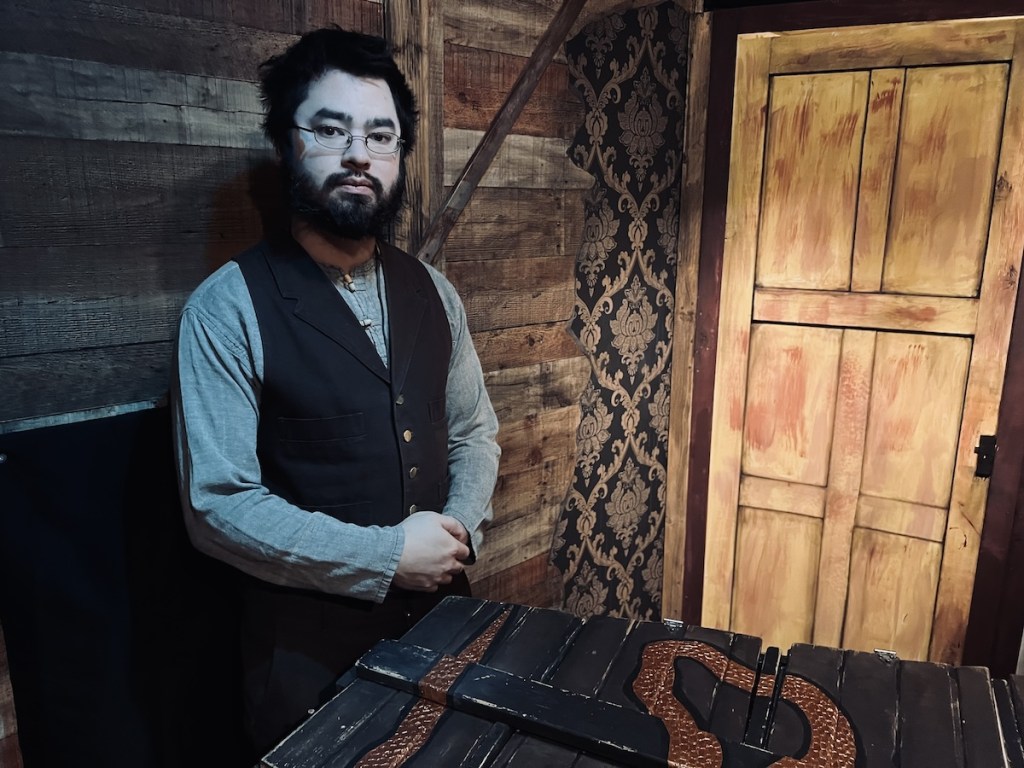
The most obvious way to include a non-player character in an escape room is to have a performer inside the game space for a significant period of time. Sometimes separated from the players by some sort of physical barrier, this person can also act as the hint system and even run show controls through hidden switches or tech they carry with them.
However, the amount of time a performer needs to be in the room to leave an impression on players can be quite small. Meaning a little bit of acting goes a long way. Brief visits from a live character might be all that is needed to create a tremendous change in the feel of a game.
If your gamemaster can pop into the game space as a character once or twice, for whatever reasons the story might require, even for a minute or two, it may be enough to really elevate the experience.
When a real person comes in to tell players important information or asks the players for help it is a more meaningful interaction, because that person actually exists. When a live character is performing, players pay attention in a way that they don’t to a video or a voiceover. When an actor asks a question, and then waits for a response, players are forced to reflect on the story and the situation and then verbalize what they know. These are the moments that players will remember.
Sometimes live performers fit into an escape room as proprietors of an establishment that players need to visit. For example, I played game where players were required to visit several equipment vendors to procure the supplies needed to complete the game’s mission. The sets included that valuable physical barrier between parties and the fun, quick, banter/ barter interactions provided us with the materials necessary to progress in the game. That section was a true highlight of the game and one I remember years later.
Tricks Of The Trade
There are a variety of ways to add life to an escape room without requiring a performer to be face-to-face with guests. There are solutions to fit almost any budget.
Some games employ puppets, robots, or animatronics to bring that spark to their experience. Charismatic non-human hint givers and storytellers that may better fit the performance preferences of certain staff members are a great option. These methods provide a sort of proof-of-life that video and audio alone just can’t match.
Players may hear a cough, a laugh, a mumble, or a scream coming from the darkness or just around some corner and suddenly, there is life in the room. A face peaking through a window or a shadow of a person (or a creature) projected on the wall or through some fabric means that we are not alone. A furry paw reaching under the door screams, “The wolf is just outside!”
Something I have always wanted to see is a scenario where players enter a space just in time to catch a glimpse of someone else leaving that same space. There is a thrill of “who was that?” or “there they go!” followed by “where did they go?” and “are they coming back?” The story’s characters are now real without any acting.
The opposite of that mechanic would be if the players knocked on a door, rang the bell, or inserted a key right as someone opened that door and told them to “Go away!” or maybe invited them in but unfortunately they were “just leaving,” thereby giving the players unaccompanied access to this new space. An encounter lasting less than 30 seconds can create a lasting memory for the players.
Onboarding Options
Game onboarding provides an opportunity for a front desk host to brief the players and show them to the game space where the actual gamemaster is already present, in character, living in the world. They can quickly exit to the control room after performing some character interaction that welcomes the players to a world that someone lives in, works in, owns, or otherwise cares about, and the game can continue on from that point just like any standard escape room.
From The World Outside
The game world is bigger than the game space. It is reasonable to expect characters to enter and leave from time to time. Information and even items can be introduced or removed from a room with this mechanic.
A well timed operation could design ways for multiple gamemasters to briefly visit the players over the course of an hour. By covering for each other in the control room, different characters would be freed up to interact with customers in different games at different times.
Mail delivered to a mailbox or a package delivered to the front door, even a phone call coming in from the outside are all small things that can make a big difference in the feel of the world.
Scenes
Some of the highest demonstrations of art that I have experienced in the escape room medium are when actions we take as players initiate dramatic scenes played out between two performers. I would love for some imaginative creators to find ways to scale this concept down to make it more approachable to a variety of escape room operations.
Refresh And Redesign
As older escape rooms are due for an update or a refresh, some creators are finding ways to include performers in the newer versions. This is an excellent opportunity to experiment with trying to enhance a proven product without the gamble of designing an entire game around actors. The game flow doesn’t have to change, but the stakes can be intensified with a character-driven introduction or the world can feel more real with an in-character hint system.
Breathe Some Life
The techniques mentioned here, along with many others not listed, make players appreciate the extra resources and effort that went into their playthrough. Sometimes, with just a little added character interaction, it can feel as though a whole host of people are being dedicated to a single game… our game. How special is that?
All of these options can help to add something amazing to an escape room experience, to help make them more memorable. There is a chasm of space between the basic escape rooms that feel devoid of life and the actor driven experiences that are impossible to forget. This space leaves so much room for creators to find their own ways to bring their games alive, with living characters that players can more easily connect with and care about.




![Dare 2 Escape – Camp Harvest Moon: Prank Wars ’92 [Review]](https://roomescapeartist.com/wp-content/uploads/2026/03/Dare-2-Esacpe-Camp-Harvest-Moon.jpg)
Leave a Reply