
“Our lives are one masked ball.”
Location: New York, NY
Date Played: November 4, 2025
Team Size: approximate 60 people per “pulse” (or group) seeing the show – come alone or with others
Duration: 2 hours
Price: ranging from $195 – $395 per person, depending on the day of the week and time of the performance
Ticketing: Public
Accessibility Consideration: Audience members should expect to be on their feet for most of the 2-hour performance. You’ll walk through and between spaces, including up and down stairs and across uneven surfaces. The show includes haze, strobe lights, and laser effects. (There is an elevator to accommodate accessibility needs; reach out to Masquerade directly for details.)
Emergency Exit Rating: [A+] No Lock
Physical Restraints: [A+] No Physical Restraints
REA Reaction
I wasn’t hopeful going into Masquerade, but my skepticism was proven wrong. I loved it.
In New York City, we’re coming off of a year where the long-running iconic show Sleep No More crumbled on the altar of urban redevelopment, and its hypothetical heir, Life & Trust, vanished into a puff of smoke with no notice mere months after opening. We were staring down the likelihood that New York City would be without an ongoing blockbuster immersive theater production. Things looked bleak, and to me, an immersive recreation of a Broadway show didn’t seem like the answer.
I was wrong, and I am thrilled.
From my perspective, Phantom of the Opera is a tired show with some great music but an uninspiring plot, and characters that are, at their best, difficult to root for. Mix that with all of the potential variability of experience in a large-scale immersive theatrical production, and I figured that Masquerade would bore immersive theater diehards and alienate traditional theatergoers.

I didn’t expect the production team behind Masquerade to put in the work to make a truly streamlined, accessible, and fair show, while also smoothing over some of the more egregious issues with the show’s titular character.
Mix that with fiery performances from the whole cast, and New York City has an ongoing immersive theater production that I deeply believe in. These performers gave everything that they had in them, and everyone in the audience didn’t just see it, they felt it.
I never would have recommended that my parents go see Sleep No More or Life & Trust. With these shows you had to either work very hard to get a good time… or get lucky. I’ll happily encourage my parents visit Masquerade. What it trades off in depth and possibility, it makes up for in consistency and fairness. Maybe I am getting older, but I am in love with the idea that everyone who walks through the door of Masquerade will have roughly the same experience that I had… because I adored that experience.
Immersive and Approachable
You can’t go wrong in Masquerade. The show was on rails, and each pulse was guided through the show together.
You’ll experience each scene from your own vantage point, which could be right next to a performer, or from the back of a larger room. No matter where you are for the scene, you can see and hear. Depending on where you’re standing, you might lock gaze with a character, hold a prop, or similarly engage with the performers.
The show was balanced and fair. Every audience member sees every scene. It didn’t award aggression like other styles of immersive theater, where audience members fight for positioning within a scene. There’s nothing to be gained by being first into the room, and the audience is choreographed through the space so that over the course of the performance you’ll be first, last, and in the middle.
The show staff were always present, invisibly guiding us into place and curating the experience for every audience member.
Structurally Complex
Masquerade is a pipelined immersive show, with six pulses per night (or weekend afternoon). This means six entry times, which are staggered by 15 minutes, and each see the same show in succession. The main characters – Phantom and Christine – stay with a single pulse all night. The other characters are choreographed so that they perform for two or three pulses, and the ensemble performs for all pulses. It’s an impressive feat of logistics.
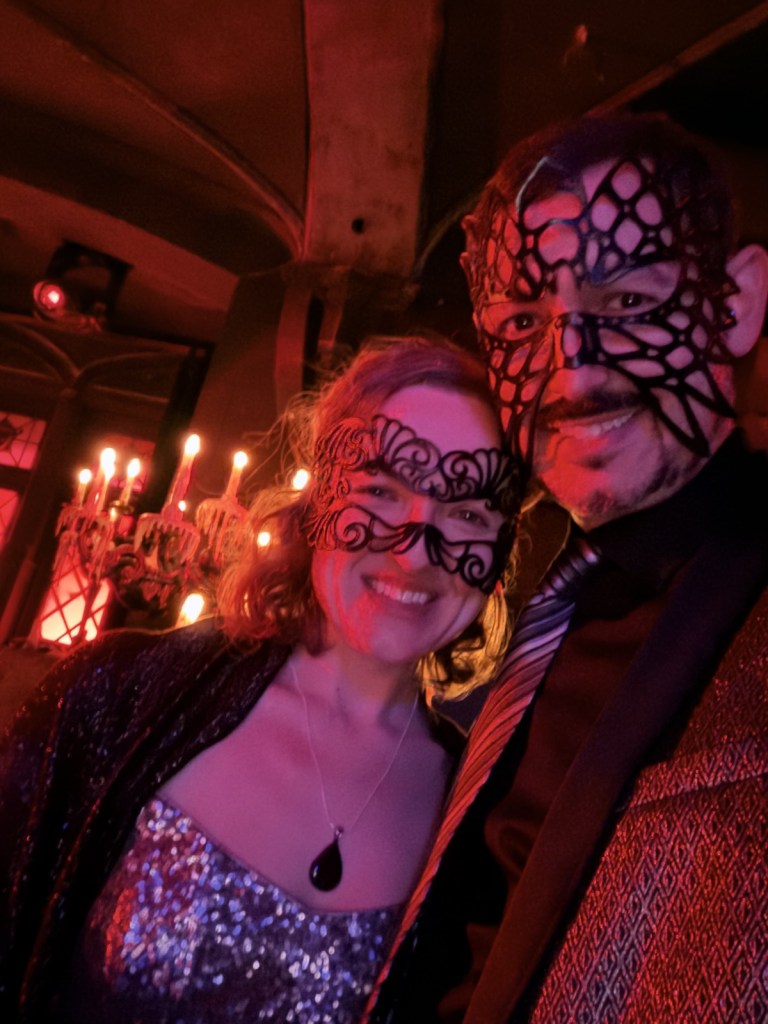
As an audience member, you don’t see any of this. It happens invisibly behind the scenes as the show unfolds in front of you. You never cross paths with any of the other pulses as you move through the sets and see all the scenes. Your actors are the characters. Nothing else matters.
Resonance
The actors were incredible. We felt that about each performer we saw, and we’ve heard the same from friends who saw different performers in the same roles. The actors poured themselves into these roles. It’s touching to see these performances up close, and the emotional resonance of certain scenes landed really well in this no proscenium format.
With this staging, the iconic scenes that are the most memorable are the emotional ones where the characters make themselves vulnerable.
More theatrical iconic scenes didn’t always land. For example, one scene that brings the house down wasn’t as exciting as it could have been in this close up format.
The Phantom of the Opera, Enhanced
Masquerade reworked the telling of The Phantom of the Opera, and in our opinion, it was better for these changes. They dropped some of the scenes that dragged in the original show.
Most notably, they made the Phantom a more sympathetic character. They invented new scenes from his childhood, giving him a fleshed out backstory, and making him more relatable. We appreciated the show more by better understanding the Phantom.
The music has always been my favorite part of The Phantom of the Opera, and it did not disappoint. The sound design in Masquerade was incredible and the music was outstanding. The violinist was phenomenal.
Sprawling Set
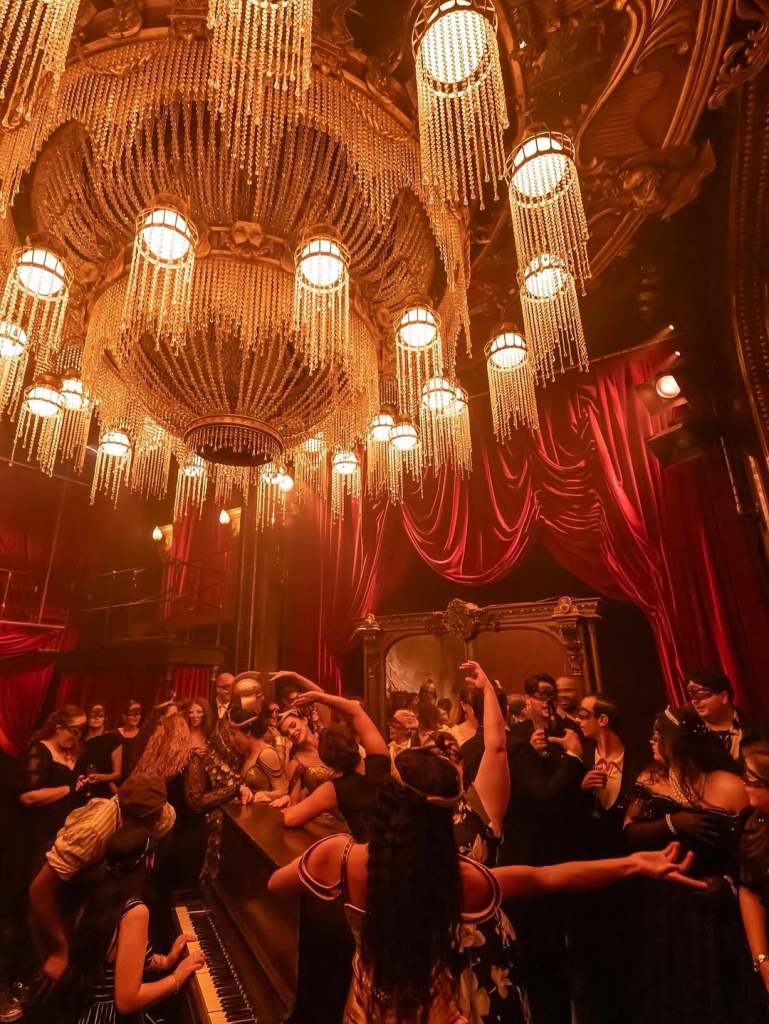
The set was enormous, spanning multiple stories inside a Manhattan building, including a scene outside in the courtyard. The set was beautifully decorated, creating a sense of place for every scene. There were some beautiful reveals.
A few scenes felt under-designed, as if Masquerade had run out of budget or time. There were opportunities to make some scenes feel more natural or more lived in. And one reveal led into a big area that felt a little too empty as it came into view.
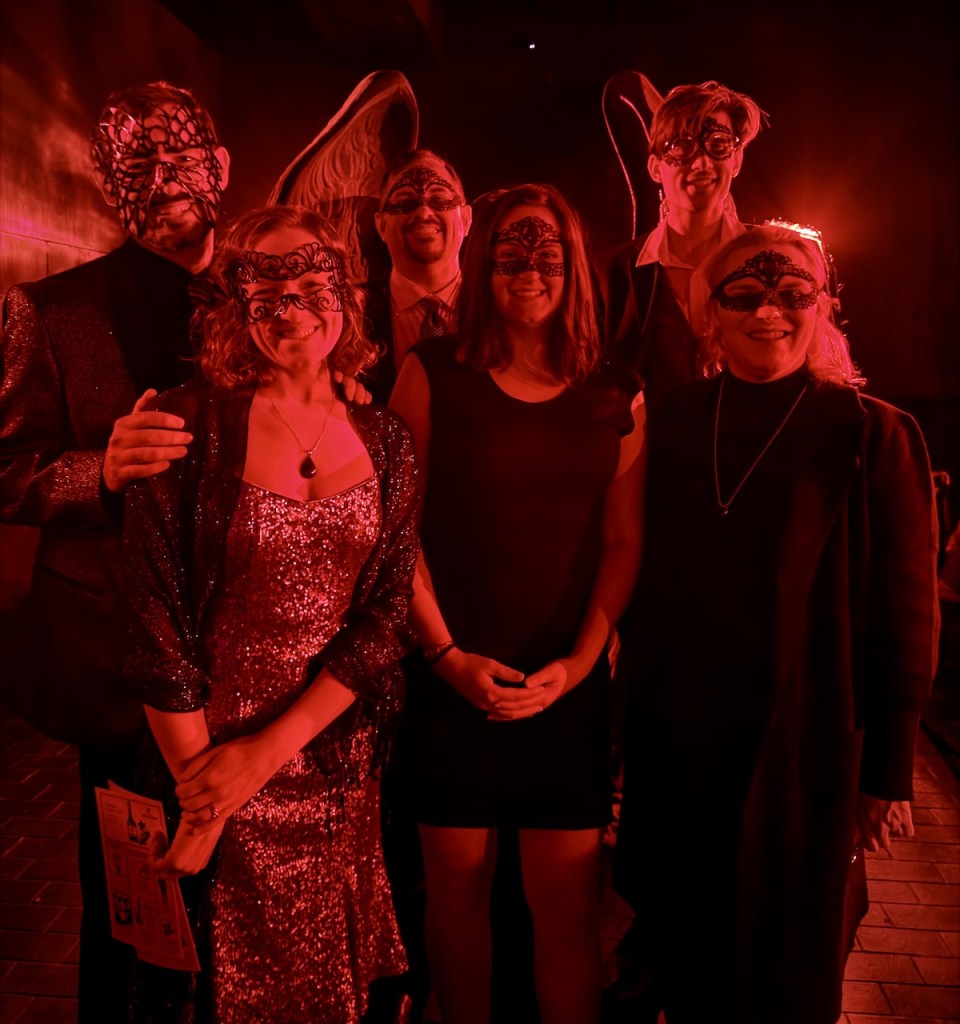
By requiring the audience members to come in thematic costumes, we all became a part of the scenery. Audience members were committed, and we admired gorgeous dresses and unique masks. As an audience, our presence enhanced the vibe of the set.
The set included a decorated off-boarding space where we could hang out, buy drinks, buy merch, and take photos. This set matched the vibe of the show. We weren’t rushed out of this space.
Who Were We?
We were the audience, and we were a part of the scenes, but beyond this, I don’t think we had a role in the show. We don’t necessarily need to have a role in the show. After all, at traditional proscenium theater, the audience is simply the audience. That said, I found myself wondering if we were meant to be, or could have been, something more than the audience. I’m not sure.
Tips For Visiting
- If you don’t know The Phantom of the Opera, or if it’s been a long time since you’ve seen it, we highly recommend rewatching it before you visit Masquerade. Unlike with other forms of immersive theater, you will see the whole show, but it’s still helpful to familiarize yourself with the characters and the plot.
- The dress code is strictly enforced: formal or cocktail attire in black, white, silver, or a combination thereof.
- Audience members are required to wear masquerade masks. You can bring your own, or wear one of the provided ones (which are comfortable and are compatible with glasses).
- Audiences members are strongly discouraged from wearing heels, and stiletto heels are not allowed.
- If you choose to bring your phone into the experience (rather than leave it at coat/ bag check), you will be required to put a sticker over the camera lens. There is an opportunity to take photos inside after the show concludes.
- Parking in New York City can be challenging. The nearest subway is the N/Q/R/W at 57 St-7 Av.
Book your time Masquerade, and tell them that the Room Escape Artist sent you.


![Escape Comics – The Alien Ship [Review]](https://roomescapeartist.com/wp-content/uploads/2026/01/the-alien-ship-the-alien-ship-1.jpg)

Leave a Reply