
IAMAI is one of the best escape rooms in London, England. Here are our recommendations for other great escape rooms in London.
AI-bohphobia
Location: London, England
Date Played: April 17, 2026
Team Size: 4-8; we recommend 4-6
Duration: 72 minutes
Price: £39.99 per player
Ticketing: Private
Game Breakage: No breakage, but some tech failures
Accessibility Consideration: All players must climb stairs to reach the game, but there are no stairs within the game
Emergency Exit Rating: [A+] No Lock
Physical Restraints: [A+] No Physical Restraints
REA Reaction
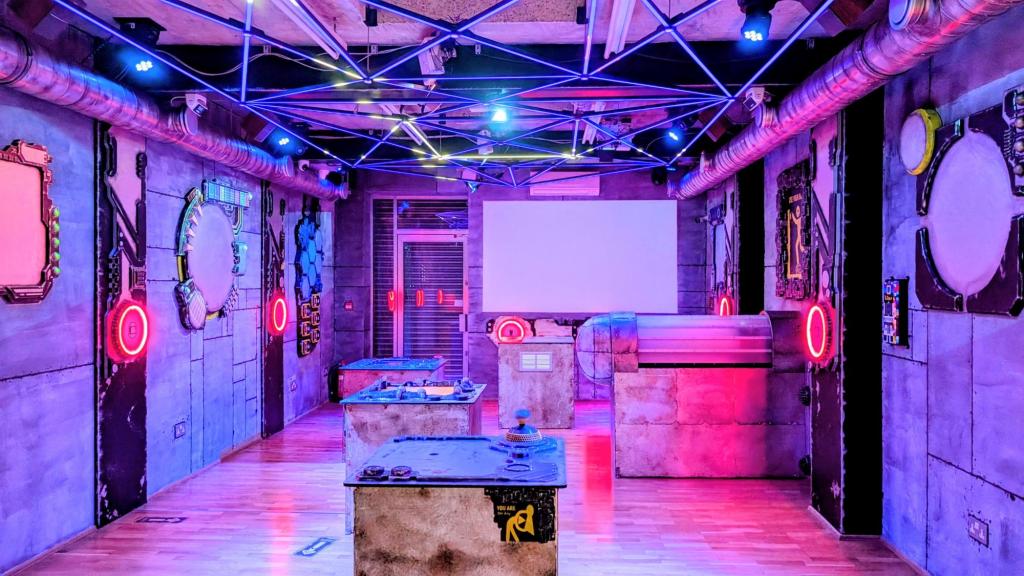
IAMAI was the epitome of a high-tech escape room and a true playground for puzzle lovers. Upon entering the space, it was instantly clear that clueQuest took a radically different approach with this experience. Rather than the cozy, hand-crafted, almost cartoonish aesthetic that characterized their previous escape rooms, IAMAI was edgy and industrial.
Puzzle stations with glowing panels filled the room, with many surfaces only later coming to life with intricate hacker-chic projections. Upon closer inspection, almost every element in the room had been 3D printed, and it looked incredible, demonstrating that with intricate custom modeling and effective finishes, 3D-printed props and set pieces can truly feel premium. We also adored the dynamic physical manifestation of one of clueQuest’s most iconic characters, the rodent-esque robot MM7.
Nothing looked like a classic escape room puzzle… because it wasn’t. IAMAI‘s puzzles were notably creative and also quite difficult. Nearly each and every puzzle was intriguingly layered, with enigmatic interfaces, a range of unexpected interactivity, and plenty of engineering-driven magical moments. There was a lot to do, even for a larger team, but the expanded 72-minute clock should allow sufficient time for most teams.
The entire experience essentially ran as a physically distributed video game. When that tech worked, it was an awesome and seamless experience. This also made the game’s operation somewhat higher risk because when the tech didn’t work, there was no game. For my team, one of the coolest interactions first started lagging and then stopped working altogether. Our gamemaster was immediately responsive in addressing these tech issues, but even after a full-game reset, we were skipped over this puzzle, and this long pause also disrupted our overall flow. We encountered a couple other more minor tech issues throughout, each of which compounded into a slight erosion of trust around whether the tech was malfunctioning or we just hadn’t understood how to properly interact with a puzzle yet. That said, as far as I can tell, my team’s technical difficulties were an outlier, and they were more than offset by the creativity, precision engineering, and wow moments of IAMAI.
IAMAI had one more trick up its sleeve, which we only learned after playing. As it turns out, the room itself is a bit of a transformer… for corporate groups visiting clueQuest, this space can be easily converted between escape room mode and a professional meeting room. While clueQuest was already quite savvy with multiple copies of each of their previous games to support higher throughput and larger groups, the two-in-one approach to IAMAI takes their business model to the next level.
For a delightfully original take on a more classic escape room, Origenes still reigns supreme. But for a bold new take on the escape room format and a satisfying, puzzle-centric challenge, IAMAI is a new top game for all visitors to London.
Who is this for?
- Puzzle lovers
- Larger teams
- Video game enthusiasts
- Best for players with at least some experience
- Players who don’t need to be a part of every puzzle
Why play?
- Real-life versions of video game-esque puzzles
- An impressive tech showcase
- clueQuest’s universe brought to life
Story
clueQuest’s recon droid MM7 had been attacked by an unknown AI and retreated to a safe house. We attempted to capture the rogue AI and save the system.

Setting
IAMAI might best be described as a hall of wondrous 3D-printed minigames. Filling a large concrete room, puzzle stations lined the perimeter and addition tables were scattered throughout the center. Each interface was unique, abstract, and intriguing. The production quality was incredibly high throughout, with a sleek, futuristic vibe to each and every component.

Gameplay
clueQuest’s IAMAI was a particularly high-tech escape room with a high level of difficulty.
Core gameplay revolved around noticing patterns, solving puzzles, and interacting with unusual interfaces. While most puzzles were solved just once, it was noted at the start of the game that specific interfaces would get used multiple times in different ways.

Analysis
➕ While IAMAI was themed and titled around AI, it notably did not include any actual AI slop. We were charmed by the distinctly human animation, graphic design, humor, and craftsmanship that filled every surface of the game.
➕ IAMAI featured one of the most ambitious and effective applications of 3D printing I’ve seen in any immersive experience. The prints didn’t feel like mere prototypes; they were hefty, detailed, and nicely finished. I was particularly impressed by some showstopper large-scale prints of forms that would have been difficult to fabricate in any other medium. Leveling up from the smaller 3D-printed interfaces found in some of clueQuest’s previous games, they’d truly pushed this technology to its limit.
➕/❓ IAMAI brought one of clueQuest’s most iconic characters to life with exquisite detail, motion, and expression. The surrounding scene played with contrasts in scale and texture that instantly drew us into the world. However, while this character was the anchor of multiple cutscenes, I wish we’d be able to interact with it throughout more of the actual gameplay.
➕ The gameplay was heavily puzzle-centric, and the puzzles were overall phenomenal. Unique video game-esque interfaces and minigames were brought to life in physical space with the help of responsive game pieces, bespoke controllers, and extensive projection mapping. There were plenty of clever, satisfying aha moments to be had, and the experience really made us work for it.
➖ While the puzzles themselves were top notch, the signposting for puzzle trailheads and the overall puzzle structure was sometimes more obfuscated than necessary. The first stage of the game presented a clear diagram showing which puzzles were presently active, and a similar structure could have been helpful for later stages, particularly for disentangling the occasional case where one puzzle was nonobviously dependent on the output of another.
➕ While the experience extensively utilized projections and projection mapping, most of the gameplay was still highly tactile at its core. We encountered numerous moments of discovery while interacting with unusual objects, learning how they moved and what they affected.
➖ Sometimes the interfaces themselves were also more of a puzzle than need be. A joystick was especially fiddly, and it wasn’t always obvious when a button was a button. Another puzzle wasn’t clear whether it was expecting a static selection or a sequence. While there was joy in the discovery of how to interact with these interfaces, tighter signaling through lighting, sonic feedback, and intermediate training levels could have helped to tighten up the flow and ensure that most of our time was spent enjoying all the clever puzzle mechanics to their fullest.
➕ A multi-dimensional puzzle was extremely satisfying to assemble, then served as the base for another layered puzzle sequence. While many individual puzzles throughout IAMAI required players to divide and conquer, I found that the gameplay was at its finest when it was interconnected rather than modular, bringing together our full team through meaningful collaboration and communication.
➕ A cool tech interaction increased our perception of some tiny details. We appreciated that this puzzle was well calibrated to ensure we’d found our target without being overly finicky.
➕/➖ While the finale was surprising and visually impactful, the “puzzle” that accompanied felt overly simplistic relative to practically all prior gameplay. Many of the previous puzzle mechanics could have served as a more substantive and climactic boss battle, or even more optimally, I would have loved to see something that blended multiple previously used interfaces in a new way.
Tips For Visiting
- Take public transportation to King’s Cross.
Book your hour with clueQuest’s IAMAI, and tell them that the Room Escape Artist sent you.
Disclosure: clueQuest comped our tickets for this game.
![EscapeTheRoom.cz – Escape Bar [Review]](https://roomescapeartist.com/wp-content/uploads/2026/06/escapetheroom-cz-escape-bar.jpg)

![Escape From the Elevator [Unintentional Review]](https://roomescapeartist.com/wp-content/uploads/2026/09/escape-from-the-elevator-escape-from-the-elevator-1.jpg)
Leave a Reply