
The Puzzle Portal
Location: Plymouth, United Kingdom
Date Played: March 29, 2026
Team Size: 4-10; we recommend 4-5
Duration: 90 minutes
Price: £20 per player
Ticketing: Private
Accessibility Consideration: At least one player must briefly crawl
Emergency Exit Rating: [A] Push To Exit
Physical Restraints: [A+] No Physical Restraints

“With a Portal-inspired tone and no shortage of benevolent trolling, The Rubicon blasted us with a firehose of puzzle-fueled trickery that subverted our expectations more times than I thought possible. This game was packed with supremely satisfying ahas, cheeky repartee, and a distinctly different interpretation of what a top-tier escape room can look like.“
REA Reaction
My visit to The Rubicon felt like a leap into an alternate dimension — one in which Western escape rooms had continued to push the bounds of puzzle ingenuity rather than environmental immersion. On the surface, The Rubicon looked closer to a game I’d have played in Budapest back in 2015 than a “top” European game in 2026. Yet this playfully minimalist setting concealed one of the most unexpectedly witty adventures I’ve experienced in recent memory. While some escape rooms in the UK are just starting to compete with other top international escape rooms on an experiential level, The Rubicon would stand out for its inventive puzzle design in truly any international market.
After floundering around for the first few minutes of the game, we quickly realized that this wasn’t your typical escape room. We stepped back, questioned our assumptions, and suddenly everything started to click. While The Rubicon‘s idiosyncratic style of gameplay did require some level of realignment with the designer’s unique way of thinking (and charmingly peculiar sense of humor), it quickly earned our trust and we were never left in the dark for too long.
The puzzles were layered, self-referential, and meticulously diverse. They put a bold spin on classic escape room mechanics, while also translating various video game puzzle formats into the tactile world. The gameplay itself was deeply funny, with lots of “see what I did there?” moments that always let the players in on the joke. But this style of play wasn’t purely cerebral or mechanical. We also found ourselves becoming emotionally attached to a character, cheering them on as they assisted us in our mission. The constant cycles of vexation and resolution yielded an ongoing flow state that was optimally aligned between gameplay and environment.
The Rubicon describes itself as a “third generation interactive video game inspired escape room” and openly admits it is Portal-themed. However, don’t go into this experience expecting Portal: The Escape Room. While the overall tone and a couple of specific puzzle mechanics had some strong Portal resemblance, Roomsmiths pulled on a range of influences to create their own original world.
My visit to Plymouth did not initially include any escape room plans, and I’m so grateful that I stumbled upon this hidden gem with a last-minute booking one dreary evening. Go into The Rubicon with an open mind and a strong team, and you may just be as surprised and delighted as I was.
Who is this for?
- Puzzle lovers
- Fans of the Portal video game series
- Best for players with at least some experience
- Players who don’t need to be a part of every puzzle
Why play?
- Wildly inventive puzzles
- A real-life video game aesthetic
- A truly satisfying challenge
Story
We arrived in a mostly empty room with some strange furniture and a glowing hexagon on the wall. What was this place??
Setting
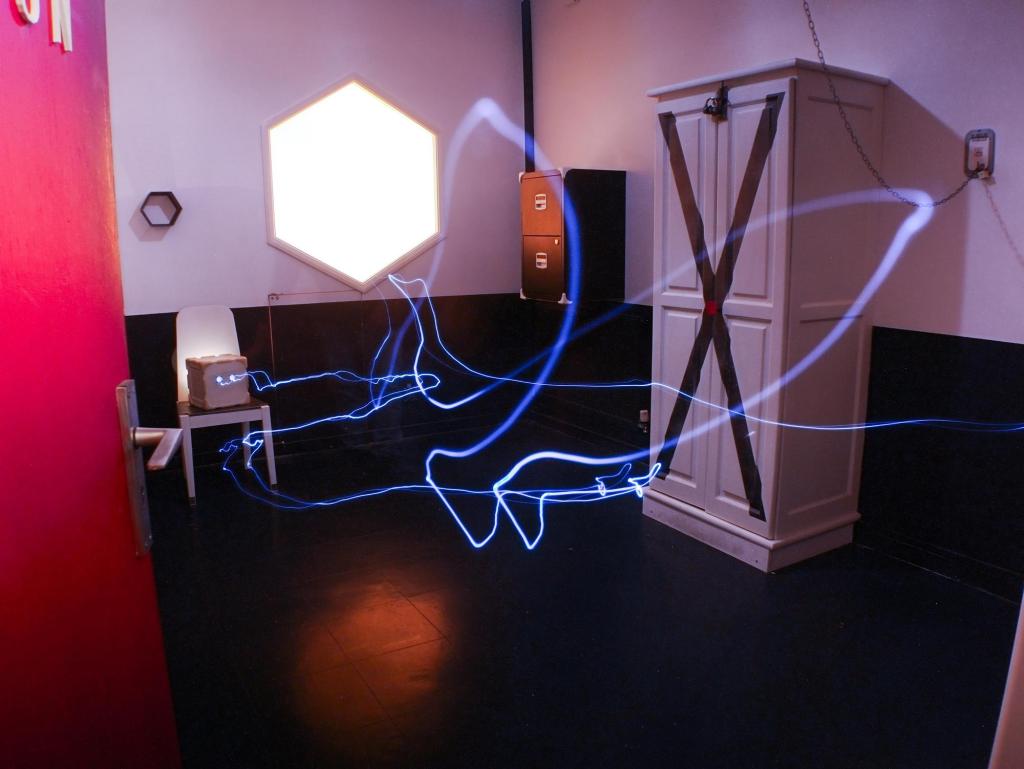
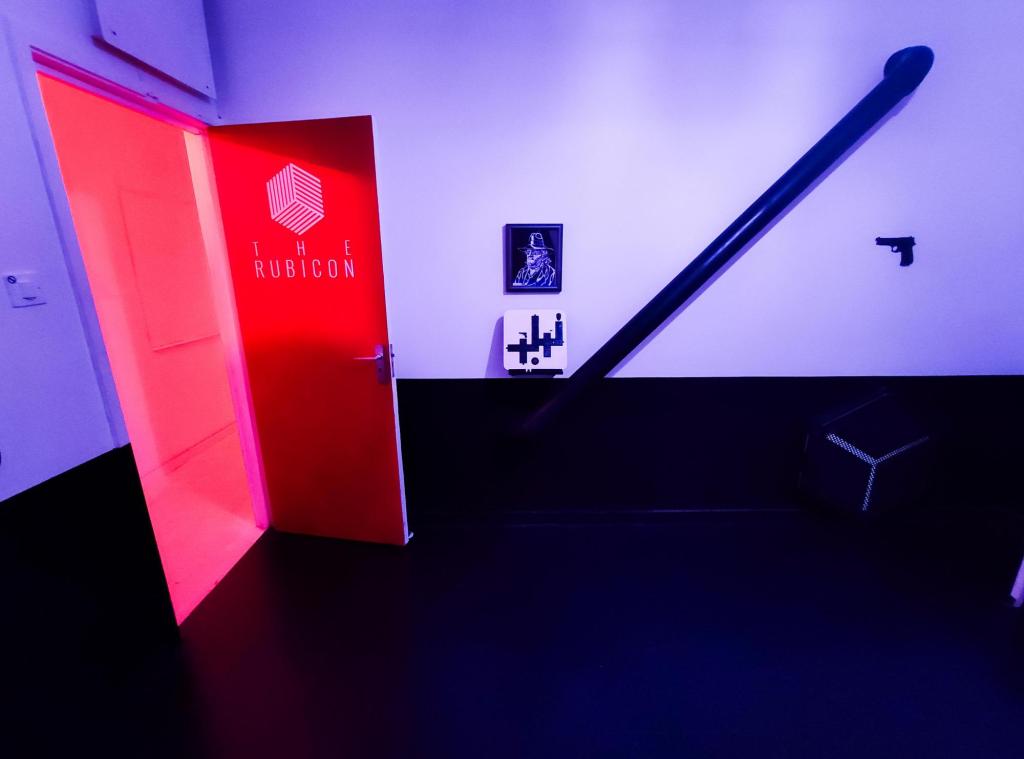
The Rubicon took place in a void-like black-and-white room. Around the perimeter were an array of strange sights: a glowing white hexagon, a floating filing cabinet, a white wardrobe, and a single white chair.
Gameplay
Roomsmith’s Rubicon was a particularly puzzle-centric escape room with a high level of difficulty.
Core gameplay revolved around solving puzzles, making connections, communicating, and getting benevolently trolled.
Analysis
➕ The Rubicon contained some of the most original puzzle ahas I’ve encountered in any escape room outside of Japan. The puzzle design was remarkably inventive, frequently breaking the rules in clever ways while also maintaining an internally consistent logic. Straying from the usual “one-time use” rule, callbacks and reuse throughout The Rubicon made the whole experience feel more interconnected and cohesive.
➕ While the gameplay was difficult for an escape room, it was also completely fair. Despite the relatively low escape rate, my team completed the game with no hints and over ten minutes to spare, and all puzzles were reasonably signposted even when quite tricksy. Much of the game’s difficulty arose from the ways that it required us to shift our perspective and sometimes reconsider how an escape room is supposed to work.
➖ The Rubicon throws players in the deep end, and for a general audience, it might benefit from more of a “training level” to teach teams how it wants to be played.
➕ The Rubicon translated numerous video game puzzle mechanics into the physical world, elegantly demonstrating that there’s nothing inherently digital-specific about this style of puzzle-based play. Rather, this approach to “level design” prioritized a theme-and-variations structure in which, rather than doing the same action multiple times, you encounter a new rule or mechanic and then each progressive iteration puts an interesting spin on it. Whether aligning paths or directing lasers, these puzzles didn’t play out on screens; they were highly tactile and well physically situated.
➕ Just when I thought I’d seen it all, The Rubicon put some devious twists on locks and other classic escape room elements that I’d never encountered before. The gameplay was at its finest when the physical inputs were equally part of the puzzle.
➕ A relentless sense of humor throughout the gameplay often felt like it was trolling us, yet in an enjoyable way. It never felt needlessly cruel.
➕ While The Rubicon didn’t necessarily stand out for its set design, the point-and-click-esque minimalist aesthetic was cleanly executed and had its own unique charm. It was exactly the sort of liminal environment that a Portal-inspired game belonged in.
➕ Roomsmiths utilized 3D printing to create a wide range of intriguing custom components and mechanisms.
➕/➖ One of the core threads in The Rubicon involved constructing a friend. This character was helpful in multiple forms, both large and small, though I questioned whether there was room to push its development within the narrative even further.
🧠 When an escape room owner shares that they’ve played few or no escape rooms themselves, it’s usually a red flag. However, for the mastermind behind Roomsmiths, innovating in a vacuum actually led to a genuinely original experience that was enjoyable in its idiosyncrasies. Yet in other ways, The Rubicon was still stuck in the past, particularly in its choice of words like “tortuous” and “frustrating” to advertise the difficulty of the game as a selling point. In context of the current escape room industry, it’s all too easy to make an experience that’s frustrating because it’s arbitrary, unfair, and poorly designed; it’s more difficult to create a game like The Rubicon that guides players on an emotional roller coaster through challenging yet well-crafted puzzles. This sort of outdated “designer vs. player” language sells The Rubicon short and may scare away teams who’d otherwise love this game, or set the wrong expectations for how to approach the gameplay. Looking to the future, I hope Roomsmiths can benefit from some increased awareness of the current state of the escape room industry without backing down from their quirky, puzzle-centric style.
Tips For Visiting
- Street parking is available nearby.
- We enjoyed a delicious dinner at Cosmic Kitchen.
Book your session with Roomsmiths’ The Rubicon, and tell them that the Room Escape Artist sent you.
![MindMaze – Galactic Pioneers [Review]](https://roomescapeartist.com/wp-content/uploads/2026/06/mindmaze-galactic-pioneers-1.jpg)
![Coney Escape Room – Over My Dead Body [Review]](https://roomescapeartist.com/wp-content/uploads/2026/06/coney-escape-room-over-my-dead-body-2.jpg)
Leave a Reply