
Space Base: Extermination is one of the best escape rooms in Vitoria-Gasteiz, Spain. Here are our recommendations for other great escape rooms in Barcelona and Madrid.
The most replayable escape room
Location: Vitoria-Gasteiz, Spain
Date Played: June 24, 2026
Team Size: Up to 4 players per team, and 4 teams per session; we recommend 2-4 players per team
Duration: 80 minutes
Price: €160 per team of up to 4 players
Ticketing: Private & Public – you’ll be on a private team in a shared space with up to 3 other teams
Accessibility Consideration: Players must climb and crawl to reach certain spaces, and generally be agile to evade monsters.
Emergency Exit Rating: [A] Push To Exit
Physical Restraints: [A+] No Physical Restraints

“Space Base: Extermination set a new bar for what replayability can look like in an escape room. With a mind-boggling 70+ puzzles and even more side quests, all set on a vast sci-fi spaceship, this is a game worth playing over and over again.“
REA Reaction
Rarely does an escape room make you go: “I want to return and play that again right now.” It’s somewhat of a defining trait of the genre that once you’ve completed an escape room, you know all its secrets and move onto the next game.
Yet this is exactly the reaction that my team had after completing Space Base: Extermination, and I’m already giddy for whenever I can return for more.
Building off experiences like Insomnia Corporation’s The Krugger’s Secret (review coming soon) and Horror Box’s now-closed Biohazard, Mayto Kingdom’s Space Base: Extermination was an open-world escape room with unmatched scale and ambition. It implemented a number of refinements and innovations that made it especially compelling and truly optimized for replayability, particularly in calibrating the balance between gameplay, exploration, and action.
The central mechanics of Space Base involved solving nonlinear puzzles throughout a large space, all while avoiding monsters and managing resources. Up to four teams played at the same time, though the space was plenty large to accommodate up to 16 players. We weren’t really competing against other teams in the space, instead avoiding those other teams so we could each work on our own puzzles. The “survival game” elements added excitement without getting in the way of puzzle-solving. Various roaming monsters typically left us alone long enough to solve full puzzles, with the occasional scare-and-chase sequence propelling us to new areas and right into new puzzles.

With this focus on the gameplay, the puzzles were actually fun, interesting, and well designed, with a diversity of puzzle types and difficulty levels. Between 70+ puzzles and various other bonus objectives, there were nearly 100 total elements to discover and solve. It was a staggering achievement in content generation alone, and to tie that together into a fairly cohesive overarching concept was all the more impressive.
Mad Mansion has created so many reasons to trek up to Vitoria-Gasteiz on an escape room holiday, including A Legendary Adventure, Tú También Soñarás, and Horror Asylum (reviews coming soon). Regardless of whether you’re a puzzle lover or a horror fan, we strongly recommend also playing Space Base: Extermination on your visit… and then another visit.
The Challenge of Replayability
Replayability is a tough nut to crack. Inherently, most standard escape rooms are designed to be played only once, even if there may be some value in revisiting your past favorites with new teammates or after some time.
What then constitutes true replayability, where consecutive visits offer novel experiences?
In one direction, “challenge arcades” offer replayability with modular mini-games, often leaning more into physical and skill-based challenges. Repeat visits encourage mastery, and may even double as a gym session. These experiences increasingly shy away from straight-up puzzles because, again, once you’ve solved a puzzle, you know how it’s solved.
In another direction, some experiences, like Doors of Divergence, create replayability by designing multiple possible paths through the experience, like a choose-your own-adventure novel. On a return visit, you can make different choices and experience new stories and (mostly) new gameplay.
Yet there’s a third approach to replayability that also still features puzzles: designing more content than is possible to see in a single playthrough. There are a decent few escape rooms with nonlinear, points-based gameplay on a smaller scale, including games like Hatch Escape’s The Ladder and Omescape’s Undercooked.
Space Base took this approach to the next level, utilizing perhaps the largest quantity of content I’ve seen to build out an entire world.
Who is this for?
- Puzzle lovers
- Adventure seekers
- Sci-fi fans
- Any experience level
- Players who don’t need to be a part of every puzzle
Why play?
- A unique take on a replayable, open-world escape room
- An action-packed space adventure
- So. Many. Puzzles.
Story
Our team took the K-16 shuttle to the USS Station, where something had gone terribly wrong. Our mission: to collect as many samples as possible while avoiding any more sinister presences.

Setting
Space Base: Extermination took place on a massive space station, which consisted of a sprawling maze with dozens of different rooms. There were a wide variety of individual settings, for research, residence, and entertainment. It had a dark sci-fi aesthetic.
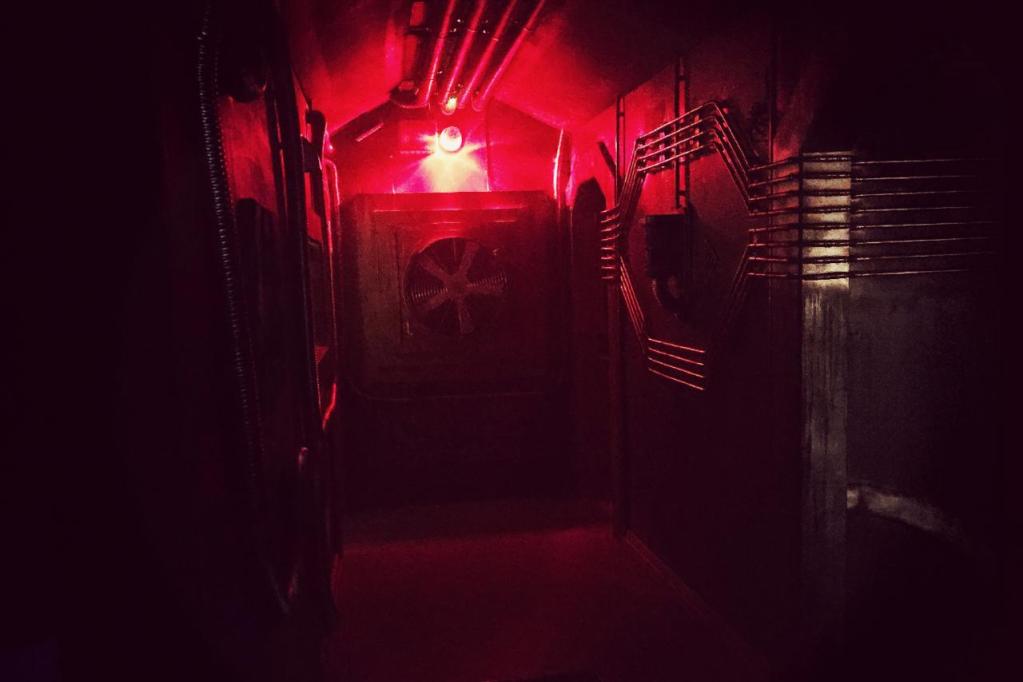
Gameplay
Space Base: Extermination was an open-world escape room with a variable level of difficulty.
Up to four teams, each with up to four players, may share the same session. Teams played independently and were not in direct competition with each other, though there were moments when cross-team collaboration was required to resolve system-wide issues. The space was large enough that there was plenty of space for all teams to stay in their own separate rooms, and if they collided, they could just go their separate ways.
Core gameplay revolved around solving puzzles and completing additional side quests, all while avoiding a range of space monsters that were roaming the space. A dedicated team HQ also doubled as a “safe space” that the monsters couldn’t enter and which contained a station for each team showing which puzzles they’d already solved, along with a full map of the space.
There were over 70 different puzzles and challenges, far more than could possibly be solved in a single session… at least not on a first playthrough. Puzzles included classic escape room styles, screen-based logic puzzles, and arcade-like minigames. Each led to a multi-digit number, which could be entered on a team’s mobile device or back at the HQ.
In addition to solving puzzles, teams also had to manage oxygen levels, obtain shields, and visit a decontamination chamber if a player was successfully attacked by a monster. Other system-wide issues randomly occurred, which had to be resolved before continuing in the gameplay.
There was no capture mechanic, and interactions with monsters mostly involved running and hiding. It was closer to one-sided laser tag, with a different weapon or game mechanic around each monster type. Shields protected against monster attacks. If you ran out of lives and “died,” it didn’t mean you had to stop playing; you just lost some points from your final score.
Space Base: Extermination offered strong potential for replayability, and we estimate that teams would require 3-4 playthroughs to finish all the content. Teams each received a printout with their full progress analytics at the conclusion of the experience, which also included a code to restore progress on your next visit.
Analysis
➕ Space Base took advantage of a large space, packing it with a wide variety of sets and a strong sense of persistent discovery. Designing an open-world environment with a vast amount of content is a valid approach to replayability, and Space Base pulled it off well. Even having visited most areas of the set on our first playthrough, my team unanimously wished we could have played the experience again immediately.
➕ The gameplay was varied, ensuring that individual puzzle mechanics didn’t really repeat throughout the space. While there weren’t necessarily any specific puzzles that stood out, the puzzles also never felt too much like busywork or formulaic placeholders. It was the sort of binge-able gameplay that made us want to keep going. A mix of gameplay styles ensured that there was something for everyone. Many puzzles were contained to a single space, while others took advantage of the full facility.
➕ Different monster types each had different abilities. They weren’t individually memorable as characters, yet there was a range of ways in which we’d react when confronted, from avoid a laser gun to simply running fast. Ultimately, we spent most of the game puzzling uninterrupted, and monster attacks were well balanced to create a sense of suspense and momentum without overly terrorizing us. During our playthrough, we were the only team in the space, so I can’t speak to what it feels like when there are more teams (and maybe more monsters) throughout the environment.
➕ There were a lot of rules presented upfront, as is reflected by the particularly lengthy Gameplay section of this review, yet everything was laid out clearly and reinforced by well-designed interfaces. We never experienced any confusion around the elements that were meant to be straightforward, allowing us to spend all our energy on the actual gameplay.
➖ Space Base essentially showed its full hand upfront, even if it was partially obscured by the sheer vastness of content. The experience would have benefited from gating some puzzles, additional sub-mechanics, or hidden layers so that they were not all discoverable off the bat. As is, there were a number of side objectives to discover, yet they were just collection quests that didn’t leave much room for deeper strategization. Especially if Space Base wants to be a “roguelike” game, it needed some elements that would more meaningfully shift the starting conditions of future playthroughs.
➕ At the end of the game, we received a summary of our progress and achievements. It was clearly and succinctly laid out, offering all the information we’d need to strategize for our next visit. At the time of our playthrough, we were told that we’d need to re-solve the same puzzles for them to count again on future visits. However, we were delighted to hear that in the time since, Space Base has added in “save codes” that allow teams to restore their progress for the next visit.
Tips For Visiting
- A fair amount of free street parking is available nearby, but still leave enough time to park.
- There’s a restroom located within the experience.
- For teams traveling from out of town, it would be reasonable to play Space Base multiple times in the same day, or even back-to-back. Booking times are generally separated by two hours, making this possible.
- Space Base is playable in Spanish or English, and there may be other teams in your session who speak a different language. Email Mayto Kingdom in advance to confirm the details of English-language bookings, though most of the game is driven by a personal tablet and other digital interfaces which were either bilingual or didn’t rely upon language.
Book your session with Mayto Kingdom’s Space Base: Extermination, and tell them that the Room Escape Artist sent you.
![The Archives of Trevosa [Hivemind Review]](https://roomescapeartist.com/wp-content/uploads/2026/08/the-archives-of-trevosa-the-archives-of-trevosa-1.jpg)

![MindMaze – Galactic Pioneers [Review]](https://roomescapeartist.com/wp-content/uploads/2026/06/mindmaze-galactic-pioneers-1.jpg)
Leave a Reply