
Escape the Ancient Ruins is an online escape room in Gather created by Raid the Room.

Format
Style of Play:
- An online escape room in Gather
Who is it For?
- Puzzle lovers
- Any experience level
Required Equipment: computer with an internet connection
Recommended Team Size: 2-4
Play Time: 45 minutes
Price: $150 per team
Booking: book online for a specific time slot
Description
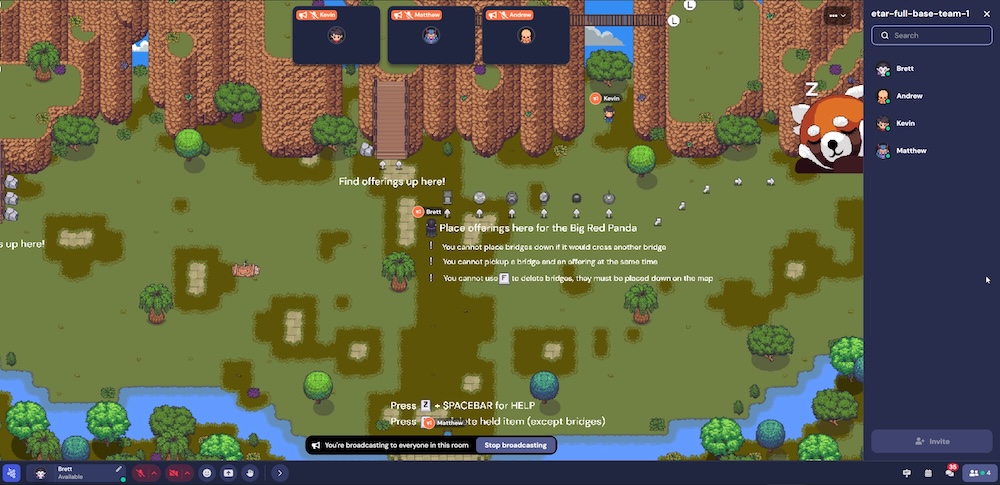
Escape the Ancient Ruins is played in Gather, an online collaboration tool that plays like a video game. Players enter into voice/ video chat with their teammates, choose their avatar, and collaboratively solve puzzles using the Gather interface.
Matthew Stein’s Reaction
I spent a nontrivial amount of time during the pandemic in Gather, roaming around in various virtual escape rooms and immersive theater shows. A few years later, at a time when I can see my friends in person again with ease, it was enjoyable to revisit Gather and see that yes, it’s still a fairly novel and meaningful way to spatially hang out with friends from afar.
Raid the Room designed Escape the Ancient Ruins in a similar style to their previous Gather-based virtual escape room, Escape the Island. While both games are primarily targeted at a corporate audience, they run smoothly and take advantage of the unique features of Gather. The puzzles in Escape the Ancient Ruins were enjoyable, well clued, and varied, with a mix of wordplay, logic, and spatial communication.
While Escape the Ancient Ruins in many ways leveled up the “what” compared to its predecessor, implementing even more technically ambitious and interactive puzzles, I wished it had put a little more thought into the “why.” I don’t need every game to have a deep story, but a clearer objective, giving us a sense of purpose and connecting the scenes together, could have made Escape the Ancient Ruins more than just a random pile of fun puzzles.
Brett Kuehner’s Reaction
- + Enjoyable puzzle variety
- + Great pixel-style graphics
- +/- Integration of instructions into the graphics makes them obvious but also makes the screen cluttered and less attractive
- + Some puzzle styles were adapted to work surprisingly well in this format (word puzzles, logic puzzles)
- + Several puzzles required coordinated teamwork to complete, using the medium well
- – Some “secret” control keys (like “ghost” mode) should be part of the introductory training, because they make the game more pleasant and are hard to discover on your own
- + It was entertaining to build a custom avatar or pick a premade one with special graphics
- + Being able to zoom in and out on the map was very helpful
- ? Story is minimal, with a primary focus on puzzles
- ? The planned competition mode, with cash prizes, might make the game more stressful and less fun, and will amplify any problems with controls or internet connections
Andrew Reynolds’ Reaction
Escape the Ancient Ruins was a series of five puzzles created and hosted in Gather, a collaboration platform. I missed out on playing Raid the Room’s first game back in 2022, so I was eager to get a chance to play their newest offering.
Escape the Ancient Ruins made learning how to interact in Gather very easy. That’s not the purpose of the game, but the first level was a word game that needed our team of three to know how to move, interact with the world, and communicate with each other. That set the stage for the next four levels, each centered around a different puzzle type but always increasing the need for communication and collaboration.
One puzzle style in the middle of the game felt like an odd choice at first, it being the kind of puzzle I don’t typically see as being collaborative. While it wasn’t as team oriented as the others in the set, it was one of the easier to digest forms of this particular puzzle type. We intentionally slowed down to discuss it, which was the right thing to do even though it likely stopped us from setting a record.
I wanted more out of this game narratively. There was no overarching story to tie the levels together. They were set on the same island but the whole game lacked any sort of set up to explain why our team was there and why we needed to escape. While the puzzles were enjoyable and our team really enjoyed solving together I would have liked to have seen at least an attempt at a basic story. This doesn’t take away from the puzzles themselves, though. The back half of Escape the Ancient Ruins truly needed us to work together, and it all felt very natural.
After we played, the developer told us that they plan on running this game as a competition, so be on the lookout for updates from Raid the Room about that!
Christina Rohlf’s Reaction
Editor’s Note: Christina wasn’t planning to review this game, but she happened to book it right around the time the REA group played. Bonus review!
When the targeted Facebook marketing ads told me that Escapopolis was hosting an online escape room competition with the potential for real prize money, how could I say no? I rounded up the rest of the Natural Crotchkeys and off we went to Escape the Ancient Ruins.
For the competition at Escapopolis, the game environment appeared to be able to host up to 20 groups at the same time. Our time started automatically once we entered the first level. NPCs in each level gave generic instructions for how to solve the puzzle in the level. There were 5 levels; we were not told how many levels there were at the start of the game. Supposedly, the top 10 fastest teams received cash prizes (1st $1000; 2nd $750; 3rd $500; 4th-10th $150); however, we were told that the prize amounts would be proportionally less if fewer than 200 teams registered to play. No hints were available during the competition.
Escape the Ancient Ruins was a series of 5 levels, each with a unique puzzle to solve. NPC characters in each level provided some direction for how to solve the puzzle at hand. In general, we enjoyed the puzzles. They were logical, clever, and did a fairly good job at keeping all four of us occupied. I absolutely loved the polymorph puzzle. However, we found the map interface for one puzzle frustrating, because there was no good way for the person at the map (who should have been directing the puzzle) to also see the location of the players. We also were disappointed that there was no leaderboard. While we were told our time at the end of our playthrough, the only follow up was a vague email indicating “the winners have been notified.” Since this was a competition, I would have liked to see how we stacked up to the other teams. In general, the Escape the Ancient Ruins competition was an enjoyable Sunday afternoon activity and a good excuse to get the band together to do some puzzling.
Disclosure: Raid the Room provided the first three Hivemind reviewers with a complimentary play.


![TR-49 [Hivemind Review]](https://roomescapeartist.com/wp-content/uploads/2026/02/tr-49-tr-49-1.jpg)

![Escape Hour Austin – Edison vs. Tesla [Review]](https://roomescapeartist.com/wp-content/uploads/2026/03/escape-hour-austin-edison-vs-tesla-1.jpg)

Leave a Reply