
This game exists to send a message
Note – August 2026 – I received an email from the creator that Over My Dead Body has closed for now. As is standard REA practice, this article will be left in its original form, beyond this note.
Over My Dead Body (戰慄品) is a game which addresses serious topics through escape room gameplay. However the players are not intended to know anything about that when they come to play. Even reading this far you already have more information than designed. This is unusual for Room Escape Artist, but with the creator’s encouragement, this article will fully spoil the experience, since it would be difficult to discuss otherwise. So, if you think you might play this game, I encourage you to not read past the first image.
Over My Dead Body is located in Taoyuan, Taiwan, the city where Taipei-Taoyuan International Airport is located. It can be booked for play in English by emailing Chun’s Room (純密室) (email removed with update) well in advance. 4-6 players are recommended at a cost of 700 NTD/ player (~$22 in May 2026). Taoyuan is not as walkable as Taipei so I advise taking the train to Laojie River station and using a taxi or rideshare from there.
The set, props, and puzzles are consistent with competent English-language games in the region. Outside of China, the industry in this part of the world is generally younger and/ or less well funded than in Europe and the Americas. That said, in my opinion, Over My Dead Body is a powerful piece of art, and a great example of what can be accomplished through immersive entertainment that would be less impactful in any other medium. If you will be in the area and can work it into your itinerary, I think it will be worth the trip.
Opt-in Safety Measures
At Room Escape Artist, we are dedicated to promoting safety in the escape room industry. This game, and others out there, have a safety issue, though it is not fire, knee damage, things that might require first aid, or most likely anything else you just thought of because it is not a physical safety concern, but a mental safety one.
Content warnings, too often joked about, are serious concerns. Vulnerable people utilize them to avoid content which could require days, weeks, months, or longer of recovery. I believe this is of special importance in the immersive industry, as the content is not merely viewed, but experienced. Games with potentially disturbing content should provide content warnings. Full stop. If secrecy is desired, it’s fine to have it behind a spoiler warning or two, or to add an extra step of contacting the company to receive the content information, but content warnings should ultimately be available to players who need them.
Since these things are also true of a full-spoiler article about the game, I have provided content warnings as the first line in the spoiler section.
Update – August 2026 – Chun’s Room has committed to adding content warnings if Over My Dead Body ever returns.

Content Warning
This article will discuss drug/ alcohol abuse, war crimes, self-harm, and mental health issues.
It’s Spoiling Time!
Now, I will walk through the gameplay in a couple of sections. After the walkthroughs, there will be some unpacking of our experience as we played through the preceding section.
Getting Marked Into Character
Over My Dead Body started to gradually draw the magic circle by putting players in their role in the waiting room. Two players volunteered to be drawn on with a marker (that washed off easily afterwards.) The first got some straight lines, and a gamemaster told them “you said your arm got cut in an accident.” The second, some red dots and “you told me you have trouble with your allergies.” One player received a bag with some pills, carried because “they are often sick.” Finally, one player received a bag with some alcohol, that they keep with them “because they are a party person.” We were given a walkie-talkie, and practiced contacting command for hints using our somewhat ominous callsign “Ghost.”
We were told that we may meet some people who would ask us some questions, and that if we didn’t know the answer it was okay to say that we didn’t know, or that we couldn’t remember. And with that we were sent to a door in the basement. Through the door, we sat in some folding chairs and an actor greeted us as if we were known to them. They asked us some questions, which we tried to answer, but they questioned our answers, which was disorientating.
Out for a Quick Bite in the Combat Zone
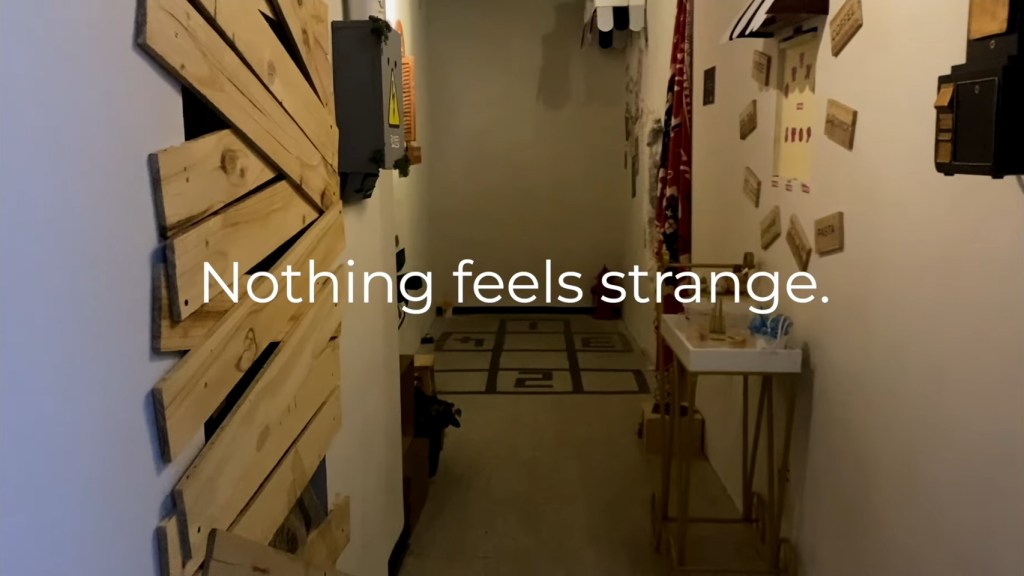
Another character suddenly arrived, seemingly drunk, and eventually it was suggested that we all go grab something to eat. To do so we headed through a door, which revealed a dark street. At the end of the street, a shooting star screamed through the sky, and then everything changed. Our new “friend” yelled and pulled out a prop handgun which they began furtively aiming around. They yelled at us, asking where our weapons were, and where the enemy was hiding. Command called us on the radio, asking what was going on. We responded and as instructed began exploring the town. The town, perhaps cursed by a little girl (which we had seen in the game’s description and intro video) consisted of a main street and some winding passageways which I interpreted as alleyways.
Throughout the town, there were puzzles to complete, but they were not just puzzles, they were memories. A store we frequented, military equipment, children playing in the street, decorations and signs, posters of our dead comrades with messages scrawled on them, each one a thread which, woven together, comprised the huge flashback we were collectively experiencing. However, we only really appreciated this angle after the debrief clued us in to it.
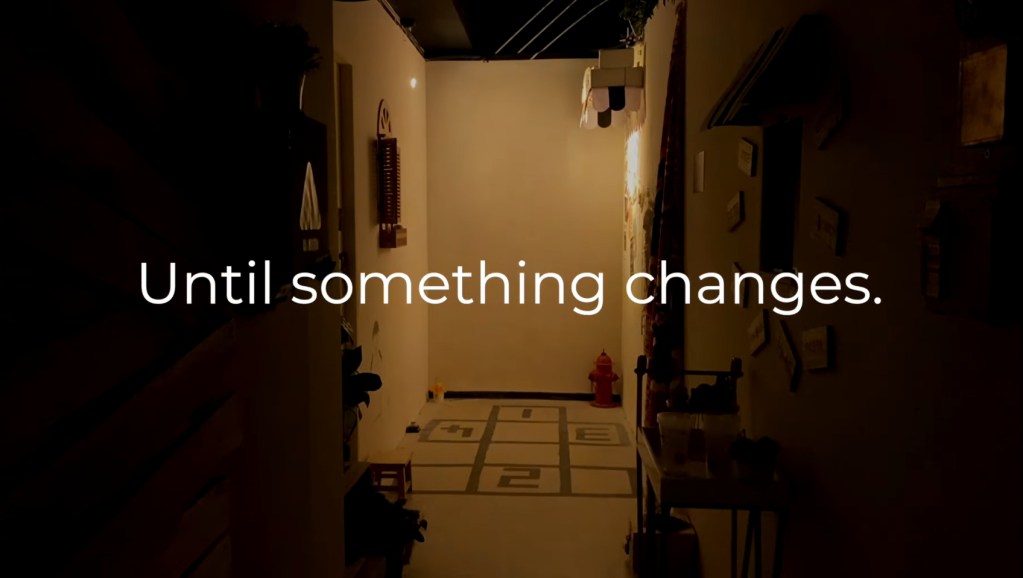
As we played, there were some general “military” background noises, but occasionally the soundscape was interrupted by the sound of jets flying overhead. Eventually, the jets started dropping bombs. We would hear explosions, followed by the townspeople screaming. There was also an unseen object that made clicking noises, as a sort of simulated gunfire. Then one time the clicking was accompanied by a wave of nerf darts being fired at our feet.
Once we had solved all the puzzles in the town, we entered the little girl from the curse story’s home. Here we solved a few puzzles which showed how the people of the village were suffering and surviving under attacks and occupation. Then we endured some puzzles themed around accusations and curses from the little girl. One particularly interesting puzzle, part of which can be seen below, used grids of Chinese characters to obtain number shapes by following her words of hatred in the only sensical pattern.
A Taste of Trauma
The introductory section nails the feel (and chaos) of a group therapy session where some people are really struggling. After we were questioned, we felt a little confused about our role and then switched to responding that we didn’t know, or couldn’t remember. This sort of confusion is sometimes experienced by people who are struggling with mental health challenges.
Over time, I found myself exhibiting behaviors created by the minor traumas inflicted by the game. I found myself involuntarily ducking slightly when I would hear the jets. I could swear the screaming became – or at least seemed to become – louder over time. This was unsettling.
After the darts fired at us, my brain went on alert whenever I heard the clicking sound, whether there were darts or not, and I was paying more attention, listening for the sound to come again.
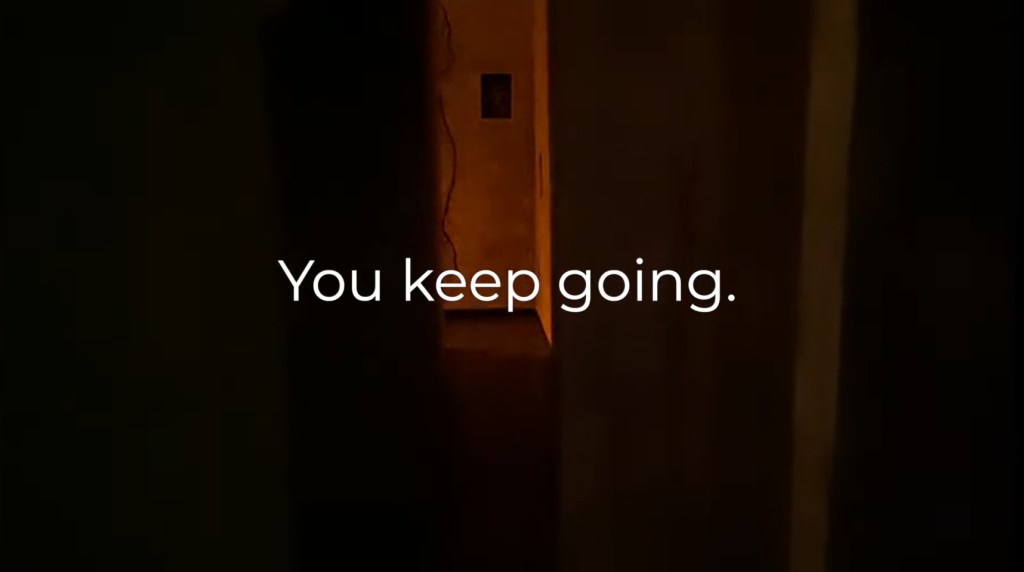
My partner says she realized the PTSD angle sometime during the town section. (I had been spoiled on this myself through the process by which this game came to our attention.) She said that along with the actor, there were a few things which were inconsistent with the otherwise fairly realistic environment which led her to that conclusion.
While I’m not going to apologize for taking this game to task over its lack of content warnings, here in the spoiler section I will say that I do understand that revealing the game is really about war crimes and PTSD would probably severely reduce the amount of players who choose to book. In addition to the gating I discussed above, I wonder if there could be some way to address this during the pre-game portion without tipping the game’s hand too much.
Previous games which address serious topics have had mixed approaches. 11S, which brings players into the World Trade Center on 9/11, is upfront about its setting. The Privilege of Escape addressed privilege and social inequity while keeping its players in the dark, but contained no potentially disturbing content. However, that game was also offered for free and made no attempt at being a viable commercial product.

The Cost
I’m going to walk step by step through the ending portion, because it contains multiple, powerful, “wow, they really went there” moments. We solved the last puzzle in the house, which opened a door to a space behind the walls. The sound of jets returned and our companion urged us to hurry inside. It was very dim. From down the way, the little girl’s voice called out, telling us to come to her hiding place. We moved forward, and then, in a dim space, we saw the silhouette of the little girl, hiding in a corner of rubble. Suddenly the jets once again screamed by, followed by loud explosion sounds as a bomb went off nearby. The little girl’s head tumbled off her shoulders into the debris below. We were overcome by a heavy silence. Mission accomplished.
But not over. We had to keep going. There was a door. We opened it and were greeted with flashing cameras and blinding lights. A press conference lectern was set up, complete with microphones plus the sound of shouting press as the wall read “Welcome Hero.”

The press conference room puzzles were a journey through being hailed as a hero but feeling like a devil. The player characteristics from the very beginning finally reveal their payoff as the “allergies,” “accidents,” medicine, and alcohol are revealed to represent the post-war mental and physical health consequences of our experiences. I particularly appreciated the self-harm puzzle which required the player to place a fake knife against their skin. I felt that these two sequences were remarkably effective at driving their respective points home in a way that has stuck with me long after I played.
Out of the Darkness, Back into the Light
We were concerned coming into Over My Dead Body that this game would leave us feeling further wearied about the state of the world. But that turned out to not be the case, and I believe the reason for this is the debrief. Debriefs are especially important in games like this where players are coming out of scenes heavy with “negative” emotions. Having a debrief allows players to shake off the fantasy, and process what they have experienced in a grounded and safe manner. In this case it also impresses upon the players that the overall intention of the game is to be enlightening and positive, not to make them feel guilty or weary about the state of the world.
First the PTSD angle was revealed, along with a lot of the explanation I’ve provided in this article. After that, a video was shown which discussed why the game was created. The creator was inspired by the Ukrainian conflict to make a game where people could experience that there are no winners in war, and that even though some people don’t lose their lives, they, too, are a tragedy. And additionally to say that those tragedies are also unnecessary ones. The final message of Over My Dead Body is that future victims of war, on all sides, can be prevented, if we all stand up against war. This game sends a message, and that message is peace, and understanding.
Though it is inspired by events elsewhere, it does not surprise me that Taiwanese creators were able to communicate a clear vision on this topic. The creators never broached the topic, but my expectation is that their experience living with Taiwan’s political position allowed this creator team to have an effective perspective on these issues. Over My Dead Body could have easily been diminished by gratuitous violence or gore, or come off as unrealistic and hackneyed, but the game manages to deftly walk tricky tightropes on a raft of issues.
As a game, Over My Dead Body met my expectations. But as a work of education, commentary, activism, and impact, I found it exceptional. I’m glad I had the opportunity to experience it.
An Uncertain Future
One more thing: Over My Dead Body needs to move to a new location. Perhaps understandably, this isn’t a game which has been a runaway success. Chun’s Room has set up a crowdfunding Ko-Fi to support the move, for those who aren’t able to come and support by playing the game, along with an official spoilers page, which includes a video from which the images in this article were taken.
Chun’s Room originally reached out to Room Escape Artist to share that this game and campaign existed, with no expectation of coverage. I happened to have a long layover in Taiwan just a few days later, the REA team’s only projected time there for about a year, and offered to drop by if they could accommodate the short notice, which fortunately they could.
Disclosure: Chun’s Room provided a free media play.
![Spy of the Year [Jubensha Review]](https://roomescapeartist.com/wp-content/uploads/2026/10/spy-of-the-year-contents-small.jpg)
![👑 🔒 Revo Escape – The Tomb: Raiders of the Sword [Review]](https://roomescapeartist.com/wp-content/uploads/2026/07/the-tomb-the-tomb-3-1.jpg)

Leave a Reply