
What the Best Star Wars Show Can Teach Us About Emotional Escape Room Design
In a galaxy full of Star Wars-style adventure games, more escape rooms should be like Andor.
Andor is a television series in the Star Wars franchise. It is the highest rated Star Wars movie or show on Rotten Tomatoes. It is widely considered the creative high point of the Disney Star Wars era, if not the entire franchise. It’s also the most tonally distinct. I see parallels in the broader escape room industry. Some of the best games feel like Andor.
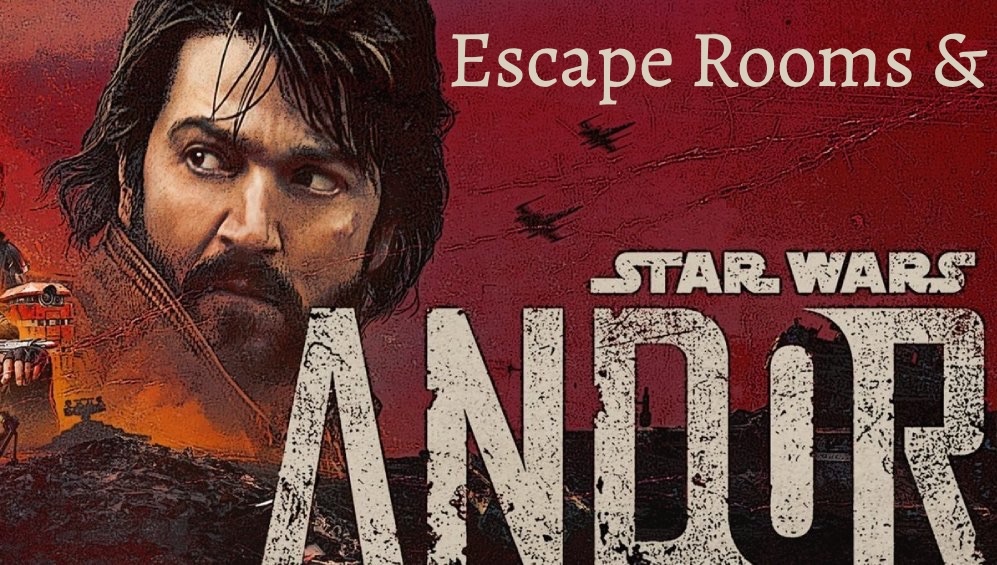
Why Andor
I grew up with the original Star Wars movies, but as an adult the new releases of repetitive adventure stories with incredibly high stakes but questionable realism ceased to hold my interest like the franchise once did. Andor came as a revelation – a true shift in the universe.
Among the Star Wars canon, Andor’s mature storytelling, complex characters, and grounded, slow-burn narrative stand in contrast to the fast-paced action of other entries, but that is what makes it better. Andor’s strengths translate well to a more mature style of escape room design.
Escape rooms are uniquely suited to emotional storytelling because players experience the story rather than observe it. Choices and discoveries in interactive art can carry emotional weight and physical actions can feel meaningful.
In a world full of fun challenges themed with a coat of paint, there is space for more situations that contain deeper relevance. Escape rooms, as storytelling art, can deal with serious, emotional concepts.
How To Design More Like Andor
Give Players Moral Weight
Unlike most of Star Wars, Andor never lets you feel clean. The Rebellion commits acts that look pretty much like terrorism. The “good guys” lie, manipulate, and sacrifice innocents. Moral fog is the point.
One of Andor’s best moves is making you, the viewer, complicit in these questionable acts. By withholding easy moral resolution, the show denies viewers the usual satisfaction. You can’t just enjoy the heroism without carrying the cost of it. This idea fits well in the escape room model where players must perform actions to advance.
A warning for escape rooms, though: while small, ethical friction makes the experience feel serious, too large of a moral decision often turns to silliness and breaks immersion.
Ground the Stakes in Human Cost
Although the larger Rebellion vs The Empire struggle serves as the backdrop for Andor, the heart of the show is in the individual characters and their relationships, ambitions, and sacrifices. A character trying to return home in time to bid goodbye to his dying mother is no less dramatic and satisfying than destroying the Death Star, but it is so much more realistic and relatable.
Victory in Andor has a cost: sacrifice, loss, compromise. It requires its characters to think before they act in a way that is missing from many escape rooms.
Andor’s power comes from the audience relating to regular people who feel the weight of every decision. They are not superheroes immune to consequences nor are they doing puzzles for the sake of doing puzzles. No action they take is superfluous or without consideration, likewise, everything escape room players do should matter. Players should feel a bit of weight too, as they move towards the goal of the room.
The Antagonist is Systemic
Andor’s scariest opponent is bureaucracy, a procedural dread, not a cackling bad guy who is comedically not very scary. An escape room could lean into this. The threat isn’t a monster who jump-scares you. Rather, it’s a feeling of something closing in, an uneasiness, or a doubt in our motivations.
This allows the villain to be whatever we imagine it to be, which is usually more effective than any rubber-masked actor could ever be.
I’ve seen some forced-failure techniques used in escape rooms that made me feel this. For example, I’ve been given a password or a key in a manner that feels almost too easy, and then it doesn’t work where I’d expect it to because, of course, it’s not going to be that easy. Instantly I am made small and gullible and the game world is bigger and more sinister.
Atmosphere Over Spectacle
Many escape rooms chase spectacle instead of realism, which can sometimes lead to a less immersive experience. Andor avoids laser swords and spectacle for banal evil, personal cost, and earned tension. It builds this tension through quiet moments, moral dilemmas, and the slow realization of consequences. Andor shows us that compelling escapes result from feeling trapped in a believable world where your actions matter.
Heavy atmosphere and serious emotional themes like grief, trauma, loss, or moral dilemmas ask players to engage in a completely different way. More reflective, more vulnerable, and often slower. Whatever the optimal duration of your designed experience, consider removing the traditional time pressure that players feel. Emotional beats need room to breathe. Rushing to solve puzzles quickly can clash with emotional reflection. It’s hard to feel grief while racing a clock.
The Tradeoff
Andor is not universally loved by all Star Wars fans. Some critics find it slow and argue it’s missing that which makes Star Wars feel like Star Wars, like the magic of the Force and the sense of adventure. It’s a deliberate stylistic choice that alienates some viewers who want a more traditional experience. This will be true of escape room customers as well.
Many players come for fun, not heaviness. Not every escape room should be more like Andor, but the audience is ready for a few more of them that are.
Conclusion
Escape games are many things to many people including family fun, a break from reality and responsibilities, or a puzzly challenge, but they can be even more.
With the use of tension through character and consequence, and heart-felt storytelling, we can create escape rooms that players remember as dramas rather than just games, thereby elevating the medium from fun diversion to life-like cinematic experience.
The tools are already there. Narrative, atmosphere, moral complexity – none of this requires a bigger budget. It requires a different intention. The question for designers isn’t whether players are ready for something heavier. Andor already answered that.


![The Archives of Trevosa [Hivemind Review]](https://roomescapeartist.com/wp-content/uploads/2026/08/the-archives-of-trevosa-the-archives-of-trevosa-1.jpg)

![MindMaze – Galactic Pioneers [Review]](https://roomescapeartist.com/wp-content/uploads/2026/06/mindmaze-galactic-pioneers-1.jpg)
Leave a Reply