
In an escape room market where there is significant risk of games feeling too similar, one of the best ways to create something distinctive is to design the experience around an engaging game mechanic. These types of games have a mechanism of play that defines the experience through the required player actions rather than through a theme or story.

Breaking the Mold
Many new escape room ideas start with a theme and then designers create puzzles and a story that fit within that setting. Taking cues from video games, some of the most innovative escape rooms are designed around a core game mechanic first, with the theme serving that mechanic rather than the other way around.
I would argue that a story driven path of puzzles that are gated by other puzzles is a single game mechanic. It is a successful and popular mechanic, but different theming of the same format has limited room for evolution. We’ve all played escape rooms where the veil-thin theme was the only thing attempting to differentiate it from many other games, sometimes from the very same company.
So Many Possibilities
When I started to think of the different game mechanics and game formats that I have seen in escape rooms and related experiences, the list got quite long. But when I sifted through my own spreadsheet of games played and tried to find examples to use, far too many names on there can be simply categorized as “puzzle path with basic theme.” Is your list filled with sameness?
Consider whether you have played an escape room designed around any of the following mechanics:
- points based
- time loop
- hide and seek
- player movement restriction
- quest/ mission based
- classic point-and-click style
- gained mastery (skill progression)
- actor/ character manipulation
- stealth and survival
- open world
- puzzle scramble
- puzzle scramble with monsters
- blood splatter
- resource management
- social deduction
- actor interruption
- human size/ scale manipulation
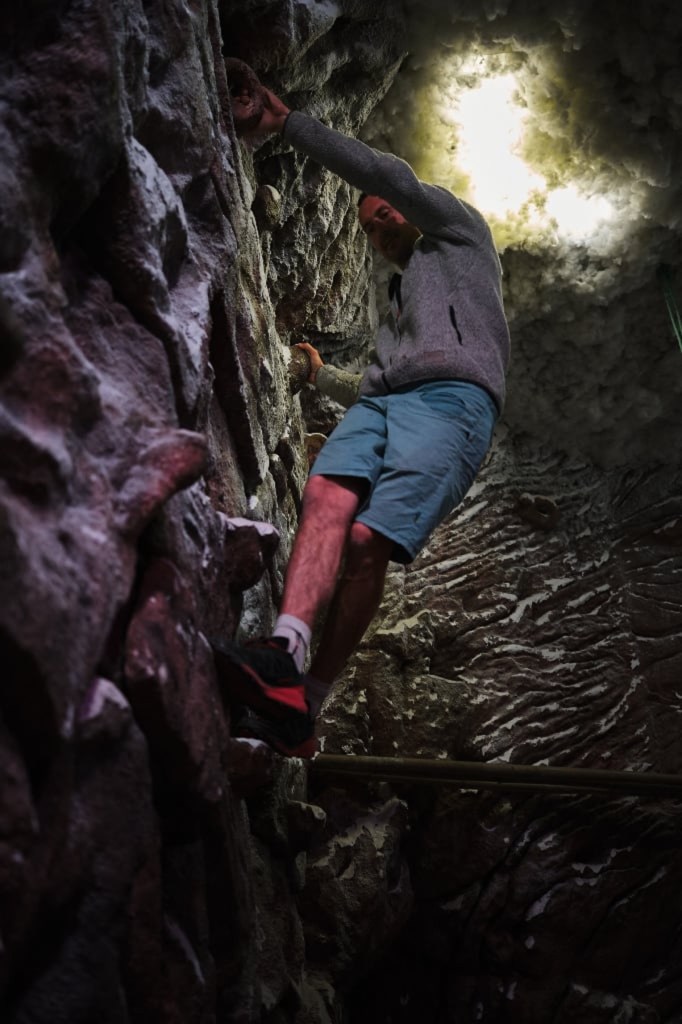
- rock climbing
- head-to-head competitive
I am sure there are many more examples and possibilities. And some of these have a review coming.
The point is that these types of games are often remembered, and talked about, more for their mechanics than for their theme. A strong mechanic creates a unique identity that players can’t easily compare to other games, even with the same theme.
Creativity Unlocked
Whether taking inspiration from movies, video games, or something else, escape room game mechanic brainstorming can be a fun, blue-sky design activity that may just yield something special.
- What if information could only be shared indirectly?
- What if players had to trade for resources?
- What if solving one puzzle made another puzzle harder or impossible, requiring choices be made?
- What if every action had a consequence elsewhere in the room?
- What if players could manipulate time, perspective, physics, memory, or trust?
Once you have a compelling mechanic, you can build a theme that justifies and supports it.
The Challenge
Mechanic-first design is harder because the mechanic must sustain an entire experience. Is it fun? Is it engaging? Does it become tiresome? A great theme and a cool set can hide a mediocre puzzle experience for a while. A failed mechanic cannot.
When designing around a mechanic, ask:
- Can players understand it quickly?
- Does it remain interesting for 45–90 minutes?
- Can it evolve over the course of the game?
- Does it involve the entire team?
- Does it create meaningful decisions or interactions?
- Does it encourage exploration and mastery for players?
Mission Based Horror Games
One of the most popular game mechanics of the moment is the asymmetric, mission-based horror game. So many of these are popping up that I thought it deserves its own section, as they also serve as a great example of mechanic-first design. Recently reviewed examples include Into the Darkverse, Cobayes, and The Mystery of the Deveaux Family. My current personal favorite is The Kramer Accident designed by Jana Erbes.
These are games where some players must venture out from a safe space to accomplish tasks in the spooky unknown, while others can remain behind. Different games do better or worse jobs at keeping those remaining players occupied and engaged, but most do a decent job rewarding the brave, thrill seekers with fun gameplay.
This is a mechanic that ticks a lot of design boxes. It is sustainable because players take turns and missions can escalate as the story progresses. They are often opt-in scenarios so more reluctant players can hang back and still feel useful in supporting roles.
Different tweaks such as sensory deprivation, player movement requirements, and adversary engagement rules keep this mechanic style spicy and fresh on new iterations.

We Want To Play
Something important that many game mechanics add to escape rooms is an increase in the amount of play within an experience. Puzzles, narrative, exploration, and discovery are key components to escape games, but so is play. Game mechanics are often specifically about ways that customers can play within the environment.
I am a big proponent of including more pure play in escape rooms. Interactions that allow us to use our imaginations and problem-solve our way to success can more easily be facilitated by games that employ mechanics of play rather than just puzzles.
Budget Friendly
Good game mechanics beat expensive set design when it comes to having fun and a memorable escape room experience. Players can get enamored with incredible sets, but it’s much more important that your game is fun to play.
While some escape room game mechanics may require hardware and tech to implement, it is quite possible to create a top notch experience around enjoyable play on a budget that is much lower than might be expected in the modern era.
Mechanic First Design
Escape room designs can start with many approaches, but a distinctive game mechanic at the core with a theme and a story that make that mechanic feel natural can combine to create an epic experience.
This is one way the industry remains sustainable. It expands. It remains interesting. Players come back because the games feel different, rather than thematically different wrappings for the same experience.
![👑 🔒 Revo Escape – The Tomb: Raiders of the Sword [Review]](https://roomescapeartist.com/wp-content/uploads/2026/07/the-tomb-the-tomb-3-1.jpg)


![Great Gotham Challenge MMXXVI [Hivemind Review]](https://roomescapeartist.com/wp-content/uploads/2026/10/GGC-2026-1.jpg)
Leave a Reply