
Should escape rooms provide writing surfaces?
Today, I’ll discuss the pros and cons of writing surfaces in general. Tomorrow, I’m going to review Boogie Board’s product line for use in escape rooms.
Don’t Force Me To Write
Escape rooms play better when the puzzles do not require writing.
Successful escape room puzzles are tangible and rooted in the game environment. They engage multiple active participants and enable onlookers to see the action.
Writing is a small, isolated experience. When I’m forced to write in an escape room, it’s usually to work on a puzzle that is best suited to a single-person solve. We might pass that puzzle around the group until it lands in the right person’s hands, but that’s not really a team solving experience.
Writing usually takes me out of the gamespace; it focuses my attention on a piece of paper. If I wanted to solve paper puzzles, I’d buy a puzzle book for less than half the price of an escape room ticket.
There are exceptions where writing works well in an escape room, but I haven’t encountered this often.

Do Allow Me To Write
While I’m rarely excited about a puzzle that requires me to write in an escape room, I do appreciate escape rooms that provide a note-taking option. This is especially true of more challenging or complex games.
The most important reason to provide a writing surface is that our brains don’t all process and retain information uniformly. Providing a writing surface is a kindness to those who need it.
In addition, I sometimes want to jot something down in an escape room because:
- There is complex math or logic that I need to write out to solve.
- I want to keep track of portions of a solution.
- I derived a code, but don’t have anywhere to input it yet.
- I noticed something obscure and I want to remember it.
- I’m struggling to solve something simple and sketching it will help.
- I want to keep track of wrong answers so that we don’t continually try them.
- I want to sketch out how I derived a solution to help a teammate understand it.
- There’s nothing for me to work on; I want to doodle… this is a bad room problem.
- I want to leave a funny note for the gamemaster to find when they reset the game.
Writing Surface Options
Here’s our preferred hierarchy of writing surfaces:

1: Environment Integration
The writing surface is a part of the set and belongs in the gamespace.
For example, we used an integrated writing surface in The Mall at Complexity in Farmington, Connecticut. The shopping mall’s Italian restaurant had a “daily specials” whiteboard on the wall. This simple, elegant writing surface made sense within the context of the escape room.
This is the ideal setup, if and only if the gamemasters maintain it as a functioning writing surface, not just as static set decor. If the writing implement doesn’t write properly, the moment is spoiled.

2: Boogie Boards
LCD writing tablets work in escape rooms because they are lightweight, easy to use, and impressively reliable. They don’t come with extra rules or risk.
Traditional writing media always come with the additional stipulation: “Don’t write on anything other than the paper or dry erase board.” While this is a perfectly sensible rule, it’s broken all too often… and then we find the remnants of the sketches around the room. These are almost always wrong because the kind of person who draws on an escape room isn’t usually an all-star player.
Traditional writing media also require ink or sharpening. If I had a dollar for every time I’ve had to ask for a pen/ marker that actually works I could buy admission to an escape room or two.
Boogie Boards skirt these maintenance issues that plague traditional writing systems.
That said, it’s usually difficult to integrate Boogie Boards within the narrative. They require explanation and some models can erase easily.
Are you interested in which Boogie Board to buy? Come back tomorrow for a deeper discussion on Boogie Boards.
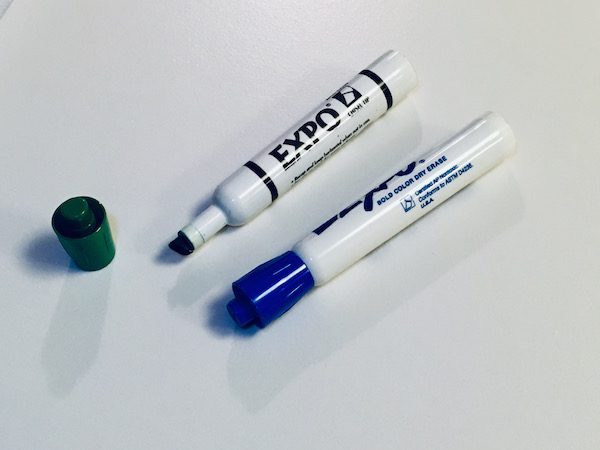
3: Dry Erase/ Chalk Board; No Integration
I’ve already discussed the cons. The pro is size.
Dry erase / chalk boards can be large enough that entire team can be involved in viewing them.

4: Pen/ Pencil & Paper
It’s better than nothing.
Expectations
In escape rooms, writing is regional. Some players expect a writing surface. That’s what they’re used to. Others will be baffled why one would write on anything. Be aware of the local norms and make a conscious decision about how to integrate (or not integrate) writing in your escape room.
What Do You Think?
I’m curious what others prefer to write with. What are your thoughts on the best and worst writing surfaces in escape rooms?


![60Out – Big Brain Labs [Review]](https://roomescapeartist.com/wp-content/uploads/2026/02/big-brain-labs-big-brain-labs-1-3.jpg)

![TR-49 [Hivemind Review]](https://roomescapeartist.com/wp-content/uploads/2026/02/tr-49-tr-49-1.jpg)

Leave a Reply