
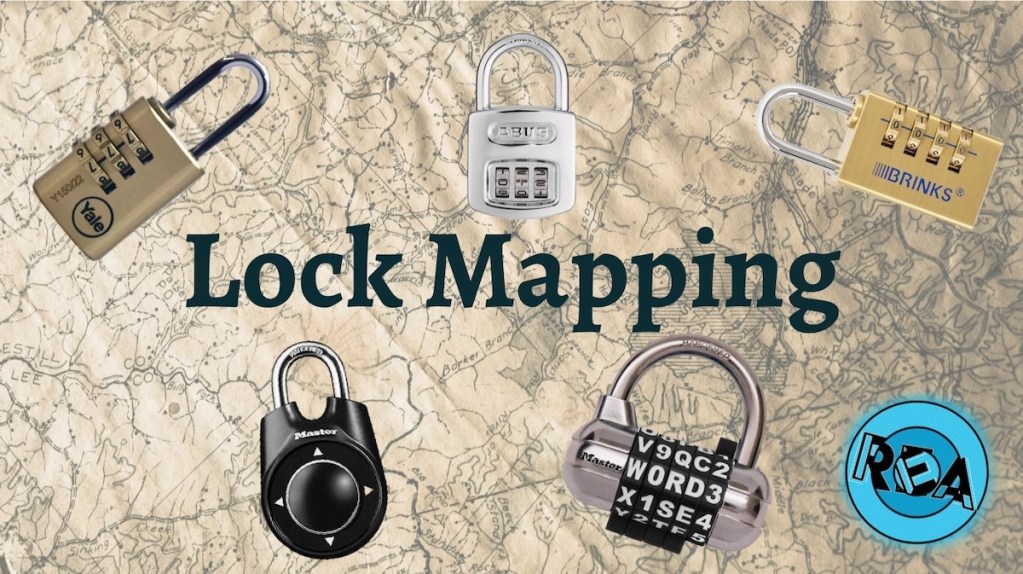
Lock mapping is a term that we have used for the better part of a decade. We’ve explained it in conference talks, and in the ERban Dictionary, but never in a dedicated post. Let’s fix that.
What is Lock Mapping?
Lock Mapping (noun, singular) – how puzzles (and/ or their solutions) are connected to locks. If lock mapping is poor, when players derive a code, they have to try it in multiple locks, deflating their momentum. This problem is compounded by many locks with the same digit structure.
To put this another way, at any given point in time within an escape room, players have access to a certain number of inputs for their derived solutions (locks and other mechanisms). If there are 5 locks available in a space, and each one is a 4-digit number lock like this:
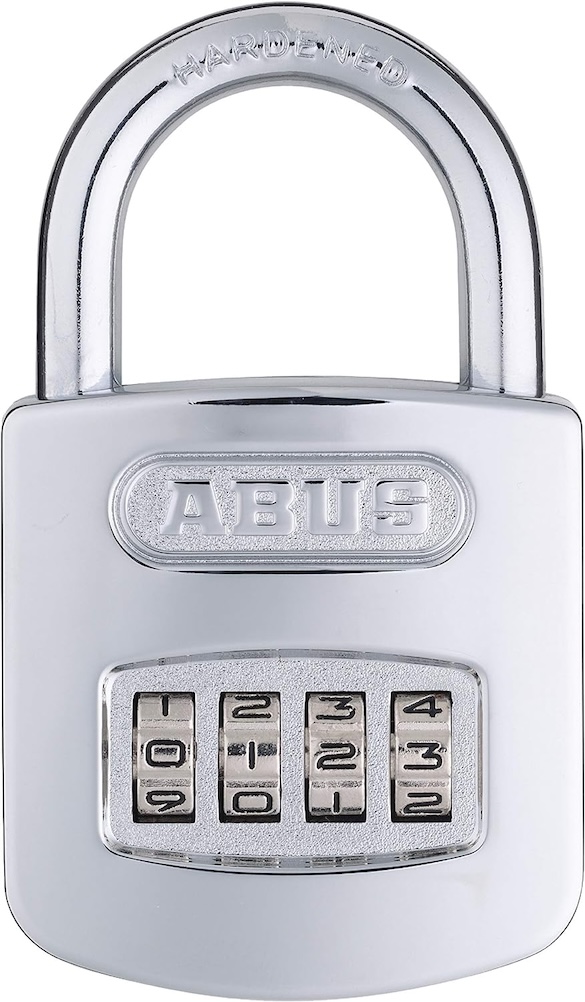
Then players need to try their solution in every single lock until they get one to open… assuming that they don’t screw up the input in the correct lock (which can happen, and will cause some chaos.)
We call this bad lock mapping, and it’s not great for players, gamemasters, and owners alike.
Why is Poor Lock Mapping a Problem?
Player Perspective:
It’s deflating to have a solution, feel confident in your success, put it in a lock, and have it fail. The hard part should be the puzzle, not inputting the solution.
To add to the problem, not everyone is great at inputting solutions into locks. For some it’s a dexterity issue, for others its seeing the small numbers. Either way, when there are multiple locks with the same digit structure, it means that you have to try and retry a solution in multiple places. It’s annoying.
Gamemaster Perspective:
Having multiple, identical locks adds an extra layer of precision to resets. If players move the locks from the hasps, it increases the odds of a mistake. And yes, you can create a variety of systems to reduce mistakes, but it is far easier to not need a system to solve an unnecessary problem.
Owner Perspective:
Player problems and gamemaster problems are owner problems. In addition to those issues, bad lock mapping results in players manipulating the locks more often. They spin the disks more, pull down on the shackles and hasps more, and try wrong codes more often. In short, this adds a lot of unnecessary wear to the locks and reduces their lifespan.
Poor lock mapping costs money.
What Does Good Lock Mapping Look Like?
Option Number 1
Good lock mapping looks like unique digit structures on all the locks that are accessible at a given time.
Let’s imagine a very simple, classic escape room with two spaces.
The Locks in Space 1 include:
- 3-digit number lock
- 4-digit number lock
- 5-digit number lock
- 4-letter word lock
- 5-letter word lock
- 1 keyed lock
After the players finish solving this set of puzzles, they unlock a door to a second space.
The Locks in Space 2 include:
- 3-digit number lock
- 4-digit number lock
- 5-digit number lock
- 4-letter word lock
- 5-letter word lock
- 6-letter cryptex
Structurally, this is a very straightforward escape room structure. It even includes reuse of most lock types. The critical bit of design is that each lock type is available in isolation. When most players derive a 3 digit number, they will intuitively understand that there is only one place to try that solution.
It’s not hard to design this way, you just have to make it a priority.
Option Number 2
If you need to have multiple locks of the same digital structure available at once, map the locks to the solutions. (This where the term “lock mapping” comes from, by the way.)
Let’s say your room has three 4-digit number locks available at once. Design such that the players will intuitively put the solution in the correct one, and it’s not a 33% chance. Here are a few ways to accomplish this:
Proximity:
The correct lock is located right where the players derive the solution. This won’t stop another player across the room from also putting the code in the lock next to them, but it will improve the odds that the solution goes into the correct lock immediately.
Visual Matching:
Use colors, symbols (or both, for improved accessibility) or another visual indicator to show which solution goes into which lock. For example, the lock with the green circle on it get the answer from the puzzle in the green circle area. Make it really visually obvious which puzzle, and therefore which solution, is associated with which lock.
There are more elaborate ways to do this, but visual matching is the predominant way, and as long as it’s clear and obvious, it works.
Lock Mapping is Usually A Mechanical Lock Issue
Lock mapping is a term that primarily applies to use of mechanical padlocks in escape rooms… but it is possible to create bad lock mapping with technology-driven mechanisms if your inputs start to look too similar.
It’s not a common problem, but it isn’t impossible either.
Foundational Concepts
We’ve been talking about lock mapping for so long that I don’t remember when we first came up with the concept. I just remember that we did.
This is the kind of concept that we work through and refine with our Patreon community. As always, we are deeply thankful to the folks who keep the lights on for us. There are times where the work of constantly creating content can get lonely, and knowing that we have such a brilliant, kind, and caring community to converse with while working through ideas (and life) means more than we’ll ever be able to fully express.
Special shout out to those who joined this month: Sylvie Bryant, Jane C Chiang, Tom, Emma Rochon, Jessi Nelson, Roxane Filion, Miki, Rory Blevins, Howard Shih, Naarg, Manda Whitney, and Elcee Vargas
@EscapeRoomExplorer
303 Escape
Abi · Lyontree
Adam Johnson
Adam M
AJ Webster
Alex Epstein
Alex Rosenthal
Alexander Gierholz
Alyssa Diaz
Amlesh Jayakumar
Amy Koo
Amy Schneider
andie auna
Andras Gal
Andrew Reynolds
Andrew Sturridge
Andy Bauch
Andy Mintzer
Angela Ward
Anjali Nath
Anna Lysova
Anna Simon
Anne Lukeman
Anonymous
Anthony Vu
Arcturus Wang
Austin Opler
Austin Reed
bananarama
Barry Joseph
Ben Enos
Ben Rosner
Bent Vent
Bill Chang
Billy Paraskevopoulos
Black Crow Productions
branden sayarath
Brandi Miller
Brandon gersick
Brandy Agerbeck
Breakout Games
Brent Busboom
Brent Mair
Brett and Kelly Johnson
Brett Kuehner
Brian Resler
Bronna Butler
Byron Delmonico
C.J. Smith
Cameo Wood
Captain Mew
Caro Murphy
Carol King
Catie Catterwaul
CB Hart
Charles Rasnake
Chris Bittle
chris gileta
Chris Loughlin
Chris M. Dickson
Chris Post
Chris Waters
Chris White
Christopher Chanes-Mets
Christopher Holland
Connor Turley
Curt
Curt Clark
Dan Arnett
Dan Necid
Daniel Egnor
Daniel Kolb
Daniel Riordan
Darren Miller
Darryl Anka
Dave
David
David Behar
David Longley
David Ryan
Dawnward
Dawson’s Escape
deadpan1113
Deejed
Derek Tam
Devin Sanders
Dino Paulo
Doug McKenzie
Drew Nelson
Dwayne Sanburn
Dylan Callery
Eddie Nguyen
Elaine
Elcee Vargas
Eliviascape (Pat Toupin)
Elizabeth Griffin
Emilio Garofalo Neto
Emily Z. Jillette
Emma Liddell
Emma Rochon
Encrypted Escape
Erik Horn
Erika Aquino
Escaparium
Evan Broder
Evan Meltzer
Expedition Escape
Farand Pawlak
Florian Thalmann
Fro
Gabe Berkovich
Gem Chien
Geneva Kaplan-Smith
George Inglis
Grant Luecke
Guy Ellis
Haley & Cameron Cooper
Hayden Sawyer
Heather Logas
Herbert Chan
Howard Shih
Ian Hickson
Imagination Junkie
Immersia
Jacky Chang
Jacob Hubers
Jacob Sager Weinstein
James and Kaitlin Trexberg
James Douberley
James Shearer
Jamie Smith
Jan-Luc Van Damme
Jana Erbes
Jane C Chiang
Janelle Gallagher
Jared Butler
Jason Adair
Jayna Shea
Jeff Harper
Jeff Keys
Jen Merrill
Jenna
Jennifer Fonfara Tactical Escape 101
Jeremiah Sizemore
Jess and Troy Seidl
Jess Noone
Jessi Nelson
Jessica Schoolman
Jill Parisher
Jim of PARADOXsquared
Jim Williams
Jo Perron
Joe Brown
Joel Smileypeacefun
John DeGroot
John H
John Houser
Jon Kaufthal
Jonathan Berk
Jonathan Cruz
Joseph Friesen
Joseph Stamps
Josh and Heather
Josh Powell
Josh Russek
Joshua Overson
Joshua Rosenfeld
Joshua Veltman
Julia Cooke
Julie Buchheit
Justin Nevins
Kachi
Katelyn Cahill-Rowley
Kathryn
Katie Kasplode
Katrina Lat
Kelsey Ziegler
Ken Zinn
Kern Konwiser
Kevin & Alyssa
Kevin Burns
Kevin McKain
Keystone Escape Games ( Mark )
Kiley and Milaine
Kurt Leinbach
Kyle P Curlett
Laura Burkart
Laura E. Hall
Laura Reynes
Laurens van Laarhoven
Lawrence J. Alfano
Leanne
Lee-Fay Low
Lennard Manke
Leslie Chong
Live Action Attractions
Lo Co
Lonnie
M. Sean Molley
M&C Saiewitz
Madeleine Alexis
Manda Whitney
Marc P
Mariana Scottini
Mark Denine
Marlee Delia
Marti
Matt Keyser
Matthew Stein
Mayu
Megan Reichard
Melanie Rice
Michael Andersen
Michael Larson
Michael Swift
Michelle Cervenka
Michelle Rundbaken
Mihir Kedia
Mike Hamel
Mike Ringrose
Miki
Miranda P
Mitchell Otis
Mrs Threepwood
Mystery Unfolds
Naarg
Natalie
Natalie Currie
Nate Javier
Nathan Walton
Negina Kolesar
Neil Patrick Harris
Nekeisha Johnson
Nick Moran
Nico Cesar
No Proscenium
Olivia
Omer Aru
Pants
Paul and Eric from Escape Mail
Paul Tashima-Boyd
Peter
Philip Ho
PJ Mann
PostCurious
PuzzleConnect Escape Rooms
Quark and Odo’s Escape Room Experience
Rachel Dunphy
Rebecca Horste
Rémy Strobbe
Rene Sorette
Rex Miller
Rich Bragg
Rich Malena
Richard Burns
Richard Chiou
Ricki Heicklen
Riddlehaven
Rob Tsuk
Robin Schriebman
Roger at Key To Escape
Roger L
Rory Blevins
Roxane Filion
Ryan Brady
Ryan Lee
Rylee Thompson
sagi meir
Sam
Sarah Zhang
Scott
Scott Chua
Scott Levy
Scott Olson
Sendil Krishnan
Shay
Sherwin Doroudi
Sida
Simon Edwards
Steffanie
Stephanie Guimera
Stephen Kowalski
Stephen Ng
Steve Gaddy
steve stribling
Steven Rawlings
Steven Valdez
Stims24
Suhani
Sylvie Bryant
Tahlia Kirk
Tammy McLeod
Taylor & Sheryl
Team Bluefish
The Catterwauls
The Ministry of Peculiarities
Theresa Piazza
Thomas McAuliff
Thomas Meston
Tiffany Schaefer
Tiger Oakes
Tobias Döring
Toby Powell
Todd
Todd Geldon
Todd McClary
Tom
Tommy
Trista
Tyler Neufeld
Tyler Robinson
Tyler Rochwerg
Victor van Doorn
Victoria Cassetta
Vivian Lien
Vivien Ripoll
Vy Tran
Wil Blount
Will Rutherford
Yvonne McDuffee
To those of you reading who have the means, we hope you’ll consider joining this wonderful group of supporters.
Support Room Escape Artist’s Mission
There are lots of ways to support Room Escape Artist, like buying from Amazon or Etsy after clicking into the links included in this post or backing us on Patreon.
The money that we make from these helps us to grow the site and continue to add more value to the community that we love so much.


![EscapeTheRoom.cz – Escape Bar [Review]](https://roomescapeartist.com/wp-content/uploads/2026/06/escapetheroom-cz-escape-bar.jpg)

![Escape From the Elevator [Unintentional Review]](https://roomescapeartist.com/wp-content/uploads/2026/09/escape-from-the-elevator-escape-from-the-elevator-1.jpg)
Leave a Reply