
Puzzlehop offered a vastly superior way to experience Disney for puzzle lovers.
Created by veteran puzzle designer Peter Sarrett, Puzzlehop was a full-day puzzle hunt that took place at Disney’s Hollywood Studios in Orlando, Florida, on February 6, 2026. Filling every nook and cranny of down time with thematic puzzle delights, Puzzlehop successfully offset the biggest downside of a day at Disney: waiting in lines. Thanks to the time-warping magic of puzzle solving, even hour-long queues flew by before we knew it.
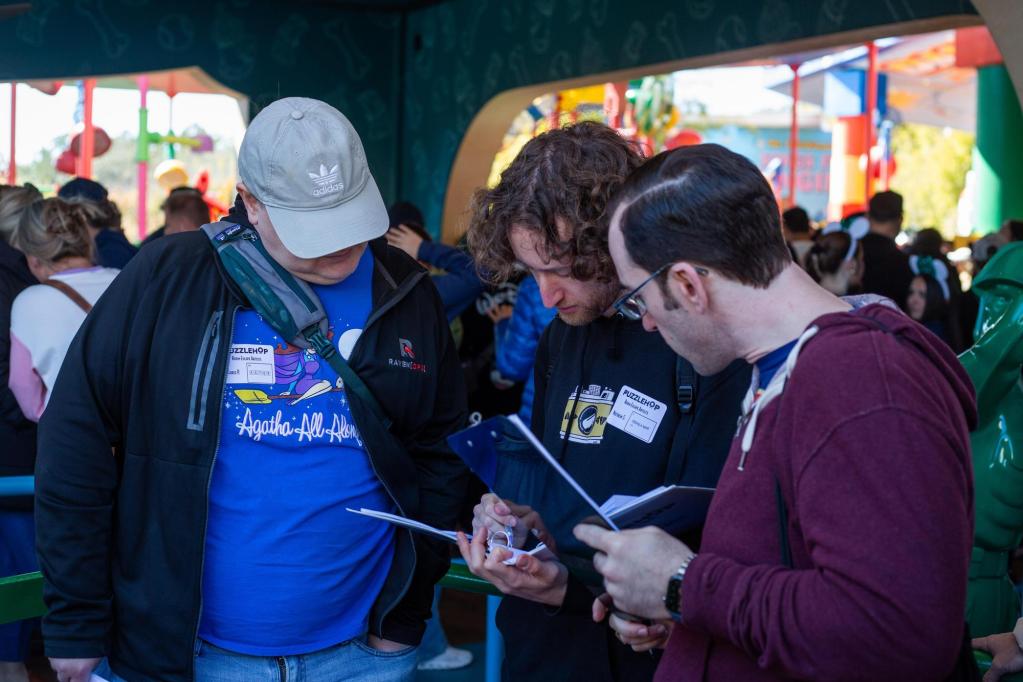
At the start of the morning, teams of up to 4 players each received a binder with dozens of original paper-and-pencil puzzles. These puzzles ranged in format and style, with a strong focus on variety word puzzles, and they were consistently polished, clever, and deeply satisfying. Some puzzles were solvable from anywhere in the park, while others either required gathering data from a specific ride to get started (Ride-and-Solve) or solved to a phrase that led us to find the final answer on a specific ride (Solve-and-Ride). Each puzzle page was labeled with an icon indicating one of these three styles, making it easy to identify which puzzles we could work on at any given time.
Furthermore, puzzles were each worth a different point value which roughly correlated to the difficulty or solve time. The event was largely automated, and the Cluekeeper app allowed teams to submit answers and receive tiered hints. Peter was also available on site to offer additional hinting and run a few live group games throughout the day.
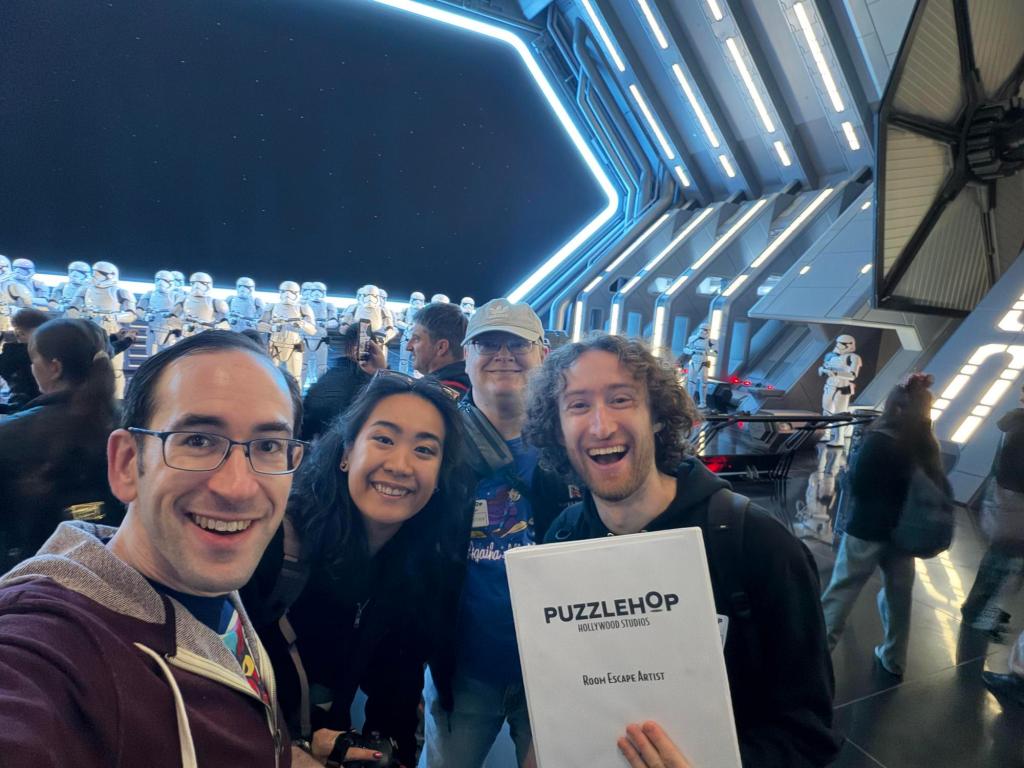
Puzzlehop offered tremendous value for its price. At $250+tax per team, on top of normal park entry, this was equivalent to 1.5-2 hours of escape rooms in the local market — for an entire day of puzzle content. And when other nearby theme parks have terrible, horrible, no good, very bad escape rooms, it was a joy to experience Disney’s Hollywood Studios through the lens of professionally polished puzzles. Ultimately, Puzzlehop was not a puzzle hunt that happened to be at Disney, but rather a thoughtful way of augmenting the amazing experience that Disney already delivers.
Thinking more broadly, it’s a shame that Disney doesn’t offer something like Puzzlehop in a more official ongoing capacity. It would improve the park experience for adults and children alike, gamifying the time waiting in lines without encouraging visitors to be glued to their phones. If adapted to a difficulty level closer to that of Eric Berlin’s Puzzlesnacks, Puzzlehop could be scaled for a general audience without sacrificing quality or creativity.
The inaugural Puzzlehop event in February 2026 was a one-off occasion, but Peter intends to run Puzzlehop again in the future. Sign up for their mailing list to be the first to know when Puzzlehop will happen next.
Puzzle Mountain
Puzzlehop featured a ton of puzzles, more than even the most competitive of teams could reasonably complete in a single day. The goal wasn’t completion, though, and there was a clear expectation upfront that we’d only get through a fraction of the puzzle content. The breadth of puzzles ensured that whatever attractions we chose to visit, we’d have some puzzles to accompany us there.
For a family-friendly event at a theme park, many puzzles in Puzzlehop were quite substantial. They generally fell somewhere between the difficulty of Puzzled Pint and DASH. The majority of puzzles were quite approachable upfront, with some trickier ahas usually reserved for the extraction. For me, the strongest puzzles were those that explicitly encouraged collaboration (such as one involving twisty phrases that could easily be read aloud to our teammates) or which were meaningfully site-specific to reframe our surroundings, rather than more straightforward data gathering.
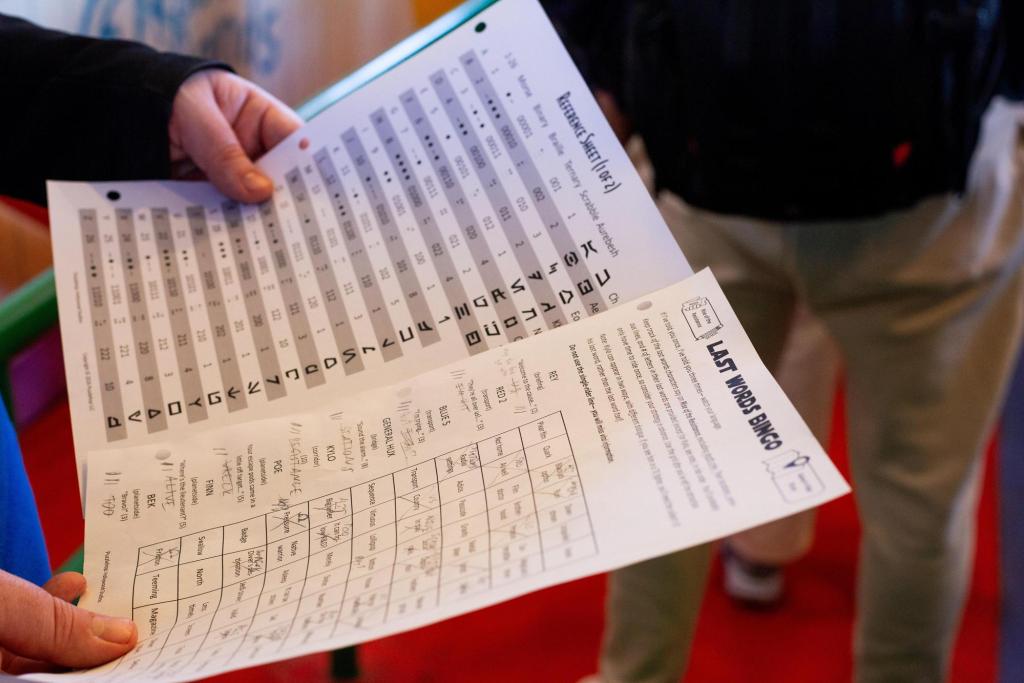
While Puzzlehop didn’t technically require any prior knowledge, and even included a reference sheet with all potentially relevant ciphers, this event was without a doubt targeted primarily at existing puzzle enthusiasts. It was helpful to be familiar with common puzzle hunt extraction methods and have some level of Disney knowledge, though internet searching was also permissible.
Not (Really) A Competition
Puzzlehop was not strictly a competition… but it also wasn’t not a competition. And with points and a leaderboard, it appeared to be more of a competition than I think it intended — or needed — to be.
Mostly, we were competing against ourselves. How many puzzles could we solve throughout the day? Could we crack that one tricky puzzle we’d been attempting on and off for the past few hours before the time was up?
The post-game wrap-up email reiterated: “This was not a competition, but some of you may be wondering how you did relative to other teams.” The leaderboard was accompanied by “medal brackets” of bronze, silver, gold, and platinum. Even if this wasn’t a competition, for an audience comprised primarily of hyper-analytical completionists, offering a large amount of content and expecting teams to voluntarily not try to complete as much as they can, or not to strategize around how to get the most points, was perhaps a misalignment of expectations. While there were no real stakes, no winners, and no prizes, this pseudo-competitive structure seemed at odds with letting our day simply be guided by which attractions we were most excited to visit, rather than which could earn us the most points.
My team split the difference, prioritizing top rides (it was my first time visiting Hollywood Studios, after all!) but also taking zero breaks from puzzling all day. In the spirit of the rules, we held back from submitting Solve-and-Ride answers where we’d solved the puzzle and knew or could easily look up the final answer, but hadn’t been able to visit the physical location yet.
The puzzles made my visit extra special, but I’m not sure that the competitive framing added much more. I understand the inclination to demonstrate value through quantity, yet sometimes less is more.

Socializing At Puzzle Hunts
My other critique of Puzzlehop is similar to one of my biggest issues with the MIT Mystery Hunt: we rarely saw or interacted with other teams.
While 17 teams participated in Puzzlehop, the park was big enough that we didn’t bump into other teams all that often during the day. A name tag puzzle theoretically should have prompted cross-team interactions, but in reality teams just took photos of each other’s name tags and moved on, perhaps even supplanting more meaningful conversations that might have happened in these moments. There was a post-game social event after the official cutoff time, after which we could no longer earn points, but as the park and rides were still open, most teams briefly checked in and then dashed off to squeeze in a few final rides.
(We made a return visit to the immersive masterpiece that is Rise of the Resistance, and were flabbergasted to encounter a record-breaking 15-minute line right before closing!)
With teams flying in from all over the country for Puzzlehop, it was a missed opportunity not to design a more robust in-park gathering, or perhaps even better, an official brunch and debrief the next morning that wouldn’t compete with enjoying the park. As is, I still got to hang out with some of my friends after hours, but it was not designed into Puzzlehop itself, and most of the substance of Puzzlehop could have happened on any random day that we chose to visit the park.
A Look Back at the Original Disneyland Puzzle Hunt
Puzzlehop was not the first Disney puzzle hunt, and it likely won’t be the last. In fact, Puzzlehop was directly inspired by Bay Area puzzle company Shinteki’s Field Trip: Disneyland event, which ran back in 2009 and 2012. Peter played the original Shinteki Disneyland event, and upon moving to Florida and getting a season pass to Disney World a few years back, he decided to create his own version.
Shinteki founders Linda and Brent Holman were in attendance at Puzzlehop, and I had a chance to chat with them afterwards about what makes Disney such a suitable environment for puzzle events like these. As they explained, “If you go to Disneyland a lot, it’s hard not to realize that all the decorations are great puzzle fodder. The data density there is phenomenal, but it’s not just data. It’s whimsical, curated data that is truly charming.”
Of course, having a park full of potential puzzle material is only half the challenge. Turning that raw material into satisfying solves requires a particular kind of creative vision. Brent credited former Shinteki teammate Ian Tullis for many of the event’s most memorable discoveries: “We had some incredible finds of manipulating data that was already there, and something magical popped out of it. A lot of credit goes to Ian for these beautiful little bite-sized puzzles where you would see something in a totally new way and just give you a really, really happy feelings.”
When the conversation turned to the broader philosophy behind Disney puzzle events, the Holmans articulated something that perfectly captured my own experience with Puzzlehop. “I think you have to remember that the goal is to go to Disney, and the puzzles should be a fun thing that fills the rest of that time. Let Disney shine. Have the puzzles be a side light in terms of pointing out some fun, whimsical things, or giving you just something else to look at, and augment the experience as opposed to dominate the experience.”

![Escape Game Knoxville – The Final Evaluation [Review]](https://roomescapeartist.com/wp-content/uploads/2026/09/the-final-evaluation-the-final-evaluation-1.jpg)
![Tour in a Box – Chicago [Review]](https://roomescapeartist.com/wp-content/uploads/2026/08/chicago-chicago-1.jpg)
![Ciphergram – Escape from Ironwood [Review]](https://roomescapeartist.com/wp-content/uploads/2026/06/escape-from-ironwood-escape-from-ironwood-1.jpg)
Leave a Reply